Opposition to statewide Prohibition by Celtic Union and German American League
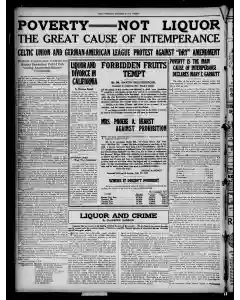
A 1914 resolution from the Committee of Mutual Conference of the Celtic Union and German American League opposes California's proposed constitutional amendment for statewide prohibition. It argues prohibition would ruin industries, cost jobs, raise taxes, and infringe personal liberty, urging broad circulation among member groups. The document cites economic data on wine, brewery, and agricultural production and defends individual freedom against government overreach.
MENTIONED IN THIS ARTICLE
Mutual Conference
The
Celtic Union
German-American League
San Fran
Cali- Mia
California
Committee of Mutual
Celtic Union and
German-American
John Donohue
USTAV
Intemperance Causes Few California Divorces, Study Says
The State Labor Bureau reports intemperance accounts for under 4 percent of California divorces from 1905 to 1913. Drunkenness is the second least common ground, with figures steady across four years. A health board president argues wine education would reduce alcoholism, claiming alcohol is not a poison and that wine at table impedes drunkard development.
MENTIONED IN THIS ARTICLE
California
State Labor Bureau
Evansville Leader Renounces Prohibition Stance
Rev Dr W C Holt ex Superintendent of the Anti Saloon League of Evansville Indiana says he will no longer let personal zeal bias policy. He argues methods must fit current conditions and that laws fail without public sentiment backing enforcement.
MENTIONED IN THIS ARTICLE
Evansville
Indiana
Anti- Saloon League
Hearst Opposes Prohibition in 1914 Letter
Phoebe A Hearst writes from Hacienda Del Pozo de Verona July 27 1914 to G E Lawrence of San Francisco stating she is not in favor of prohibition though opposed to intemperance. She supports moderate wine use and argues prohibition would harm a wine producing state. She notes W C T U requests declined.
MENTIONED IN THIS ARTICLE
G. E. Lawrence
Geary Street
San Francisco
Phoebe A. Hearst
Hacienda del Pozo de Verona
Prohibition Cities Record Arrest Ratios for Disorder in Year
A table compares drunkenness and disturbing the peace arrest rates across several prohibition-era cities over one year. The figures highlight how enforcement differed between locales and reflect the era's temperance focus.
Liquor and Crime by Clarence Darr
The author argues liquor has little to do with real crime and cites murder patterns, poverty, and social agitation as primary factors. He asserts most violence stems from adolescence and poverty, with monopoly driving poverty and wealth avoiding punishment.
MENTIONED IN THIS ARTICLE
Clarence Darr
Qyne
United States
iVery
Poverty Drives Intemperance Says Mary E Garbutt
In a paid advertisement by the Wage Earners' League of Washington, Mary E Garbutt argues poverty is the root cause of intemperance, citing low wages, unemployment, and factory closures as factors. She contends even full abstainers face poverty and urges the Woman's Christian Temperance Union to address systemic causes.
MENTIONED IN THIS ARTICLE
Mary E. Garbutt
Woman's Christian Temperance Union
Smith
W. C
Richard G. Ely
Frances E. Willard
Woman’s Christian Temperance Union
Wage Earners’ League of Washington
Also Mentioned on This Page
He) Oh
Mutual Conference Committee
Federation of Labor
Washington
Martin Regensburger
Hortense Russell
California State Board of Health
Anti-Saloon League
California Grape Grower
Enness
Kansas City
Portland
Topeka
Kan
Wichita
South
Carroll D. Wright
Wright
Scoor Bok Sdb
Sosa Dasha Poon Micsduks Saensdcuedteros
Esee
Pocmiooue
Elas
Cdedeavn
Veetesd Este Dream Beeneee
Oondic Ice Ad Ccceke
Pet

 This is just the beginning! Our collection holds over 300 years of history, including rare newspapers, obituaries, marriage records, birth records, and so much more—most of which you won’t find anywhere else!