Romantic lines about a good man’s quiet kindness
A Wordsworth line reflects on the best part of a man’s life as small, nameless acts of kindness and love. The idea elevates everyday deeds over grand outward displays and memory.

 This is just the beginning! Our collection holds over 300 years of history, including rare newspapers, obituaries, marriage records, birth records, and so much more—most of which you won’t find anywhere else!
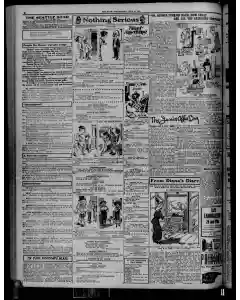
This newspaper page contains 32 articles. Subscribers can read the full text of each article.
Newspaper
Seattle Star
Location
Seattle, Washington, United States of America
Date
Jul 10, 1912
Page
4
A Wordsworth line reflects on the best part of a man’s life as small, nameless acts of kindness and love. The idea elevates everyday deeds over grand outward displays and memory.
In Tacoma Hanford denounces critics of judges and defends judicial integrity. The Olsson case adds to tension as Taft’s stance strains Hanford’s stance, with speculation he may back the Prohibition party candidate amid broader party loyalties.
A newspaper column extols atmosphere as a driver of thought and behavior. It argues individuals can create an empowering environment to draw out best efforts, warns that doubt and fear destroy success, and cites a reader letter on public smoking restrictions prompting a town discussion.
In a patriotic stance editors warn against Robespierre era fashion for women, arguing the historical period represented moral decline and danger. They acknowledge the allure for Paris demimonde and note New York dressers may still adopt such styles despite criticisms.
The piece notes a dry Hanford probe session with no drinks mentioned and predicts presidential frontrunners Wilson or Roosevelt ahead in Washington while Taft or Debs trail. It highlights Seattle Tacoma Portland Spokane festivals and a split Republican Party causing a Walla Walla store partnership breakup over Taft and Roosevelt loyalties.
William Thair writes that enforcement of the city ordinance banning spitting on sidewalks is essential for decency and health. He condemns offenders and urges stricter enforcement to protect pedestrians in business districts.
A fragmentary item reports Oswise remarking that the county convention at Beeleysport strains the capacity of the cuspidors. The line hints at crowded rooms and service challenges during the event.
A fragmented OCR passage presents a wartime style exchange about a man named Oldbatch and comments on life choices. The text juxtaposes a “fire trap” remark with references to “reb ell” and “double life,” hinting at social judgment and personal reputation without a clear narrative.
A witty exchange recalls why a prohibitionist could not succeed as a lawyer. The humor hinges on the idea that lasting success depends on one’s standing at the bar, with Mister Interlocuter and Mr. Tambo prompting the point.
A Baltimore American quotation frames resilience with a rain day proverb about planning ahead and keeping faith in the ball game. The line touts earning a rain check as a mark of practical foresight and steady spirit.
A Houston Post quote recalls a man who learned a dozen locals had never heard of him. He then set out to locate them and borrow money, a bold and perhaps reckless response to the slight.
A stray anecdote from Stray Stories features Boas being asked to help a poor man unable to work. The man cites pride in declining assistance, contrasting strength with his claim of inability to work.
In a Kansas City Journal snippet a doctor orders sleeping powders for a patient while the wife woke him four times at night. The dialogue hints at medical concerns and a comment about Jinks with an insured life.
A terse exchange references scarcity of doe and the idea that men attend dances for lack of partners. The remark is attributed to Cornell Widow in a guide note in Venice, with a wry aside about Saint Mark and American tourists.
A Yonkers man is pressed in a heated exchange over his claim to fire and water and the burden of bankruptcy. The dialogue shows friction as arguments escalate around financial distress and responsibility.
A fragmentary quotation shows a dialogue about a poem contained in a fluid. Skeptical Friend urges quick consumption. Meggendorfer Maetter is credited.
A garbled citation from the St Paul Pioneer extracts casual remarks about time and weather. The fragmentary text hints at a discussion over getting more time or opportunity and uses colloquial phrasing.
A satirical exchange quotes a campaigner urging speeches to prove workers discontent. The Washington Star vignette reflects political cynicism.
A young boy asks what a demagog is and his father replies that a demagogue is a man who can rock the boat and persuade others a terrible storm is coming. The exchange evokes political manipulation and fear as a teaching moment.
Quote dialogue pieces mix a judge’s blunt definition of a court of last resort with brief lines about politics and everyday life. The snippets reference Pa and Birmingham Age-Herald, Boston Transcript, and a domestic note about a new cook.
Comic dialogue on social rank features a claim that plain people wear many rubber tires raising prices. A family scene includes Mazie and a mother discussing Harold on the balcony as Mazie explains his actions as a curve throw rather than kisses.
The text appears garbled and lacks full context. It seems to urge completing a task while mentioning adding life to a “critter,” but no coherent event, person, place, or organization is identifiable for a factual newspaper card.
Dialogue style quips about risk and money with a jab at a thief labeled as a kleptomaniac. The exchanges feature humor on scams and social behavior in a Baltimore American translated tone.
A fragmentary note describes plans to visit familiar places of the author’s youth and mentions Maud planning a trip to a buried city, reflecting travel intentions and social chatter.
A compact editorial note urges readers to pause before speaking when angered, illustrating with a cautionary line about avoiding trouble. It appears amid satirical clippings from multiple papers including the San Francisco Examiner, Kansas City Journal, and local quips on patriotism and suffrage.
A whimsical fragment notes a girl in a dainty frock who admires herself yet yields no bread. The speaker mentions clocks on stockings as a passing detail and adds lines about pace and self image. The verse closes with a playful exclamation about sound and self.
The Moore Thurlow Bergen Players present The Lottery Man this week across Seattle venues including Metropolitan Dark, Orpheum Vaudeville, Empress Vaudeville, and Pantages Vaudeville with Clemmer Photoplays and Melbourne Photoplays offering motion pictures and vaudeville offerings at Grand and other theatres.
A writer recalls a Beattie Turkish bath experience, describing the three divisions of bathgoers the stout the sick and the soused. The scene unfolds with a heavyset attendant weighing a patron and noting the dramatic physical toll of the spa rituals.
A hazy morning scene unfolds in a steam room where several heavyweights and an elderly man relax amid perspiration and drink. One patron relays a restless night of vivid dreams as others sip cocktails and lounge on divans while a clock ticks toward daylight.
The text sketches Pete Rice and Frank Mackintyre as the two fattest men in the world sharing a comic adventure. They roam Broadway in a car lot, shop for clothes, bicker over looks, and end with a playful quarrel and a returned友 friendship.
In Diana's Diary, IV, Miss Dillpickies recounts building setbacks as the house diverges from her plan. She describes misfitting closets, low stair headroom, a kitchen placed for precedent not practicality, and a chimney blocking a window, while family members fret over the project.
An old advertisement touts Maystone powder and witch hazel as beautifiers for warm weather. It claims powders keep skin soft and fair, resist dust and dirt, and help brows grow with light fingertip brushing. The copy mixes vague claims about shine and texture with directions for use.
We want people to find what they are looking for at NewspaperArchive. We are confident that we have the newspapers that will increase the value of your family history or other historical research. With our 7-day free trial, you can view the documents you find for free.
People find the most success using advanced search. Try plugging in keywords, names, dates, and locations, and get matched with results from the entire collection of newspapers at NewspaperArchive!
You can also successfully find newspapers by these browse options. Explore our archives on your own!
Browse by location and discover newspapers from all across the world.
Browse by date and find publications for a specific day or era.
Browse old newspaper publications to find specific newspapers.