Farewell and Welcome Moon Bronze Ode
A poetic fragment contrasts night’s sadness with the earth’s greeting of the moon. The speaker invokes cosmic imagery of farewell and birth to frame a quiet celestial welcome.

 This is just the beginning! Our collection holds over 300 years of history, including rare newspapers, obituaries, marriage records, birth records, and so much more—most of which you won’t find anywhere else!
This newspaper page contains 15 articles. Subscribers can read the full text of each article.
Newspaper
Scandia Journal
Location
Scandia, Kansas, United States of America
Date
Jan 05, 1906
Page
2
A poetic fragment contrasts night’s sadness with the earth’s greeting of the moon. The speaker invokes cosmic imagery of farewell and birth to frame a quiet celestial welcome.
George, aged 19, and Sidney plan to wed without consent. The father at Morrow’s offers help to elope with a raise in pay, while Nell stirs jealousy. They marry in Higginsville with the old man’s secret blessing and forgiveness.
Senator Foraker urges gentle refutation of falsehoods and shares a parable from Indiana. In a hotel reading room drummers boast of sales while another drummer calmly validates the praise, prompting a quick, quiet rebuke rather than a harsh accusation.
The tale, told by Rev. C. P. Smith of Kansas City, centers on a wedding fee asked by a negro groom in Walla Walla. The groom surveys his bride and declares the preacher has “ruined me for life, you has, fur sure,” after the price is left open.
The Wells branch station at Wanstrow in Somersetshire has no signals or staff. A lone platelayer tends the waiting room fire and platform lamp, with occasional visits by the Witham station master to check order.
The fragmentary dialogue discusses beliefs about continuity of occupation after death. A long chaired passenger asks if people will have the same vocation in the next world as in this, and a reply dismisses the idea as impossible in many cages.
An early 20th century note highlights wash dresses as winter wear for women, noting cleaner upkeep in heated homes, lighter comfort after spring and summer wear, and health and economy benefits. Gingham and linen skirts are rising, with spinach and Endive per French dressing suggested as a side dish.
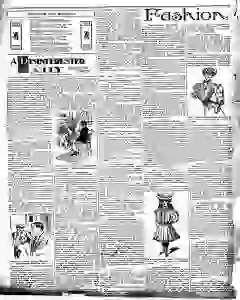
The article notes violet gowns as the season’s favorite for afternoon events. It highlights a model with a snug hip skirt, no train, and three deep tucks. The bodice blouses over a velvet girdle, opens to a chemisette, with fringe velvet bows and violet pearl buttons.
Childs dress features a gray cashmere skirt and blouse with bands of red white and blue scotch plaid taffeta bordered by cashmere. The yoke matches the plaid, sleeves have epaulets and deep cuffs, and the cravat is red velvet with a red leather belt.
Children enjoy vegetables and salads, but they should be delicate. Celery should be young, white, tender, chopped finely and dressed with oil and a few drops of lemon juice. If lettuce is used, it must be tender young center leaves.
A catalog fragment describes a range of girls and women garments including a new Taffeta Walst frock for ages 12 to 16 with plaited or gathered skirts and puffed sleeves. It covers blouses with velvet knots, chemisettes trimmed with lace, and a girdle of silk or ribbon. It also notes wash dresses for morning wear and color preferences for fabrics and patterns to brighten cloudy days.
Needlework in aprons arrives as linen takes a front seat. One style features an oval cut, buttonhole finish, and drawnwork squares framing orange tree motifs with white cotton fruit. Another piece displays a smooth new working size with deep bottom, narrow hemstitch, and a plain, elegant border suitable for a table centerpiece.
The article details a blouse and shirt-waist in white crepe de chine. It notes a waistline crush girdle holding the fabric, a V-shaped front with a lace edged chemisette, surplice center-front, and elbow-length sleeves.
The article describes French flannel being used for light sun garments and princess robes. It notes a softer blue ground compared to turquoise and mentions scattered tiny garlands of roses on a cheery pink ground. Overall effect resembles a Persian motif with a delicate, practical fabric choice.
A brief fragment mentions braid and real aces with references to a prince and duchess. The garbled text suggests discussions of braid as a decorative or symbolic element tied to noble titles. The exact context and meaning remain unclear.
We want people to find what they are looking for at NewspaperArchive. We are confident that we have the newspapers that will increase the value of your family history or other historical research. With our 7-day free trial, you can view the documents you find for free.
People find the most success using advanced search. Try plugging in keywords, names, dates, and locations, and get matched with results from the entire collection of newspapers at NewspaperArchive!
You can also successfully find newspapers by these browse options. Explore our archives on your own!
Browse by location and discover newspapers from all across the world.
Browse by date and find publications for a specific day or era.
Browse old newspaper publications to find specific newspapers.