Beckwith Special Agency Representatives Named
Representatives in New York at the Tribune Building and Chicago at the Tribune Building are listed for the S. Beckwith Special Agency.
MENTIONED IN THIS ARTICLE
The
Beckwith
Representatives
New York
Tribune
Chicago
Address changes and home delivery notices requested
Subscribing readers should provide both old and new addresses for paper changes. If delivery is irregular, notify the office. The San Antonio Light is on sale at hotels and newsstands throughout the United States.
MENTIONED IN THIS ARTICLE
San Antonio
United
San Antonio Light May 1911 circulation figures
Harvey L. Steele circulation manager verifies May 1911 totals for The San Antonio Light. Report shows monthly totals, average daily, exchanges and unsold copies, and net paid circulation. Notary John J. Wahl attested on June 1 1911 in Bexar County Texas.
MENTIONED IN THIS ARTICLE
SAN Antolio
Harvey L. Steele
The
San Antonio Light
John J. Wahl
San Antonio
Bexar Co
Tex
Rally of the Profs The first Texas prohibition rally in Dallas
Prohibitionists held their first rally in Dallas amid strong enthusiasm telegraphed from the city. The piece argues prohibition faces a tough fight, noting alcohol is a persistent habit and urging education and evolution as the path to change rather than rapid legislation.
MENTIONED IN THIS ARTICLE
Dallas
Texas
Earth
Short Term Soldiers Proposal Attracts Young Recruits
Gen Leon ee Woon suggests army adopt short term service not exceeding six months. The idea promises to attract many young men who would not otherwise enlist for three years, potentially expanding manpower. Early support notes its practical value while acknowledging it must be tested in practice.
MENTIONED IN THIS ARTICLE
Leonee Woon
Wood
United States Supreme Court
United States Army
Aspaper
Wood plan to enlist six months for high intelligence men
The piece argues General Wood may allow six month enlistments for youths of high intelligence, noting enforcement questions and the risk of misclassifying intelligence. It contends such a program could popularize the army among capable young men while warning against releasing less capable recruits too soon.
European critics on American congressmen and state legislators
European commentators note many brilliant exceptions yet argue that average American congressmen lag in private enterprise driven talent. They cite a drunken and grafting senator guest who justified himself amidst libel claims and absences as proof of flawed public service and diminished legislative fervor. The critiques admit the critic’s logical discernment remains imperfect.
MENTIONED IN THIS ARTICLE
New York Senate
Senate
Empire State
Boston Man Recovers Speech After Court Fine
A Boston man regained his speech after being fined ten dollars in court. The report notes the Nebraska man did not require a similar quickening influence.
MENTIONED IN THIS ARTICLE
Boston
Nebraska
Freight boat unloads 20 million cannon crackers in New York
In preparation for the Fourth of July celebrations a freight boat has discharged a cargo of 20,000,000 cannon crackers at New York. Officials note no importation of surgeons is needed as local supply suffices.
MENTIONED IN THIS ARTICLE
New York
Up in Kansas suffragettes face the heat
In Kansas the summer heat hits suffragists as activists campaign and endure the high temperatures while pushing for votes. The piece humorously notes the resilience of those marching for women’s rights under tough conditions.
Morris Sheppard Allows Senator Bailey to Retain Seat
Relief spreads as Judge Morris Sheppard appears to permit Senator Bailey to keep his seat unopposed amid ongoing political tension. The statement hints at a self sacrificing declaration possibly influencing the proceeding.
MENTIONED IN THIS ARTICLE
Morris Sheppard
Bailey
Shepherd Without a Flock Sparks Debate in Village
A contemplative piece questions the role of a shepherd when no flock remains, exploring duty, identity, and community expectations in the rural setting.
Senator Bailey Sharp on Lorimer Question
Vedrine's airspeed record of 155 mph appears slow beside Bailey's rapid position switch on the Lorimer matter.
MENTIONED IN THIS ARTICLE
Vedrine
Bailey
Lorimer
Mexico Quake Shakes Many Regions but Capital Escapes
Dispatches report tremors across numerous Mexican areas while the zone around the presidential chair experienced its own quake days earlier, highlighting regional differences in impact and timing of the event.
MENTIONED IN THIS ARTICLE
Mexico
Dispatches
Missouri Twins Tie the Knot at San Marcos
Two pairs of twins from Missouri were married recently at San Marcos. The report notes Missouri’s reputation for flair in social displays is being upheld by the weddings and the grooms’ origins are highlighted.
MENTIONED IN THIS ARTICLE
Missouri
San Marcos
Ringed necks on cormorants but rings for trusts differ
The article notes Chinese cormorants wear neck rings to stop fish swallowing. It adds that the country’s trusts use a different kind of ring not worn on the body, implying a figurative use of ring terminology.
Texas Party Silence Decline Quiets Noted Reply
The party most interested may decline to respond to Mr Blythe but cannot expect to quiet all Texas parties through silence. The remark signals political maneuvering and strategic communication in Texas affairs during the period.
Noisy politics linger after near noiseless streetcar
Inventors claim a nearly silent streetcar while politicians still dominate the scene. The contrast highlights ongoing public debate and skepticism about technical progress versus political processes.
Arbitration sentiment bound to go forward stance
The Omaha Bee argues arbitration will advance due to material grounds of money rather than moral appeal. It notes past futility of abolishing war by moral influence and reflects on mankind’s innate selfishness influencing efforts toward peace.
MENTIONED IN THIS ARTICLE
Omaha Bee
Japan enters dispute with hope for pacific accord
The Cleveland Plain Dealer hails Japan's expressed readiness to pursue a general arbitration treaty with the United States. The notice is seen as a move toward cordial relations between nations with shared interests and prospects for reduced tensions in the Pacific.
MENTIONED IN THIS ARTICLE
Japan
United States
Pacific
Cleveland Plain Dealer
Japan Opens Door To World Peace Pact
The St. Paul Dispatch reports that Japan is prepared to join a peace pact similar to the one proposed with England and France. Germany remains aloof for now, a temporary stance, as the German people are expected to eventually join a global movement toward a universal blessing.
MENTIONED IN THIS ARTICLE
Japan
England
France
Germany
St. Paul
Make War A Last Resort Says Arbitration View
A Batimore News opinion argues the proper end of an arbitration treaty is to make war a last rather than a ready resource. It suggests measures that force sober second thought to reduce the risk of war.
MENTIONED IN THIS ARTICLE
Batmore News
Anglo Saxon nations seek arbitration to settle differences
In a spirited exchange across the country and in England, the prevailing sentiment favors arbitration. An agreement between the two great Anglo-Saxon nations to arbitrate all differences is seen as likely to spur similar action by other powers.
MENTIONED IN THIS ARTICLE
England
Troy Times
Universal peace delayed by human passions and slow warfare
A Hartford Times quotation on the slow pace of achieving universal peace. It argues that evolution cannot be rushed to produce lasting results, and until human passions are better restrained, war will be slowed more by disciplined conduct than by mere paper treaties to abolish it.
MENTIONED IN THIS ARTICLE
Hartford Times
Arbitration stance shifts away from Roosevelt fears
The Taft administration and pro arbitration allies including New York Boston and London chambers of commerce disagree with Colonel Roosevelt. They deem it safe and wise to arbitrate any and all questions and recognize any issue as arbitrable.
MENTIONED IN THIS ARTICLE
Taft
Friends of Arbitration
Chambers of Commerce
New York
Boston
London
Roosevelt
Chicago Record-Herald
No Alliance With England Says Tribune
A Minneapolis Tribune editorial asserts there will be no Anglo-American alliance beyond romantic notions of young naval officers. It argues such a pact would breach traditions, harm both nations, and that treaties must aim for peace rather than war.
MENTIONED IN THIS ARTICLE
England
Minneapolis Tribune
Married Men's Troubles at Revival Night
A preacher asks husbands with troubles to stand. all rise except one who sits, claiming paralysis. The lone man is declared “one in a million” as the church reacts to the amusing scene from a Ladies' Home Journal feature.
MENTIONED IN THIS ARTICLE
Ladies’ Home Journal
Deceptive Cheese Patter At Store Leads to Note
A traveling salesman in a store encountered a delivery boy who claimed to be the whole cheese. The man left a note for the proprietor, which the boy read aloud with a quip about being nearly out of cheese.
MENTIONED IN THIS ARTICLE
Wupon
Success Magazine
Pecans a Penny A Bag Stun San Antonians In Prohibition Town
A San Antonio train halted briefly in a prohibition town where a vendor sold large pecan bags for five cents. Passengers grabbed bags and paid, then opened them to find only shells after stuffing pockets with pecans. The incident sparked shock and jokes about unexpected punishment.
MENTIONED IN THIS ARTICLE
Fort Worth
San Antonio
Prohibition
The Summer Cottage by Clever Budget and Taste
A cottage built and furnished by a thrifty woman blends ingenuity with economy. She uses wall mounted toilet tables, factory mirrors with backs, and plain frames, while avoiding bulky bureaus. White enamel, green denim, and simple materials create a clean, cool, summery interior that rents well.
MENTIONED IN THIS ARTICLE
Isabel Gordon Curtis
Shore
Criminal nature, or human flaws, say warden
Warden Thomas Tynan denounces the idea of criminal nature as a fixed trait. He argues criminology misleads the public by labeling eye and ear as criminal, insists most offenders are ordinary people. recounts a barber and tailor’s transformation of a man into a feared figure and a courtroom joke about a prisoner.
MENTIONED IN THIS ARTICLE
Thomas T. Tynan
Colorado State Penitentiary
It Is Not Mr Bryan's Fault in Democratic Party
A fragmented note discusses the Democratic Party and public perception, contrasting Mr Bryan with the broader party presence in New York. The text hints at shifting political dynamics and media commentary.
MENTIONED IN THIS ARTICLE
Mr. Bryan
New York World
Can Leiden
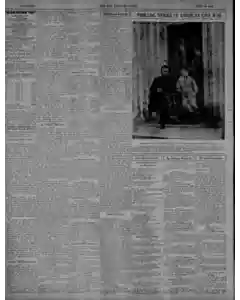
Grant Center of Civil War Storm at City Point Photo
A modest man sits beside his wife and son in front of a cottage at City Point Virginia. The image shows Ulysses S. Grant, commander in chief, amid the fiercest storm convulsing the republic during winter headquarters 1864 65 near Petersburg.
MENTIONED IN THIS ARTICLE
Ulysses S. Grant
United States
American Republic
City Point
Petersburg
The Advertised Trust of Meat and Milk Monopoly
A satirical verse mocks a powerful trust controlling milk and meat prices. It celebrates a generous public image while exposing alleged collusion and price fixing. The speaker claims the trust circumvents competition with judicial endorsement.
Whimsical Domestic Chaos In A Shaving Morning Farce
A comic verse describes a chaotic morning as a household scatters supplies and furniture, a shaving routine goes awry, a painter surveys a shattered object, and a woman questions changing appearance while the crew endures delays. The narrator jokes about duty, appetite, and the mess while awaiting completion of the task.
New York Fire Commissioner Sacked as Police Fares Change
Citizens react to leadership shakeup with the police commissioner ousted while the fire department chief is retained. The decision sparks debate over control of city safety and emergency services.
Seedling progress seen in amateur gardeners’ dig
The amateur gardening season enters a phase where gardeners dig down to seeds to check if they are sprouting. Local observers report hands-on soil testing and early signs of growth as hobbyists nurture beds.
MENTIONED IN THIS ARTICLE
Albany Journal
Fourth of July Safety Suggestion
A Philadelphia Press editorial argues that if July Fourth celebrations were as safe as Memorial Day, the nation would enjoy better public spirit and reduced risk, urging practical caution and orderly festivities.
MENTIONED IN THIS ARTICLE
Philadelphia Press
World panic history sparks threat to Burns investigator
George W. Perkins comments on the World account of 1907 panic history and threatens to send for Mr Burns the investigator. Burns is noted for his specialty in uncovering information.
MENTIONED IN THIS ARTICLE
George W. Perkins
Mr. Burns
Governor Wilson Docked For Tour In The War
The Buffalo Times notes that Governor Wilson was docked a month's salary for his tour in the wear. It ponders how much salary President Taft would earn if pay stopped for every day he is away from Washington.
MENTIONED IN THIS ARTICLE
Wilson
Taft
Washington
Buffalo Times
Wickersham and the Trusts Threaten Presidential Size
The Memphis Commercial Appeal jokes that if Wickersham keeps obtaining verdicts against the trusts he may reach what is called presidential size, a humorous remark on his growing influence and legal pressure.
MENTIONED IN THIS ARTICLE
Wickersham
Memphis Commercial Appeal
Roosevelt and liars become targets of denunciation
A Louisville Courier Journal remark notes Colonel Roosevelt’s claim of having no use for liars, arguing that liars are valuable as objects of heated denunciation and public rebuke.
MENTIONED IN THIS ARTICLE
Roosevelt
Louisville Courier- Journal
Lightning speeds into Ohio telegraph girl incident
A lightning flash struck in Ohio injuring a telephone operator who collapsed before she could answer. The Chicago News reports the striking event tied to a sudden storm and the ensuing medical response.
MENTIONED IN THIS ARTICLE
Ohio
Chicago
Announcement Quotes Champ On Window Throwing
The Washington Post notes Champ says he would not throw anyone out a window and doubts Woody Wilson would risk calling. This remark frames a lighthearted disagreement over a sensational statement.
MENTIONED IN THIS ARTICLE
Champ
Woody Wilson
Washington Post
Wade Ellis’s Role in the Memorable Victory
The St. Louis Republic credits the renowned trust buster Wade Ellis with a pivotal part in a landmark victory. Ellis’s actions are noted as decisive in shaping the outcome and securing the win.
MENTIONED IN THIS ARTICLE
Wade Ellis
St. Louis Republic
Gates Bets a Million It Does
A garbled note cites the Pittsburgh Leader quoting Mr Gates about a million dollar bet and opinions on pay not affecting his stance. It preserves the core claim that Gates asserts certainty regardless of external views.
MENTIONED IN THIS ARTICLE
Gates
Mr. Gates
Pittsburg
Diaz comeback not seen as priority in Atlanta Constitution
The Atlanta Constitution reports little urgency for Diaz to return as nobody seems anxious about his comeback. The tone suggests lukewarm interest or indifference among readers and staff.
MENTIONED IN THIS ARTICLE
Diaz
Atlanta Constitution
Kings and Crowns Burn in Modern Gown Satire
A 1910 poem by Geo. Matthew Adams shows a monarch weary of power. It contrasts royal pageantry with a simple rural life, imagining a king preferring a quiet farmhouse and farm chores over imperial duties and gilded halls. The speaker hints at graft and the toll of sovereignty on the ruler.
MENTIONED IN THIS ARTICLE
Geo
Matthew Adams
England
Scotland
Cork
Wales
Baar Mean Not An Old Man s Game
An old man seeks a lost golf ball near a bush and endures thorny discomfort while policing his temper. A passing voice scolds him, prompting a final loss of temper as the ball is reclaimed.
Traveling man asks when summer comes in North Dakota
A St. Louis traveler on his first trip through North Dakota wakes to surprising May snow and asks the hotel clerk when summer arrives. The clerk, unused to seasons, replies he has only been there eleven months.
MENTIONED IN THIS ARTICLE
St. Louis
North Dakota
Success Magazine
Also Mentioned on This Page
Evening
Associated Press
VHE Light Publishing CO
Charles 8
Diehl
Harrison L. Beach
Serene Bkead
Tate
Rally OF the “Pros
Kansas
Mercury
Thrilling Stories OF
Grant
Reasonable Ballads
Percy Shaw
Milk
N. P. Babcock
Dear
Sore
Sonda
Boston Transcript
Woodrow

 This is just the beginning! Our collection holds over 300 years of history, including rare newspapers, obituaries, marriage records, birth records, and so much more—most of which you won’t find anywhere else!