Sports Clothes and Calico Frocks Define Summer Wardrobe
A New York Times fashion view argues sports clothes have secured a permanent place in the American wardrobe for informal wear. It highlights material choices from calicoes and prints to ratines and linens, emphasizing practical silhouettes, short sleeves, and comfortable skirts suitable for everyday activities.
MENTIONED IN THIS ARTICLE
Country Club
New York Times
Coats Displacing Sweaters in Semi-Sports Wear
Coats of this type are replacing sweaters for afternoon wear and more dressy sports outfits, appealing to outdoor enthusiasts especially women avoiding mannish attire. Accessories matter. flat heeled shoes, lisle stockings and restrained colors like black gray and tan create the desired effect, while colored shoes risk misfit with conservative styles.
To Tighten Sewing Machine Strap
Instructions advise applying a few drops of castor oil to a loose sewing machine strap and leaving it overnight so the belt tightens and returns to proper tension by morning. This common home remedy suggests lubrication to restore fit without disassembly.
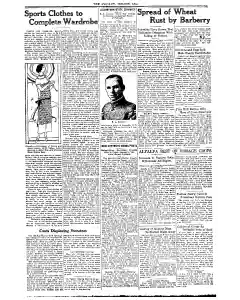
Legion Man State Engineer Named for Nebraska
LR L Cochran of Lincoln, a World War I veteran and American Legion member, was selected by Gov. Bryan as Nebraska state engineer. A University of Nebraska graduate, he worked as a rodman, Lincoln county surveyor, consulting engineer, and state bridge inspector before his army service. After discharge he settled in North Platte and supervised paving projects.
MENTIONED IN THIS ARTICLE
Nebraska
LR. L. Cochran
Lincoln
American Legion
Bryan
University of Nebraska
Cochran
Atchison, Topeka & Santa Fe Railroad
Lincoln County
Wyoming
Supreme Court
Engineering Corps
Army
Coast Artillery
Fortress Monroe
North Platte, Neb
North Platte
New Contests Among Posts Aimed at Disabled Veterans Service
The national rehabilitation committee of the American Legion proposes a district contest to boost post effort in helping ex service men reintegrate into community life. A loving cup would honor the post with the most service, based on points for hospitalized men, compensation, training, insurance reinstatement, and job opportunities.
MENTIONED IN THIS ARTICLE
National Rehabilitation Committee of the American Legion
Veterans’ Bureau
Joe Sparks
National Committee
Legion Post
Sparks
Hospital for Trachoma Patients Opens in Kentucky
The Veterans' Bureau opens a hospital at Pikesville Kentucky to treat World War veterans afflicted with trachoma, a rare eye disease, according to information sent to the Legion service division.
MENTIONED IN THIS ARTICLE
Veterans’ Bureau
Pikesville
Kentucky
Legion Service Division
Spread of Wheat Rust by Barberry
The article recounts barberry bushes spreading black stem rust to nearby wheat, with Dr. E. C. Stakman of the USDA noting epidemics disappeared after bushes were removed. It traces 18th–19th century debates, De Bary's 1865 findings on rust life cycle, and confirms barberry as the rust source.
MENTIONED IN THIS ARTICLE
United States Department of Agriculture
E. C. Stakman
England
de Bary
Doctor Stakman
Barberry
Chickens and Eggs Sold Make Family Comfortable
A Colorado woman improved family finances through poultry keeping after a poor crop year. She sold culls for 106 dollars to buy lumber for a larger poultry house, and eggs and chickens brought 597.20 dollars. The income covered taxes, interest on farm debt, new poultry-house space, and interior home work, giving the family a cozy three-room house.
MENTIONED IN THIS ARTICLE
Colorado
United States Department of Agriculture
Maney
Flies Threaten Milk Flow In Cattle In Dairies
The dairyman notes flies are costly and reduce milk output by annoying cows. Extension division suggests a protective repellant mixture of ecarbolic acid turpentine tar oil and tannin to be diluted with kerosene to five gallons and sprayed on cattle twice daily.
MENTIONED IN THIS ARTICLE
College
Alfalfa Best of Forage Crops
Alfalfa ranks as a leading forage crop, adaptable to many soils and climates. It prefers dry air with irrigation, tolerates heat, but suffers in cold and thaw cycles, especially with poor drainage and high water tables. Deep loams with open subsoils and good drainage favor growth. prolonged flooding during growth harms plants.
MENTIONED IN THIS ARTICLE
United States Department of Agriculture
United States
Imperial Valley
Cal
Colorado
Taming of Guineas Must Be Started Right Away
Guineas can be tamed if training begins after hatching and kept confined in hen houses. Some may remain wild if hatched by guinea hens and allowed to roam with predators about, but tame birds are quieter and valued for meat and eggs. Demand grows in Eastern markets and eggs are considered rich and longer lasting.
Insure Cleaner Potatoes With Formaldehyde Treat Potatoes
A historical notice urges using formaldehyde or corrosive sublimate to treat seed potatoes to ensure cleaner, higher quality harvests next fall. Farmers encouraged to dig more and improve storage practices for better yield.
Feather Eating Habit in Poultry Cured by Proper Feed
Harry Embleton of the A and M college explains fowls crave certain foods they miss. Milk, tankage, meat scraps, or alfalfa pasture satisfy this need. supplying enough of these feeds helps end the feather eating habit.
MENTIONED IN THIS ARTICLE
Harry Embleton
A, and M College
Culture of Clover for Profitable Seed Crops
Farmers with heavy clover crops should cut when heads brown, cure in windrows, haul under cover, and salt each two-horse load to absorb moisture. If salt is unavailable, layer straw between loads. Side delivery hay rakes aid efficient curing by allowing hot air and sun to dry without breaking fine leaves.
Color of Eggs by Ear Lobes and Breeds
A hen with a white ear lobe lays a white shelled egg while a hen with a colored ear lobe lays a colored egg. Leghorns and Anconas have white ear lobes and Plymouth Rocks Rhode Island Reds and Wyandottes have red ear lobes.
MENTIONED IN THIS ARTICLE
Leghorns
Anconas
Plymouth Rocks
Rhode Island
Wyandottes
Also Mentioned on This Page
Cretonne
Legion Man State Engineer
R. L. Cochran
R. L. Gochran

 This is just the beginning! Our collection holds over 300 years of history, including rare newspapers, obituaries, marriage records, birth records, and so much more—most of which you won’t find anywhere else!