Breeders Debate Pedigree Versus Individual Merit In Swine Herds
A Prairie Farmer style discussion argues that while pedigree matters, true merit lies in the individual animal. It cites a two-year-old boar headed a superb sow herd, warns that lineage alone can mislead, and urges focus on animal quality plus careful farrowing care and feeding practices to ensure strong pigs and profitable pork production. It notes breed improvements over twenty years and a Kansas farmer endorsing pure Poland China hogs fed on ear corn and water for rapid growth.
MENTIONED IN THIS ARTICLE
Ikke
I. Lewis
Illinois
Breeders Gazette
Poland
China
Soil and grass variety selection for sturdy field meadows
Prairie Farmer urges farmers to assess soil type and subsoil before choosing grass species and sowing time. Analyzed soil, local guidance, and expert station input help select varieties best suited to the land, with seedbed prep and sowing timing treated as secondary factors. The text also notes splint injuries in livestock improving with bone growth and eventual reduction of lameness.
MENTIONED IN THIS ARTICLE
Horzen
Lonion Live Stack Journal
Pedigreed stock and pure Dred breeding guidance
An article argues farmers should pursue pedigreed stock registered in breed associations. It outlines selecting a breed, contacting the registry secretary, studying rules, buying foundation stock, and rear and manage animals to achieve high quality meat yield and maturity without legal costs. It emphasizes blood purity and economic benefits of pure stock over mixed stock.
MENTIONED IN THIS ARTICLE
Pratt Br
Mom. Small
Breeder's Gazette
Lost horse debate from Carus ward letters on draft stock
Mr Willi J Overton of Illinois argues in a Breede jagette letter that American bred draft horses with Morgan influence perform best for farm work and hiring men, cautioning against overlarge draft crosses while noting changes in stock over the past two decades. He advocates sticking to good sized, smooth American bred horses and warns against overbreeding drafts. He adds commentary on bull breeding, saying a well kept bull should sire calves with 80 to 90 percent success by fourteen months, and that Jersey cows may calve younger but are not necessarily more productive.
MENTIONED IN THIS ARTICLE
Willi J. Overton
Ilinois
Breede Jagette
Carus Ward
SYS
Cottonseed Hulls as Feed for Dairy Cattle
Tennessee experiment station endorses cottonseed hulls as a valuable feed for milk cows when used properly. Recommend up to 18 pounds hulls per 1000 pounds live weight daily, warning that higher levels may weaken digestion and cause diarrhea or constipation. Cottonseed meal can be fed safely up to five pounds daily per 1000 pounds live weight, with butter making not to exceed three pounds daily.
MENTIONED IN THIS ARTICLE
Tennessee Experiment Station
Dairy cattle study: cheap versus costly butter production
A Connecticut dairy expert outlines methods from a jury association meeting detailing how feed costs, cow type, and balanced rations affect butter yield. He contrasts low cost, common dairy cows with high quality cows, noting an average of about 20 pounds of butter per cow yearly at roughly two cents per pound feed cost.
MENTIONED IN THIS ARTICLE
J. Lchuecher
Connecticut Jury Men's Association
Size Or Water Ltd
Seree
Giusyill
Eon
Acreas
Profitable Cow Test Requires Repeated Milking Tests
The article discusses how profitability from dairy cows hinges on feed cost and milk quality. It suggests that accurate profitability cannot be determined by a single test and recommends multiple measurements across the milking period.
Sanitary Stable Practices For Milk Cattle
Advice from a New York Tribune style column explains how to keep cow stables warm, well ventilated, and lighted to produce clean, good tasting milk. It argues for a uniform temperature, dry bedding, accessible water, and strong sanitation measures including dusting, absorbents, and properly designed floors. It emphasizes sunlight, air flow, and light to kill microbes and improve milk quality, urging consistent effort and honest work.
MENTIONED IN THIS ARTICLE
The
New York Tribune
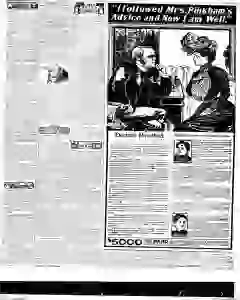
Lydia E. Pinkham's Vegetable Compound Aids Women
The article extols Lydia E. Pinkham of Lynn Massachusetts and her Vegetable Compound as a remedy for female ailments. It claims vast experience and success, asserting that over one hundred thousand women have been treated in the last year and urges any woman to seek her advice.
MENTIONED IN THIS ARTICLE
Lydia E. Pinkham
Lynn
Mass
America
Dean
Lydia
Pinkham
Samuel Bors
Cozy Ave
Oneonta
N.Y
Mrs. Prxxiam
Sophie Bontunm
Oak St
Chicago
Grateful letters praise Lydia E Pinkham’s Compound
Trusted testimonials from women across Ohio New York and Maine describe relief from backache headaches nervous fatigue and menstrual and womb ailments after using Lydia E Pinkham's Vegetable Compound Liver Pills and Sanatire Wash. Patients credit life saving improvements and lasting health gains to the regimen and medical guidance.
Care of Tairy Cows and absorbents for barns
The piece discusses cow care and gutter cleanliness, recommending twice ten day cleaning, brushing and carding cows daily, plus ample bedding and fresh material. It cites absorbents like long horse manure, sand plaster, and South Carolina rock as useful additives, blending them for value and odor control, with a humorous aside about anecdotes and a brief Philadelphia Press comment.
MENTIONED IN THIS ARTICLE
New York Tribune
South Carolina
Also Mentioned on This Page
Kansas Marmer
Llano
Ditty Creatory
Emor
Ella E. Brenner
East Rochester
Ohio
Lipia E. Pinkgam Medicine
Mass, Ree
Ely
Coakley
Lineain
Lincoln
Jonkley
Philadelphia Press

 This is just the beginning! Our collection holds over 300 years of history, including rare newspapers, obituaries, marriage records, birth records, and so much more—most of which you won’t find anywhere else!