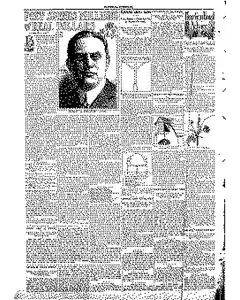
Poet and Watchman in One: Yron R Newton of Treasury
A historical profile notes Yron R Newton as assistant secretary of the treasury a newspaper man a watchman and a poet. It highlights his early verses his musical talent and his belief in publicity while touching on how such figures move into higher business roles.
Byron R. Newton and Public Health Service Spotlight
The article chronicles Byron R. Newton born in New York, a former cub reporter turned assistant secretary of the treasury who promoted information about the Public Health Service and government building site oversight. It recalls Newton’s journalism career from Spanish American War reporting to a published poem and his role in selecting proper sites for federal buildings, ensuring efficiency and guarding Uncle Sam’s interests.
MENTIONED IN THIS ARTICLE
the Treasury
Uncle Sam
Mr. Newton
Newton
Great Press Association
Havana
Santiago
Winslow
Ensign Worth Bagley
Byron R. Newton
New York
Treasury
ASSERT LIGHT IS WASTED
The article argues that city lights in London and worldwide are wasted due to poor directing of light from shop windows and street luminaires. It urges illuminating engineers to focus on consumer benefits and better light distribution rather than solely on lighting companies.
MENTIONED IN THIS ARTICLE
London
Belief in Little People Shapes Colorado Cliff Dwelling Views
The Mesa Verde region's Utes revere spirits they call the little people who guard ancient cliff dwellings. This belief makes them reluctant to approach the prehistoric Mancos cliff cities, which they hold as sacred and inhabited by unseen forces.
The Sort She Liked
A fragmentary exchange reveals a lover’s curiosity about a personal album. The speaker explains the book as a collection of souvenirs, hinting at memories and nostalgic ties.
MENTIONED IN THIS ARTICLE
Spoona
Building Small Barn Affords Strong Roof and Large Mow Space
Instructional note by W. B. Frudden on a 28 foot wide gable roof barn design using 2x6 rafters 18 ft long and a four 2x12 plank girder. Describes tieing studs joists and rafters to prevent sag or twist, with a concrete foundation and one ton per running foot mow capacity.
MENTIONED IN THIS ARTICLE
W. B. Frudden
Iowa
Harvest Hairy Vetch Seed Harvesting and Yields
The text explains harvesting hairy vetch seed with a mowing machine at full pod ripeness. Do not drive over cut vetch to prevent seed loss. Dry pods crack easily, so careful curing and handling are required. Thresh with a grain thresher by lowering concaves. Yields of three to ten bushels per acre are possible, with complete separation from rye or wheat done by a spiral separator.
Cultivation of the Garden by M F feees Renkas
The article offers garden cultivation guidance for small plots using hand tools. It covers soil moisture, watering timing, shallow furrows, and post watering cultivation. It advises pest control including arsenate sprays for flea beetles and aphids, soap sprays for green aphis, and bran mash with sugar or molasses to deter cutworms.
MENTIONED IN THIS ARTICLE
M. F. Feees Renkas Experiment Station
Protect the hay entrance porch design for barn use
A barn porch plan adds a 10 by 10 foot sheltered area with a boom extending to the gable end for hayfork handling. It recommends a door hung from above and ropes to secure inside, keeping tackle under cover to prevent warping rot and rust, with roof extension limited to four to five feet.
MENTIONED IN THIS ARTICLE
Orange Judd
Fight Apple Tree Insects
The article explains insect pest habits and vulnerable points on apple trees. It classifies pests into three groups: borers and sap feeders. foliage feeders. and fruit feeders, detailing examples such as bark borers scale insects leaf pests caterpillars and the mottled fruit caterpillar noted for laying eggs on leaves and a ground pupal stage.
MENTIONED IN THIS ARTICLE
B. M. Patch
United States
San Jose
Usefulness of Small Toad in Agriculture
The toad lives 10 to 40 years and lays over a thousand eggs yearly. It can starve two years yet cannot survive long underwater. It feeds on wasps, ants, beetles, worms, spiders, snails, caterpillars, and more, consuming four stomachfuls in 24 hours. One toad can eat over 10 000 insects in three months, offering farmers a valuable ally. Ohio State University notes its benefits to gardens and fruit patches.
MENTIONED IN THIS ARTICLE
O —Ohi State University
Cut Worms Exterminated by Simple Fur Row Barrier
The pest is troublesome only when numbers have increased enough to devour all forage. Larvae travel in compact masses and have a vulnerable point at their path. A fur row opened across their path stops them as they cannot climb out of steep sides, allowing utter extermination.
Don’t Waste Wood Ashes as Fertilizer or Weed Killer
The article notes wood ashes hold about 8 or 9 percent potash and 2 percent phosphoric acid. Investigators estimate a bushel of ashes could yield 20 to 25 cents in value, with 10 to 15 cents more for the potent weed-rot power.
Chicks Scratching and Busy Feeding Advice
The guidance stresses keeping chicks scratching as they eat and exercise. It warns that without proper feeding growth stalls and without movement the birds may perish.
Egg Shell Feeding Practice Reported in Poultry Study
A brief note indicates feeding eggshells to poultry as a dietary inclusion. The exact practice mentions using crushed eggshells to supplement feed, aiming to improve calcium intake and shell quality in laying hens.
Grass Weaks Earth Surface Hold Through Deep Roots
Grass forms a strong, close-clinging network with its roots that stabilizes the earth’s surface throughout the year. The text notes its seemingly soft green surface hides its extensive, far-reaching structural role.
Protecting Orchard From Insects and Winter Habits
An article urges orchard owners to guard fruit crops by clearing dead grass weeds and brush piles that harbor insects. It explains eggs hatch in spring from summer fall deposits and that careful spraying in season reduces fruit damage and losses.
Pruning Proves Profitable in Orchard Survey
An orchard survey in Town county shows pruned orchards outperforming unpruned. Annually pruned trees yielded average net returns above 125 dollars per acre versus about eight dollars per acre for less frequent pruning.
MENTIONED IN THIS ARTICLE
Avery
Also Mentioned on This Page
Yron R. Newton
United States Treasury
Washington
Frank A. Vanderlip
Great City National Bank of New York
Robert O. Bailey
Vanderlip
Bailey
Queen the Heavenly Muse
Remenyi
Colorado
Haye
Ae ‘Colt
Pestare

 This is just the beginning! Our collection holds over 300 years of history, including rare newspapers, obituaries, marriage records, birth records, and so much more—most of which you won’t find anywhere else!