Hotel with all clocks kept in perfect sync
A curious claim about a hotel where every clock keeps the same time. The piece notes a rail or trolley car incident and mentions train robbers as a contrast to the trolley service remaining on schedule.

 This is just the beginning! Our collection holds over 300 years of history, including rare newspapers, obituaries, marriage records, birth records, and so much more—most of which you won’t find anywhere else!
This newspaper page contains 23 articles. Subscribers can read the full text of each article.
Newspaper
Mitchell Capital
Location
Mitchell, South Dakota, United States of America
Date
Nov 16, 1894
Page
5
A curious claim about a hotel where every clock keeps the same time. The piece notes a rail or trolley car incident and mentions train robbers as a contrast to the trolley service remaining on schedule.
Telegraph orders are issued to inform the public that the Sultan of Morocco is in. Officials note the cost is about 250 and emphasize urgency amid rising news interest.
A remark suggests early North Pole arrival was hampered by explorers rushing home for lectures on the platform. The comment frames cautious voyage as delaying dramatic polar achievement.
Benjamin R. Hardson a New York millionaire faces a court settlement over dower rights claimed by a woman presenting herself as his common law wife. His rustic New York cottage housed a middle aged housekeeper and a young colored girl, with a visitor noting a large sign near the parlor declaring the woman is not his wife and that he is a widower.
The Michigan Supreme Court ruled that a state law requiring foreign corporations to file articles and pay a franchise fee does not apply to manufacturing and mercantile firms doing business via agents in Michigan. The decision aligns with rulings limiting licensing fees on commercial travelers and peddlers as interstate commerce interference.
Samuel Fielden, once condemned for the Haymarket dynamite massacre and later commuted to life imprisonment and pardoned by Governor Altgeld, plans to abandon city life for farming. He seeks a suitable farm and argues others should also seek rural pursuits to improve comfort and reduce unrest.
The text notes West era train robbers taking gold from an express car and other bands in Virginia stealing 2130.00. It praises companies for sometimes foiling raids and turning the tables, killing or wounding robbers, yet laments the vulnerability of unguarded railroad cars and questions what express companies will do to protect money moving across the country.
An American traveler in Normandy recalls a wall card in a country tavern outlining the law against intoxication. After two formal condemnations for scandalous and public drunkenness the offender incurs disabilities: loss of vote, disqualification from election, jury service ban, ineligibility to act as executor, and loss of right to carry arms.
The document contrasts pay for British and American legal leaders. It notes Lord Chief Justice Coleridge at 340000 yearly, UK Lords of Appeal at 30000, and British Attorney General at 370000, versus US Chief Justice at 10 dollars, Attorney General at 2800, and Secretaries of State at 25000 with lifelong pension provisions for some.
An interview with a Chicago killer whose death sentence was commuted to life reveals his terror of looming execution and the relief and happiness upon news of commutation. He says the approaching gallows and prison noises haunt him, while dreaming of escape from eternal punishment.
Chicago widow Mrs Baseman wins an injunction after Jacobson, who sued for breach of promise, hires a German band to play suggestive tunes under her window. Neighbors endure smiles until court steps in, sparking debate over personal liberty and male frustration in love disputes.
Excerpt notes how Ugandan soldiers wore well-filled cartridge belts amid reflections on the 1890s Brussels Conference acts and colonial regulations. The author recalls learning that guns and related munitions could be bought in Uganda as easily as in Pall Mall, highlighting colonial access to weapons.
A fragment notes a boastful creature arguing its superiority among animals, asserting both vocal prominence and value. The odd phrasing frames the subject as a social or philosophical point rather than a concrete event.
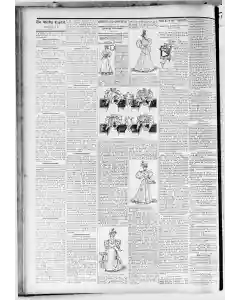
Gossipy New York correspondence reviews high society attire with emphasis on wealth shaping trends. It describes street dresses calling gowns as theater and calling gowns as affordable, noting heavy heather materials, sable edging, draped overskirts, and lavish styling while hinting at costly upkeep and social display.
A detailed survey of period dress ideas highlights mixed color silks and wool capes, including a color palette of browns pinks and blues. Descriptions cover bodice, collar, sleeves, belts, and bows, with satin and brocade combinations, fur trims, and a lace and fur pairing.
A reader seeks advice on handling daughters aged 18 and 16 who were out late, prompting a mother to whip them. The editorial stance favors gentle, disciplined mother daughter talks, not public airing. In a second tale a father disowns his daughter if she wears bloomers after a ride with him ends with a public display and a vow to never wear them again.
The piece argues a woman earning nothing monthly still has time and health costs beyond board and clothes. It notes recreation, rest, and personal services strain the worker, plus nerve exhaustion from continual labor. It urges women to resist the pressure of domestic expectations to avoid overextension.
A fragment suggests married couples might be happier if quarrels stayed private and couples kissed and made up after every dispute, reflecting a social belief about domestic harmony.
A reflective piece argues for equal household burdens and mutual consideration between spouses and lovers. It suggests wives should not be overburdened with chores and that men should show greater sympathy, noting recreation and shared effort as essential to harmony.
The piece humorously critiques adjustable wardrobe hooks for women, arguing current designs ignore varied statures and gowns. It laments that low hooks drag sleeves and skirts, while high hooks force women to jump to manage dresses, mocking men’s failings and praising the age of invention.
A piece condemns dinner table discourse, arguing that chattered food should be half divested and surly dinners distress the dyspeptic. It says those bearing bad news or grim topics should be barred from the table and that wholesome conversation aids nourishment.
A collection of society gossip items mentions Amelie Rives Chanler planning a Holy Land trip in Europe and Empress Eugenie declining Scotland. It notes Anna Gould’s engagements, public figures like Mrs Washington and Mrs Barrie, Harriet Beecher Stowe’s still earning, and Princess Louise’s betrothal. Bernhardt’s fame and a Chicago mail carrier named Charlotte Waldo are also cited with vivid, partial anecdotes.
A lively South Hustlers bar exchange features a fortune teller predicting marriage within a year while a fortune seeker counters with a prior claim of two or three years. The dialogue highlights a man known for drinking and for causing mischief, drawing a sharp local critique of vanity and excess.
We want people to find what they are looking for at NewspaperArchive. We are confident that we have the newspapers that will increase the value of your family history or other historical research. With our 7-day free trial, you can view the documents you find for free.
People find the most success using advanced search. Try plugging in keywords, names, dates, and locations, and get matched with results from the entire collection of newspapers at NewspaperArchive!
You can also successfully find newspapers by these browse options. Explore our archives on your own!
Browse by location and discover newspapers from all across the world.
Browse by date and find publications for a specific day or era.
Browse old newspaper publications to find specific newspapers.