Vine the beautiful vine the tree of Death
Eliza Cook contrasts deadly symbols with a lush vine as the only true tree of death. The poem laments graves, fame, and decay while praising the vine's deadly allure amid corpses and revels.

13 Jul 1839
Page 1
 This is just the beginning! Our collection holds over 300 years of history, including rare newspapers, obituaries, marriage records, birth records, and so much more—most of which you won’t find anywhere else!
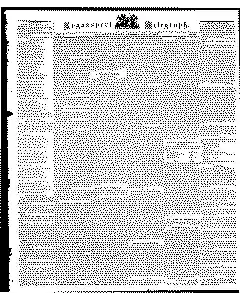
This newspaper page contains 21 articles. Subscribers can read the full text of each article.
Newspaper
Logansport Telegraph
Location
Logansport, Indiana, United States of America
Date
Jul 13, 1839
Page
1
Eliza Cook contrasts deadly symbols with a lush vine as the only true tree of death. The poem laments graves, fame, and decay while praising the vine's deadly allure amid corpses and revels.
A mother explains nature’s signs to her child through a sequence of birds and their meanings. The dove represents fidelity and home, the eagle embodies courage and striving, and the speaker ties these birds to human virtues and enduring love.
A distant relative from Scotland seeks aid from Worthington descendants after a shipwreck leaves him destitute. He is turned away by most, though an old Quaker eventually hears his plea and offers charity. The scene unfolds at the Worthington estate amid a row of factories.
An English paper recounts a village in Weckford where a beggar claiming kin to the Worthingtons tests their hospitality. He proves the long lost Thomas Worthington who made a fortune in the Indies and later marries Almira Perley, upgrading Auburn Grove after returning to claim family wealth.
Dr Channing argues that beauty pervades all creation and elevates human life. He urges cultivation of the sense of beauty as infinite in the universe, noting nature, art, and literature express this grandeur and that neglect impoverishes humanity. He links beauty to moral and intellectual development for every person.
An 1839 Oriental Annual excerpt recounts a Hindu burial of a living Pariah girl with her lover Yeughal in the same tomb. She endures a night with her father before a ritual ascent to a cone tomb where armed guards escort the interment amid a crowdless, solemn scene.
A cruel punishment tale moves toward a grim end as Pariah and her guards reach a wooden teak bridge and a gully. She consents to the sentence lowering Youghal’s corpse, then enters a living grave beside her lover, sealed by bamboo canopies and earth.
The speaker argues ignorance fuels prejudice against change. self conceit and bias block reforms. He notes innovators face hostility and even violence, citing Lancashire and early sawmills where progress provoked mob action and fear of losing bread. Indifference hampers progress today.
The text argues learning strengthens both body and mind, making future study easier and understanding deeper. Science is a connected whole centered in Deity, linking all truths from the largest to the smallest. A person who stops learning forfeits knowledge of Creator and self, which hinders happiness.
A Virginia hive and racing clan names two fleet racers Swartweut and Price with a betting ratio of two to one on Swartweut as the favored runner.
An essay argues that collective agreement can be harmful when mistaken, while doubt fuels discovery. It cites Luther Copernicus Galileo Harvey and Columbus as examples of thinking differently leading to progress. It warns against persecution for opinion and notes assent or dissent arises from understanding, not will.
The article details vast public works across Ohio Kentucky Indiana Illinois and Michigan including canals slackwater navigation two railroads McAdam roads and related components totaling about five thousand miles of artificial communication. It estimates twenty thousand laborers and a regional population around one hundred fifty thousand dependent on these projects with annual expenditures of four to five million dollars and pledged sums near forty eight million dollars plus five million from individuals. It forecasts similar spending over the next eight years.
A characteristic letter from Mr. Adams appears in the Alexandria Gazette discussing pirenaology topics and presenting his viewpoints. The piece showcases the era's editorial voice and Mrs Adams era commentary.
In a Washington 1839 missive J Q Adams responds to Dr. Thomas Sewall’s phrenology lectures with sharp skepticism. He mocks the 33 to 35 faculties notion and likens phrenology to alchemy and augury while praising the author’s argumentative effort.
In a Troy Whig anecdote a British officer asks if the Governor of Vermont resides at Gov. Chittenden’s house. A servant replies yes, and the officer halts his horse at the door, is told the governor is in the yard, and must wait while the officer jostles his plan to transact with the master.
The Buffilo man recalls a visitor finding Gen Houston, then president, in a dilapidated log cabin with a damaged roof and bare bedding. Houston sits in shirt, one leg exposed, talking to Gen Henderson while earnestly catching fleas, an account presented as non fiction.
A poor woman recalls her daughter’s marriage and describes the husband as tolerable, noting he has a long tailed coat and a ruffied shirt as the decisive traits.
A Yankee boy and a Dutch boy attend a Yankee school where the master tests their names by spelling They spell Aaron aloud with emphasis on letters and are dismissed as a man Then Hauns is called and spelled out as r o n The master again proclaims that is a man and directs him to sit down
The article traces Illinois population from about 390 in 1800 to 54,090 in 1820 then 157,445 in 1830 and 269,784 by a state census four years later. It notes 64,000 votes cast in the 1838 gubernatorial election in a territory with only about 3,000 inhabitants years earlier.
In Cincinnati a dispute at a livery stable between Mr Taylor and Elijah Hinton ended when Hinton died after Taylor threatened to whip him. The article notes the incident followed an excited reaction by Hinton, who collapsed at the spot.
A fragment describes public sentiment shifting with citizens up and down under a changing administration. A character named Leu notices a bee and mistakes it for a hummingbird, exclaiming about the heat and Lis little foot.
We want people to find what they are looking for at NewspaperArchive. We are confident that we have the newspapers that will increase the value of your family history or other historical research. With our 7-day free trial, you can view the documents you find for free.
People find the most success using advanced search. Try plugging in keywords, names, dates, and locations, and get matched with results from the entire collection of newspapers at NewspaperArchive!
You can also successfully find newspapers by these browse options. Explore our archives on your own!
Browse by location and discover newspapers from all across the world.
Browse by date and find publications for a specific day or era.
Browse old newspaper publications to find specific newspapers.