Large Omaha grain elevator fire causes heavy loss
A Sunday night blaze in Omaha destroyed a 1,000,000 dollar grain elevator, with damages totaling about 500,000 dollars.
MENTIONED IN THIS ARTICLE
Omaha
Neb

 This is just the beginning! Our collection holds over 300 years of history, including rare newspapers, obituaries, marriage records, birth records, and so much more—most of which you won’t find anywhere else!
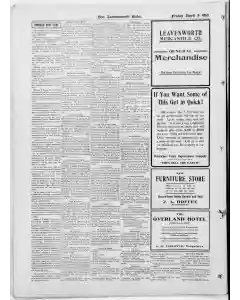
This newspaper page contains 23 articles. Subscribers can read the full text of each article.
Newspaper
Leavenworth Echo
Location
Leavenworth, Washington, United States of America
Date
Apr 08, 1910
Page
6
A Sunday night blaze in Omaha destroyed a 1,000,000 dollar grain elevator, with damages totaling about 500,000 dollars.
The 11 year old Harvard math prodigy asserts a 20 minute aerial voyage to Venus is possible by attaching radium to an airship. Sidis says he solved aerial navigation conceptually and only needs to test it, using alpha rays from radium to propel the craft at tremendous speed. He has worked out the theory but not yet demonstrated it.
Dr Edwin Montgomery of Walla Walla says six hookworm cases were found in Weston Oregon the first in the northwest. The Weston family moved from Smith County Tennessee and the ten year old boy showed symptoms with worms found on examination. He notes soil transmission is possible but curable. California has recently reported cases.
At a tea party a guest wins a guessing game and requests a slice of cake as a prize. She explains she will force her husband to eat it to prove there is a worse cook somewhere in the world.
The Manchester Mail argues that English society pressures middle class lads toward desk jobs with fixed pay and years of service. It warns social ostracism for pursuing hands on or entrepreneurial work and says class distinctions suppress romance and discourage deviation from the norm.
An acquaintance stated substitutes in goods rise to rival originals including oleomargarine and celluloid. Billings replied there is no substitute for wisdom, but silence remains the best yet found.
In the progress of a case Sir Charles Darling reproved a barrister for his argument. The barrister replied that Darling had argued similarly when at the bar. Darling conceded the point with a quiet smile noting that the judge at the time allowed it.
The article recounts Frederick I of Prussia dying after fear of a haunted vision and an insane wife who once fled her keeper and, stained with blood, attacked him. He believed in the ghostly white lady and died six weeks after the incident. A mortgage on the house is noted as unrelated commentary.
The Pittsburg Chronicle Telegraph reports a story Lincoln told about a slave preacher who says he must draw inferences from Bible texts as they come to his mind. The master challenges him to infer the meaning from the line the ass snuffeth up the east wind and the slave quips about the wind’s long reach before fatness. The anecdote illustrates folk humor and the president’s use of parable.
A London Globe report describes a tiger trapped in the jungle using a mouse-trap like device. The full grown male tiger roared and battered the structure in fury until hunger subdued him, illustrating that tigers can be trapped though not often.
An article recounts the Orloff diamond once set in the idol Serringham’s eye in the temple of Brahma. A French soldier feigned conversion to gain temple access and sold the gem for £2000. It passed through a Constantinople banker to the Russian empress by 1774 for £90000 and a life pension, and remains in the Russian imperial scepter weighing 194½ carats.
Ancient Iceland emerged from Norwegian settlers in A D 874. John Fiske praised the rapid colonization and growing population of about 50,000, with strong trade in fish, oil, butter, and skins. Political freedom and judicial fairness supported swift wealth and cultural growth.
The western governor tours state institutions and asks about a chaplain appointed to an insane asylum. The guide responds that the chaplain’s preaching is “very successful,” and that the inmates especially enjoy it.
A Chicago Tribune exchange questions why one trains for achievement in opera or taste for alcohol without pursuing related ventures. The dialogue compares long training with the decision to avoid related careers, highlighting self-critique and irony.
The Bookman reports Bill Nye told a London authors dinner a story of meeting Abel P. Jones in Indianapolis a year earlier. Nye says Jones begged for a half dollar but Nye offered to publish his next book instead. This led to an invitation to travel Europe on Jones's steam yacht.
A boy recalls being whipped for lying and questions his parents about honesty. He wonders how a father who never lied as a boy and a mother who never lied as a girl could have a son who lies so much, ending with a child's ironic observation.
A Scots Field reader notes the confusion between plaid and tartan in Glasgow shops and in Dickens. The letter cites an Englishman asking for plaid ties and a definition of plaid as a colored square pattern, arguing the terms are not interchangeable in Scotland.
The London Star reviews Hall Caine’s The Scapegoat chapter 23 and remarks on a night scene where Israel returns from prison under an eastern, first quarter moon. The piece calls Caine one of many authors who stir intrigue by depicting moons and strange scenes.
A Flushing steamboat notice requests passengers to obtain and retain receipts for all provisions taken on board, a rule Hadier points out as difficult to follow, echoing an Ostend to Dover limerick about holding out until the end.
A collection of short witty exchanges and quips from 1920s papers. The Louisville Courier Journal notes a playful exchange about assembling oneself with a new switch and makeup. The Philadelphia Record jokes compare dealing with Crusty to a wornout deck of cards. Abrantes offers a sharp line on prejudice.
A London board school lesson on ability ends with a classmate quipping opposite luck nobility. A later exchange shows a father asking about a day’s work and two boys replying with humor. The snippet closes with a paper joke and a quotation on difficulties revealing character.
A humorous exchange in which a worried suitor questions his ability to support a family as a magnate notes the prosperous American farmer, implying he may have missed something.
Elections across 260 Illinois cities show a shift on the saloon question with 39 dry towns going wet and 19 wet towns going dry. Of the towns, 72 wet towns kept saloons while 110 dry towns stayed dry.
We want people to find what they are looking for at NewspaperArchive. We are confident that we have the newspapers that will increase the value of your family history or other historical research. With our 7-day free trial, you can view the documents you find for free.
People find the most success using advanced search. Try plugging in keywords, names, dates, and locations, and get matched with results from the entire collection of newspapers at NewspaperArchive!
You can also successfully find newspapers by these browse options. Explore our archives on your own!
Browse by location and discover newspapers from all across the world.
Browse by date and find publications for a specific day or era.
Browse old newspaper publications to find specific newspapers.