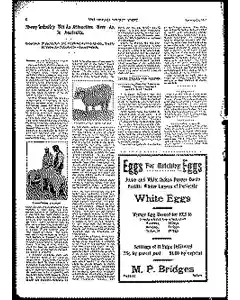
Sheep Industry in Australia and New Zealand Compared
The United States Department of Agriculture reports that in New Zealand and Australia sheep farming operates on range and paddock principles with large, fenced flocks and centralized wool handling. New Zealand uses land intensively with high flock sizes and profitable grazing land, while Australia combines extensive grazing with leasing, security of tenure, and subdivided wool lots to maximize profits.
MENTIONED IN THIS ARTICLE
United States Department of Agriculture
Australia
New Zealand
Department of Agriculture
America
Wyoming
United States
Queensland
New South Wales
Young steers for feeding favor profitable gains
The article urges selecting high quality feeding cattle to match high feed costs. It condemns scrub cattle and robber steers, stressing economy and efficiency. Two year olds are identified as the best feeders due to body build and appetite.
Feeding Steers For Rapid Profits In A Mixed Farm
The guide advises farmers on selecting and feeding cattle for quick, economical gains. Three-year-olds can be used if reasonably purchased, but two-year-olds usually yield faster gains. Buyers favor uniform herds in shape color and breed, so purebred beef males are recommended. Neighbors in corn beef and hog regions should cooperate and follow similar practices. Feed steers off as quickly as possible.
Plan for Great Things and Immortality
The passage urges living life on a grand scale beyond trivial joys. It argues immortality should prompt pursuit of high aims and enduring achievements rather than petty triumphs.
Caplains Flow of Rivers
The easterly direction of America's great rivers is linked to the Andes running north south on the continent's west edge and the east west mountain chain in Europe and Asia guiding river directions.
MENTIONED IN THIS ARTICLE
America
Europe
Asia
Also Mentioned on This Page
Hampshire
Parcel Post
Express
M. P. Bridges
Plainfield
Indiana

 This is just the beginning! Our collection holds over 300 years of history, including rare newspapers, obituaries, marriage records, birth records, and so much more—most of which you won’t find anywhere else!