Jim Beam Bourbon Secret Case Through The Ages
A fragment hints at a 1795 Kentucky secret behind Jim Beam Bourbon. The tale centers on Jacob Beam and a long held mystery about the product’s flavor and craft.

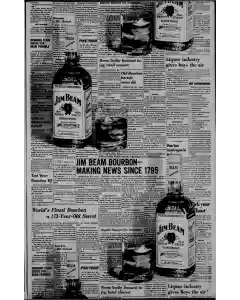
 This is just the beginning! Our collection holds over 300 years of history, including rare newspapers, obituaries, marriage records, birth records, and so much more—most of which you won’t find anywhere else!
This newspaper page contains 20 articles. Subscribers can read the full text of each article.
Newspaper
Independent
Location
Long Beach, California, United States of America
Date
Sep 16, 1968
Page
5
A fragment hints at a 1795 Kentucky secret behind Jim Beam Bourbon. The tale centers on Jacob Beam and a long held mystery about the product’s flavor and craft.
Moscow sources claim that Bourbon is a Russian spirit not American. The piece notes Bourbon’s origins linking to Jacob Beam who reportedly distilled the first batch in 1795, challenging its national identity and traditional status.
In 1966 Sam collected over 2.8 dollars from liquor sales at 10.50 per gallon. That 2.8 billion aids the Federal Government by more than 7 million dollars daily. Consider the vast costs for public health education and space exploration.
A short trivia item presents two questions about bourbon origin and grain usage. The quiz notes scoring: 20 points per correct answer and a perfect score of 80 for top scorers.
FeO Se eee and free water from limestone springs are described as the finest. Beam set out to make Bourbon in this rolling country and he added concepts to the distillation effort.
An advertisement extols Beam Bourbon as a global favorite reflecting six generations from Jacob Beam to Booker Noe. It tells of 173 years of craft and the Beam family's stewardship passing from father to son while praising American spirits abroad.
The text discusses archaic methods to gauge whiskey strength using gunpowder and flame signals. It mentions a younger crowd shifting from rye to bourbon as they mature and hints at the role of water in bourbon distillation.
In Gravel Switch Kentucky the Jug er Not band members performed at the Music Hall. Donald Daisey drew eyes by replacing a jug with a Jim Beam Bourbon bottle to produce a distinctive square shaped tone. He called the bottle sound groovy and sparked talk of a potential sound revolution.
Louisville report notes more than one million bourbon barrels discarded last year and reused by other whiskey makers who value their durability. Describes barrel construction, heat treatment, charring and the role of white oak from the eastern and southern United States in flavor and aging. Mention beam family and origin of Beam bourbon recipe dating to 1795 with choices.
A reporter visits Kentucky to test bourbon aroma, guided by James B. Beam Distilling Co. Beam demonstrates a simple sniff-and-wash test using Jim Beam Bourbon. The article notes various cultural phrases for toast and a Hawaii origin claim, highlighting global curiosity about bourbon.
An advertisement highlights Jim Beam bourbon tracing its heritage back to 1795. The copy emphasizes long history and ongoing branding context for the spirit.
In north central Kentucky, the Beam family has produced Jim Beam Bourbon since 173 years ago. The distillery sits amid limestone springs, fertile valleys, and white oak forests. Fifth generation T Jeremiah Beam cites the use of fresh Jug yeast as key to the better bourbon.
Fragmentary passage discusses Jim Beam Bourbon in Kentucky near Beam limestone spring. It notes hilltop aging, unheated warehouses, and secret rhythms of seasons shaping flavor with patience and time.
The piece surveys how different nations greet with toasts in their own languages. It mentions American, Australian, French Canadian, French, German, Italian, Norwegian, Japanese, and Hawaiian phrases. The tone mimics playful linguistic comparisons across cultures.
In Belle Fourche, South Dakota the liquor industry funds Sky Ranch a flying rehabilitation center started in 1954 by Father Don Murray. The program supports homeless boys through air and ranching training until they reach 18 or their needs are met with industry backing and plans for growth.
In Chicago a short tale explains that true bourbon prestige comes from place climate and a perfected recipe. Jacob Beam is noted for discovering clean iron soil that shaped the early bourbon craft and set a high standard.
A fragmented passage recalls Bourbon as a symbol tied to American identity and historic branding. The text references West German and American spirits, advertising language, and a boast about Bourbon as a defining ingredient, tying drink to national narrative and pride.
In a partial report a small pile of gunpowder and a flare are described. A steady blue flag indicates a course or signal while the text notes the fire is strong and the alcohol content high.
A condensed historical notice reflects on America’s identity and its place in global affairs through concise, era-appropriate prose. The piece emphasizes national values and the broad scope of American influence without detailed events or figures.
A beef bourbonnaise dish with bacon drippings onions mushrooms and round steak is browned then simmered with flour marjoram thyme and beef broth wine vinegar and Bourbon. The mixture cooks two hours plus additional 30 and 10 minute steps, served with noodles salad and bread. For best flavor use Jim Beam Bourbon.
We want people to find what they are looking for at NewspaperArchive. We are confident that we have the newspapers that will increase the value of your family history or other historical research. With our 7-day free trial, you can view the documents you find for free.
People find the most success using advanced search. Try plugging in keywords, names, dates, and locations, and get matched with results from the entire collection of newspapers at NewspaperArchive!
You can also successfully find newspapers by these browse options. Explore our archives on your own!
Browse by location and discover newspapers from all across the world.
Browse by date and find publications for a specific day or era.
Browse old newspaper publications to find specific newspapers.