Our Daily Bread Sliced Thin by The Editor
Editorial brief on the concept of everyday bread thinly sliced by The Editor Alex H Washburn of General Electric.

 This is just the beginning! Our collection holds over 300 years of history, including rare newspapers, obituaries, marriage records, birth records, and so much more—most of which you won’t find anywhere else!
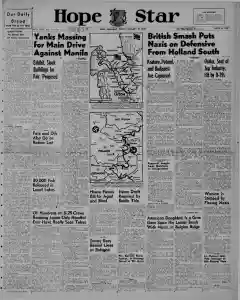
This newspaper page contains 19 articles. Subscribers can read the full text of each article.
Newspaper
Hope Star
Location
Hope, Arkansas, United States of America
Date
Jan 19, 1945
Page
1
Editorial brief on the concept of everyday bread thinly sliced by The Editor Alex H Washburn of General Electric.
The article critiques a Department of Justice anti trust case against General Electric alleging conspiracies with six foreign firms to divide the world’s electric equipment market. It argues that wartime deals with German scientists aided production, accuses the government of targeting private industry, and warns of a drift toward state socialism. It also urges a national manpower conference led by Byrnes and CIO leaders to address shortages and improve efficiency. It notes psychiatric screening for soldiers and references a British diplomat murder case as context.
Hempstead County Fair association building committee voted to seek designs for an exhibit hall and livestock building costing up to 20000 dollars with the county to pay up to one third if the plan is approved. City of Hope expected to cover the remaining two thirds with driveways and utility extensions included. Committee members include Ed Thrash chairman Leo Ray C Q Thomas and Syd MacMath. Basil Edwards and local contractor Basil Edwards to submit sketches.
Washington report notes fats and oils join rationed items under OPA. Retail sales of lard shortening and salad and cooking oils halted until Monday to curb runs while rationing is prepared. Wartime directive directs 40 percent of lard output for armed forces.
About 30,000 fish from Lonoke state hatcheries were released into Hempstead County lakes under Arkansas Game & Fish Commission supervision. Red Lake received 5,000 bass and 10,000 bream and crappies, with Beard's Wire also stocked with the same quantities by E. J. Barham and Lester Wade.
Saipan report recounts B-29 crews who bombed Japan rarely seeing Tokyo beyond outskirts. Capt. Jim Darden recalls Tokyo sighting on a mission to Nagoya. crew later disappeared after Dec 12 raid. Describes flight routines, briefing, and post-momb investigations.
The Arkansas House approved a bill to boost old age, blind and crippled children grants by about one million dollars annually. The 87 to 0 vote backs raising household deficiency allowances from 43 to 100 percent under Welfare formulas. If enacted, grants rise one third and $500,000 would come from welfare fund surplus, matched by federal funds. an appropriation bill will follow.
Rome reports sizable activity behind German lines opposite the American salient ten miles south of Bologna. Fifth and Eighth Army patrols probed enemy positions as the lull on the Po valley fronts continued. German forces in the Adriatic sector drove Eighth Army patrols from outpost positions near the nificia canal two miles west of San Alberto. Eighth Army units reportedly repelled a small enemy bridgehead across the Senio near Fusignano.
A historical note explains that aging is valued in Chinese culture and that it is courteous to assume a person’s age may be greater than stated. The piece discusses politeness in recognizing long life as a sign of wisdom and respect.
Washington reports the army's surgeon general urged drafting nurses to address a 270 percent rise in battle casualty patients. Maj. Gen. Norman T. Kirk testified before the House Military Committee that hospital patients increased from 260000 to 450000 since May while nurses rose only about 2000. He supported President Roosevelt's draft proposal and called for elective service to quickly fill the nursing shortage.
Pfc. Kennen C. Burns of Patmos is listed as missing in action since December 25 in Belgium. He served with the 9th Army, entered service in November 1943, and went overseas in August 1944. His wife Louise Kent and his mother Mrs. Ida Burns reside in Patmos.
Frank Glarney, a 40 year Orchestra Hall doorman, laments casual concert attire. He recalls that attendees once wore formal dress and believes fashions have shifted away from "fancy duds."
Allied forces pressed the German line from Holland to Luxembourg as British troops seized Hangen three miles inside Germany and U S Third Army captured Rosport near Trier. American units held north of St Vith while Dalhunden Stattmatten Dengelsheim fell near Strasbourg as Rhine bridgehead lines shifted under pressure.
London reports Marshal Stalin’s army captured Krakow, 47 miles from the Silesian border, part of a fourth winter offensive that swept 38 miles on a 50 mile front southeast of Krakow. Lodz also entered by a western Polish maneuver as German garrisons withdrew toward the Danube.
President Roosevelt, 24 hours before his fourth term inauguration, quipped that the first 12 years in office were the hardest. He dodged questions on whether this term would be his last. He joked about Vice President Wallace, saying he wouldn’t starve, promising reporters a tip.
John Lillis obtained the 1945 Illinois automobile license plate number 51771. He says when the plate is viewed upside down it reads his surname Lillis, a quirk he has pursued with each renewal.
With the American First Army in Belgium, January 16 Delayed soldiers say they now hate the Germans actively and personally after the Belgian bulge. Prisoners are treated harshly and cigaretttes are no longer handed out as they once were. The 82nd Airborne and a tank commander reflect the shift to a rougher, more determined war attitude.
U S wartime dispatch reports a strong B 29 force bombed Osaka and Kobe in daylight, targeting Honshu industrial centers with several craft from the Marianas. Tokyo affiliates noted some damage while Japanese reports described scattered raids and ongoing air defense actions.
Pravda reports from Warsaw that Germany moved Poland's industry to Breslau and Leipzig while rail freight was blocked by Russian pincers. Airplane and tank factory equipment, bakery machinery, and food processing gear were stolen as tens of thousands were sent west. Churches and castles were looted and the occupation saw executions.
We want people to find what they are looking for at NewspaperArchive. We are confident that we have the newspapers that will increase the value of your family history or other historical research. With our 7-day free trial, you can view the documents you find for free.
People find the most success using advanced search. Try plugging in keywords, names, dates, and locations, and get matched with results from the entire collection of newspapers at NewspaperArchive!
You can also successfully find newspapers by these browse options. Explore our archives on your own!
Browse by location and discover newspapers from all across the world.
Browse by date and find publications for a specific day or era.
Browse old newspaper publications to find specific newspapers.