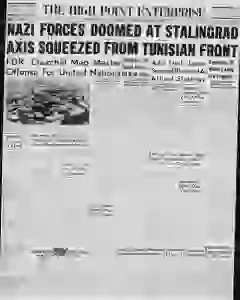
FDR Churchill Map Master Plan for 1943 World War II
A 10 day Casablanca conference forged a master war plan to force unconditional surrender of Germany Japan and Italy. Roosevelt and Churchill agreed on objectives and commanders for future Allied offensives with De Gaulle and Giraud present. Stalin and Chiang Kai shek were kept informed amid spy concerns as top leaders reviewed strategy and decorations were awarded to troops.
MENTIONED IN THIS ARTICLE
Associated Press
Casablanca
French Moroccos
Germany
Japan
Italy
Roosevelt
Churchill
Charles de Gaulle
Henri Giraud
Axis
Joseph Stalin
Russia
Generassimo
Chiang Kaishek
China
Spanish
Morocco
U.S
Casablanca Conference Portraits Highlight Roosevelt and Churchill
At Casablanca a press conference shows President Roosevelt and Prime Minister Churchill aboard the war effort. Generals De Gaulle and Giraud pose in uniform as they discuss plans and armistice efforts. Churchill smokes a cigar while Roosevelt wears a light gray suit.
MENTIONED IN THIS ARTICLE
Casablanca
Roosevelt
Churchill
John J. Pershing
Hitler
Africa
Casablanca Meeting Divides Americans on Its Gains
Washington observers split over the Roosevelt Churchill Casablanca summit with some hailing it as a bold advance and others saying it revealed limited new gains. Officials praised the 1943 war plan and unconditional surrender stance while noting missing leaders and guarded disclosures.
Papuan Victory Seen as Slap at Japanese Forces
Lt. Gen. Robert Echelberger called the Papuan campaign a slap in the face to Japan. He noted Allied casualties were smaller than Japanese losses as the Jap defense failed at Milne Bay, Gona, and Sanananda after a push toward Port Moresby was deterred. The interview highlighted swamp assaults versus Japanese ground prep and automatic weapons.
MENTIONED IN THIS ARTICLE
New Guinea
Sanananda
Robert Echelberger
Port Moresby
Milne Bay
Gona
Persistent rise in living costs worries officials in 1926
Federal observers track a 7 percent price increase over twelve months with the cost level at about 101 for the year 1926. Farm goods lead gains around 11 percent while overall inflation lags behind wartime peaks. Quality declines and black market activity may distort the figures, and O P A relief measures complicate the picture as labor wage demands loom.
Steagall Defends Farmers Against Inflation Charges
Rep Henry Steagall of Alabama told the N C Farm Bureau Federation in Raleigh that farmers seek parity prices fair to rising costs and not inflationary. He noted farmers earn only 25 percent of consumer prices and suffer low prices for what they sell while paying higher prices for what they buy.
MENTIONED IN THIS ARTICLE
Raleigh
Henry B. Steagall
D-Ala
N. C. Farm Bureau Federation
House Committee On Banking and Currency
Broughton
Itep
Harold Cooley
J. E. Winston
Haywood Dail
Greenville
C. L. Daniels
Martin County
George Ross
State Agriculture Department
P. H. Jamison
Paostuorank County
N. C. State College Extension Service
Charles D. Lewis
Washington
East Central
The
AAA
Lewis
Allied offensives squeeze Axis on Tunisian front
Allied communiques report U S forces breaking German defenses in the Ousseltia Valley while the British Eighth Army advances toward the Tunisian border from Tripoli. Reports say prisoners and targets taken along the Kairouan Qusseitia pass and intensified bombing along Rommel’s retreat path.
MENTIONED IN THIS ARTICLE
London
United States
Ousseltia
Eighth Army
Tripoli
Rommel
Kairouan
Qusseitia
Cairo
Zauia
Zuara
Zaara
U.S Army
1Nth
Sicily
Messina
Italy
Jurgen von Arnim
Paris
Mareth
Gulf of Gabes
Tatahouine
Tunisia
Plaster
Hedenine
Zauja
Maknassy
Mareth Line
Gulf
Sfax
Gabes
Sousse
Axis First Japan Second Planned As Allied Strategy
Washington, Jan. 27. Allied leaders Roosevelt and Churchill reportedly agreed on defeating Italy and Germany before Japan. The plan allocates resources among Atlantic European, Russian, and Pacific theaters with actual application left to the combined chiefs of staff.
MENTIONED IN THIS ARTICLE
Axis
Japan
Churchill
Washington
Italy
Germany
Roosevelt
Parliament Expected Quick Action After Casablanca Conference
London observers expect rapid moves after the Casablanca talks between President Roosevelt and Churchill. Members praised Roosevelt for his bold trip and anticipate an early report from the Prime Minister, with Britain hoping for unconditional Axis surrender and a coordinated 1943 campaign.
MENTIONED IN THIS ARTICLE
Casablanca
Roosevelt
Churchill
United Nations
Axis
London
D. R
Mr. Roosevelt
Britain
American heavy bombers strike German naval targets for first homeland raid
United States Army Air Force heavy bombers including Flying Fortresses and Liberators attacked naval installations in Germany in the war's first homeland raid. The exact target area was not disclosed, but U-boat centers were believed to be the focus. The attack came after RAF strikes along Lorient Bordeaux and in the Ruhr and Berlin while Liberators gain prominence alongside Fortresses.
MENTIONED IN THIS ARTICLE
London
United States
Germany
United States Arme
Air Force
Reich
United States Army Air Force
RAF
Lorient
France
Gironde
Bordeaux
Ruhr
Berlin
St. Nazaire
Japs Fire On Planes Over Wake Island Recon Mission
Washington reports American planes over Wake Island were attacked by eight Japanese Zeros on January 25 but returned safely. Two Zeros were believed shot down. Earlier, January 26, B 17 bombers targeted Ballale Island airfield in the Shortlands starting fires in revetments.
MENTIONED IN THIS ARTICLE
Washington
Wake Island
Navy
Wake
Pacific
U. S
South Pacific
Flying Fortress
Ballale Island
Shortland Islands
Senate committee backs Flynn as Australia envoy
The Senate Foreign Relations Committee approved President Roosevelt's nomination of Edward J. Flynn to be minister to Australia and personal representative in the southwest Pacific. The 13 to 10 vote included three Democrats joining seven Republicans against confirmation, sending the nomination to the Senate with opposition over Flynn's ties and past political roles.
MENTIONED IN THIS ARTICLE
Senate Foreign Relations Committee
Roosevelt
Flynn
Australia
Washington
Edward J. Flynn
Southwest Pacific
George
D-Ga
van Nuys
Dind
Gillette
Iowa
Senate
Johnson
Calif
Capper
Kas
Vandenberg
Mich
N. Y
New York
Clark
D-Mo
Hatch
DNM
Remnants Of Hitler's Army Trapped At Stalingrad
London datelined report says 12 000 German troops are encircled in two pockets before Stalingrad. Russians claim 40 000 killed and 28 000 captured since Jan. 10, with liquidation expected within two to three days. The front runs from Voronezh to Armavir as rail lines reopen for Soviet supply. The 534th infantry surrendered, while parts of the 669th were wiped out.
MENTIONED IN THIS ARTICLE
London
Stalingrad
Hitler
Red Army
Monitor
Entire German Regiment Surrenders at Stalingrad Trap
The 534th German regiment surrendered to Soviet forces in the Stalingrad pocket, with detachments of the 165th infantry reportedly wiped out. Moscow also claimed advances on other fronts, including captured towns and large stockpiles of weapons as they encircled German units on the Voronezh front.
MENTIONED IN THIS ARTICLE
Sovut
Voronezh
Don River
Armavir
Upper
Caucasus
Rostov
Red Army
Stalingrad
London
534Th
Also Mentioned on This Page
Fdr
William H. Wilbur
Henri Honore Giraud
Giraud
de Gaulle
Roosevelt-Churchill
Washington Today
Nye
R-Nd
Chiang Kai-shek
Wheeler
D-Mont
Vern Haugland
ALAI
By Ray Tucker
Rep
Steagall
By John M. Hightower
James King
Upper Caucasus
Salsk
Tatsinskaya
Povorina

 This is just the beginning! Our collection holds over 300 years of history, including rare newspapers, obituaries, marriage records, birth records, and so much more—most of which you won’t find anywhere else!