
 This is just the beginning! Our collection holds over 300 years of history, including rare newspapers, obituaries, marriage records, birth records, and so much more—most of which you won’t find anywhere else!
Aerial Giants Redefine Travel and the 1930 Air Era
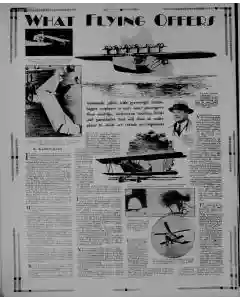
The year 1929 marks rapid aviation advances from airships to transcontinental flights. The Graf Zeppelin proved oceanic travel by airship, while refueling in flight extended airplane endurance. By 1930 safer airliners, autogiros, and automatic pilots promise smaller airports and possible rooftop landings, with plans for a floating Atlantic airport and more passenger planes.
MENTIONED IN THIS ARTICLE
Dale Jackson
Forest O'Brine
St. Louis
Guggenheim Safe
America
Airways of America
Aeronautic
U. S. Department of Commerce
Germany
Graf Zeppelin
Nansen
England
Kever