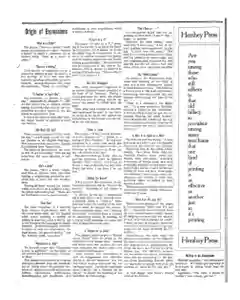
Origin of Expressions: dad as a hatter and mad as a hatter
The saying dad as a hatter is linked to venomous vipers and adder myths. Mad as a hatter traces to an ancient form mad as a hatter or adder, suggesting fevered or irrational behavior.

 This is just the beginning! Our collection holds over 300 years of history, including rare newspapers, obituaries, marriage records, birth records, and so much more—most of which you won’t find anywhere else!
This newspaper page contains 20 articles. Subscribers can read the full text of each article.
Newspaper
Hershey Press
Location
Hershey, Pennsylvania, United States of America
Date
Oct 22, 1909
Page
2
The saying dad as a hatter is linked to venomous vipers and adder myths. Mad as a hatter traces to an ancient form mad as a hatter or adder, suggesting fevered or irrational behavior.
The phrase Dead as a herring arose among fishermen after noting that herrings die rapidly when removed from water making live observation difficult.
A saying tracing to Hungary in 1509 says no feather in a hat was allowed unless the wearer had slain a Turk. The rule allowed one feather per Turk slain, reflecting a martial custom of the time.
An article notes the origin of the phrase not worth his salt tracing to Roman salarium from Latin salarium and connects to the modern word salary. It explains the phrase’s long lineage and link to pay in ancient times.
A ruler visiting a neighboring principality asked to see fortifications. He waved to his troops, saying these are my fortifications every man is a brick. The quote links the line to the hosts and their soldiers in a soldierly array.
An etymological note explains that scot derives from sceot meaning tax share, once linked to payment obligations. In modern usage scot relates to two phrases, pay scot and rot and the common term scot-free.
The essay traces the proverb cleanliness is next to godliness to an Isaiah commentary. It claims the maxim summarizes practical religious doctrines including carefulness vigor guiltlessness abstinence and cleanliness as core duties.
A phrase linking cleanliness and godliness to holiness appears, framing moral virtue as a spiritual path. The wording suggests a tradition of purifying conduct to achieve sacred standing.
The phrase it suits to a T means it fits exactly and traces to the T shape of the T-square used by draftsmen. Dr. Johnson’s era is cited by Boswell with a Wharburton remark about fitting him to a T.
The article explains the origin of scapegoat from Hebrew Passover practice. Priests placed sins on a young goat at the altar after individuals laid on hands. The goat was then released into the forests to be killed by wild beasts.
Saint Ambrose explained the saying when consulted by a Milan woman about Friday or Saturday fasting. He noted he fasts on Saturdays in Rome but not when he is elsewhere, illustrating context matters in following local customs.
The article notes two theories for the origin of the saying about death by hanging. One links it to a pig carcass suspended by a bent wood device called a bucket. The other ties it to death by one’s own action from standing on a bucket to adjust a noose and then kicking away the bucket.
The saying Roland for an Oliver traces to medieval romance where Roland and Oliver, two legendary peers of Charlemagne, were depicted in far exaggerated tales. The expression grew to mean matching one extravagant lie with another.
An explanation argues the phrase I dont care a damn is not profane and traces damn to a two cent coin once common in India. The expression meaning evolved to convey indifference as I dont care two cents. The origin highlights currency as the measure of care.
An official of the Smithsonian Institution explained the origin of the phrase showing the white feather. He described a French gray wheatear with a drab breast black wings and a small white tail spot. The bird is common in Scotland where it is called clacharan and the expression comes from its visible white feathers in flight.
In a Turpin tale set before Charlemagne, two friends Amis and Amile endure peril and sacrifice. Amile saves Amis at risk to life and fortune, and Amis allegedly sacrifices his children to cure Amile of leprosy. The tale explains the proverb's meaning and endurance.
Two origin tales explain the expression Mind your P s and Q s. One links it to pub credit where P stands for pint and Q for quart, with weekly tallying. The other attributes it to printers confusion between lowercase P and Q in Roman type.
A veteran well digger asserts ample space beneath the surface for new shafts and deeper wells. He notes ongoing demand from farmers and smallholders seeking reliable groundwater access despite cost. He urges careful inspection of soil and geology before digging.
The Hershey press unit reports a tightened budget as revenue slips and costs rise. Officials say actions to cut expenses and preserve operations are underway to stabilize the newspaper’s future.
An applicant argues that taking odd jobs would not harm anyone, while the employer resists, saying it would steal work from his own men. The exchange reveals social attitudes about labor and scarcity in a historical workplace.
We want people to find what they are looking for at NewspaperArchive. We are confident that we have the newspapers that will increase the value of your family history or other historical research. With our 7-day free trial, you can view the documents you find for free.
People find the most success using advanced search. Try plugging in keywords, names, dates, and locations, and get matched with results from the entire collection of newspapers at NewspaperArchive!
You can also successfully find newspapers by these browse options. Explore our archives on your own!
Browse by location and discover newspapers from all across the world.
Browse by date and find publications for a specific day or era.
Browse old newspaper publications to find specific newspapers.