Lydia E Pinkham Remedy Proved Helpful for Women
Chicago woman describes relief from displacement and irregularities after using Lydia E Pinkham Vegetable Compound and Sanative Wash. She reports restored energy, ability to do housework, and three healthy children. The letter promotes the remedies and offers free advice from the Pinkham Medicine Company in Lynn Mass.
MENTIONED IN THIS ARTICLE
Chicago
Lydia E. Pinkham
A. Kwaneuski
W. Oakdake Ave
Dia E. Pinkham Medicine Co
Con Lynn
Mass
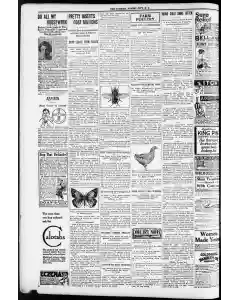
Pretty Insects Cost Millions In Alfalfa Losses
A rancher cites a yellow butterfly as a major alfalfa pest costing Arizona and California farmers about 1 million dollars annually. The piece, drawn from USDA Farmers Bulletin 1004, explains the alfalfa caterpillar lifecycle and control methods including irrigation to trigger disease, cutting alfalfa, disking fields, and dragging to crush pupae and larvae.
MENTIONED IN THIS ARTICLE
Arizona
California
Kansas
Oklahoma
Texas
Rembrandts
United States Department of Agriculture
Department of Agriculture
Alfalfa Caterpillar Life Cycle and Damage Explained
The text describes the alfalfa caterpillar in adult and larval stages, its leaf stripping damage, and how disease, moisture, and predators affect populations. It notes worm coloration, size, and the impact on alfalfa yields, with examples of natural enemies like birds and flies.
Best Practice With Clover For Seed Preservation
The clover should be cut when the seed is in the dough and well cured, then raked up early and stored. Some growers leave the cut clover in swaths for weeks risking wet weather loss, but better practice is to haul to barn and hull the seed when cold and dry. Clover chaff provides good stock bedding and grain may be top-dressed with the chef.
Hessian fly outbreak warned for 1921 across early planted wheat
Shortage of farm labor and bad weather at planting last fall led to heavy Hessian fly infestation in most early planted wheat. Authorities urge winter wheat growers to unite in applying approved control methods during summer and fall 1920 to avert a likely disastrous outbreak in 1921.
Farm Poultry: Break Broodiness With Small Raised Coop
A United States Department of Agriculture poultry specialist advises confining a broody hen to a small raised coop with a flat bottom to break broodiness quickly. Typically three to six days suffice, though some hens need 10 to 12 days, with water available and feeding optional. Indicators include night nesting, feather ruffling, aggression, and clucking. disappearance signals recovery.
MENTIONED IN THIS ARTICLE
United States Department of Agriculture
Poultry Choice Varies With Farm Type and Resources
The hen remains the main source of white meat and eggs on farms, but turkeys, guineas, geese, and ducks also aid production. Standards like 100 hens per farm are safe but not universal for other poultry. The suitability of turkeys or ducks depends on water access and land features. each farm must determine profitable poultry mix while maintaining adequate numbers of all kinds for free range.
MENTIONED IN THIS ARTICLE
United States Department of Agriculture
Food supply for chickens and balanced feed notes
The article explains three key feed constituents mineral nitrogenous and carbonaceous present in corn wheat oats and barley but not in ideal proportions. It emphasizes supplementing animal feed and green feed for economic poultry production. United States Department of Agriculture.
MENTIONED IN THIS ARTICLE
United States Department of Agriculture
Splendid Garden Results From Rich Soil
An agricultural note extols the yield from a well kept farm garden. It argues continuous cultivation prevents dry, baked patches and keeps all soil busy through the season, making the garden attractive and productive.
Poultry Care Tips For Egg Power And Clean Nests
Poultry note advises one nest per four hens to keep nests clean and reduce egg costs caused by chicken mites. For summer, skim milk or buttermilk is beneficial. Sell, kill or confine all male birds after hatching season. A good cockerel is valuable though poor birds are costly. For egg production only, White Leghorns or Anconas are recommended. Whitewash poultry house annually, possibly twice a year in fall and spring.
MENTIONED IN THIS ARTICLE
Poultry House
Nitrogen needs for leafy vegetables and seed crops
Vegetables grown for foliage such as cabbage collards lettuce and spinach require large amounts of nitrogen. Crops that yield many seeds but little foliage, like the tomato, need mainly phosphorus.
Young child bitten by venomous snake in Mount Airy
In Little Mountains, a 14 month old boy was bitten twice by a venomous snake entering Roy Venable’s house while parents worked in the garden. He was rushed to a local hospital where doctors held out small hopes of saving him as peach growers report a record crop and early varieties being sold.
MENTIONED IN THIS ARTICLE
Mount Airy
Roy Venable
Little Mountains
Also Mentioned on This Page
Mrs. Kwarcinski
Bayer
Bax
Bright
Izzy
North Carolina
Perry
Doan
Oster-Milburn CO
Buffalo
Calomel
Eczemat
Wade Sliteaiene
Eczem
Plymouth Rock
Asheville
Hannah R. Herndon
Zebulon B. Vance
Robert Vance
Washington
Central Methodist Church
Salisbury
Johnsie Colt
Columbia University
Elon College
Charles H. Stephenson
Raleigh
Bessie Holt
Burlington
Sunday School and Christian Endeavor Convention
The
North Carolina Christian Conference
Wilmington
Hugh Owen
Tidewater Power Company
Winter Park
Sanford
Seaboard Air Line Railroad
J. B. King
King
Seaboard
Southern
Atlantic Coast Line
Bristol
Tenn-Va
Harry J. Runser
Roscoe Turner
Big Stone Gap
Winston-Salem
Southern Newspaper Publishers’ Association
Association
James H. Allison
Fort Worth
Lincolnton
Hickory
Durham
Camp Glenn
North Carolina National Guard
Ararat
County Board of Commissioners
New Bern
R. B. Lane
Craven County
W. P. Hilton
Norfolk
Allens
Aki Os
Senge Patarsa
D JR
Ame
Wenn
Crush
W. F- Young, Inc
Temple
Lyell King Pin Chewing Tobacco
Fletcher
Ynaraies
Isis

 This is just the beginning! Our collection holds over 300 years of history, including rare newspapers, obituaries, marriage records, birth records, and so much more—most of which you won’t find anywhere else!