Invasion Opens New Chapter For Torn France
The Allied invasion of France signals a bold new phase in World War II as American and British forces join with Canadian and other troops. Eisenhower’s D Day plan launches a decisive effort to breach Hitler’s Atlantic Wall and strike toward Berlin, echoing the great battles of earlier eras and reshaping the war’s course.
MENTIONED IN THIS ARTICLE
Warsaw
Dunkerque
Pan
France
Dwight D. Eisenhower
Maine
California
Lafayette
Paul Reynaud
Atlantic
Berlin
Adolf Hitler
Belgium
Napoleon
Hitler
Germany
Poland
Henri Philippe Petain
Verdun
Marne
Petain
Britain
Vichy
America
Congress
United States
Enem
Toulon
English Beachhead at Calais Won Hundred Years War
An account of Edward III and the 1346 Calais invasion establishing a lasting English foothold. The narrative notes English advantage from trained archers and strategic moves, then the French counter with iron shot, ending with Calais remaining under English control for a century beyond the main war.
MENTIONED IN THIS ARTICLE
Associated Press
England
France
Calais
Edward VII
Portsmouth
Edward
Barfleur
Rouen
Paris
Palais
Britain
Marines Speak 39 Languages In Roi Namur Survey
Enlisted men of the Fourth Marine Division in the Marshall Islands report a remarkable linguistic range after fighting at Roi and Namur. More than 1,000 Marines surveyed claim fluency in 39 languages, illustrating broad multinational exposure and communication prowess within the unit.
MENTIONED IN THIS ARTICLE
Pacific
Fourth Marine Division
League of Nations
Roi
Namur
Marshall Islands
Egypt Fertile In History
Egypt yields richer history than any land for future historians. The article notes vast excavations in the Nile valley and references ancient Nazi legions in shifting sands. It states about 100000 deaths occur yearly from accidents and mentions Kapok's capacity to support thirty times its weight in water used in life saving gear.
MENTIONED IN THIS ARTICLE
Egypt
Valley of the Nile
Allied Invasion Backed By Five Years Of Planning
The Allied invasion of western Europe rests on nearly four years of prep after Dunkirk. From 1940 to 1944 Britain fortified home defense and prepared for a continent-wide assault. By 1943 to 1944, German defenses and Allied forces hardened, with air, sea, and ground plans converging toward a decisive June invasion.
MENTIONED IN THIS ARTICLE
Paul Kern Lee
Associated Press
Western
Europe
Britain
France
Dunkerque
RAZ
Germany
Ireland
Winter 1941 42 Was Fateful Era For Adolf Hitler
The article analyzes Hitlers strategic shift during the 1941 42 winter, noting a buildup of coastal fortifications along 500 miles from Brest to Dieppe, and heavier troop concentrations inland to defend Germany. Evacuations of civilians from Marseilles and the southern coast are described as part of German defense preparations.
MENTIONED IN THIS ARTICLE
Adolf Hitler
Fred L. Strozier
Associated Press
Myppter
Ece Aes
Adolf Hit
England
Ivan ToPesa
Soviet Russia
Moscow
Hitler
France
Low Countries
Norway
Brest
Brittany
Peewee
Holland
Calais
Boulogne
Dieppe
Europe
Marseilles
Germany
Meuse
Aisne
Soldier Uses Self As Mosquito Bait At Camp Davis
Cpl. Walter Stevens volunteers as human mosquito bait for the medical inspector's office. He spends three nights a week for 15 minutes exposing his leg to attract mosquitoes, which are captured, examined, and identified in the lab. Malaria risk from bites is described as remote by medical staff.
MENTIONED IN THIS ARTICLE
Camp Davis
Freezing Stops Landslide at Grand Coulee Dam
During dam construction workmen drove six miles of pipes into the earth and filled them with sea salt brine to freeze a threatening landslide, stabilizing the hillside and enabling continued work on the project.
MENTIONED IN THIS ARTICLE
Grand Coulee Dam
Fortified Frontiers Hold Line Across Northern Europe
The river and the Alps grip the northern front from the Rhine to the Swiss border. The Maginot line along the old French frontier stands as a major aid for defense with proof shelter for men and supplies. Within Germany the Siegfried Line extends to the North Sea as a last-ditch fortress defending the nation.
MENTIONED IN THIS ARTICLE
Alps
Old Rhine
Maginot Line
Germany
West Wall
Siegfried Line
North Sea
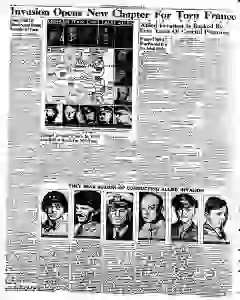
Portraits of Allied invasion leaders in North Africa
A mosaic sketch profiles Omar Bradley, Harold Stark, Carl Spaatz, and Arthur Tedder, detailing their roles in the North Africa invasion and their contrasting styles. Bradley is praised for tactical skill and grit, Stark for steady execution, Spaatz for air power insight, and Tedder for strategic calm and long view. The piece highlights their careers, temperaments, and impact on allied operations.
Also Mentioned on This Page
Carl C
TIN
Eire
Spain
Great Britain
Algeria
Austria
Yugoslavia
Romania
Turkey
Etra Shrer
Amerien
Northern
Vry
BSP
lDieppe
West
Europi
Dwight D. Risenhow
Mander
Teheran
Erwin Ronmel
British Isles
Omar N. Bradley
Goa
Mateur
Bizerte
Point
Command and General Staff
Rominei
Harold R. Stark
U. S
Sterk
Loiz
U.S. Naval
Leutenant
North Africa
Tunisien
Carl Spaatzi
U.S
Jett A. & Tor
Air
Arthur Tedder
Miet
Spier
New South Wales
Royal Navy
RAF
Jose Wid
Eer
Mont
Foie
Risa
Emiditest

 This is just the beginning! Our collection holds over 300 years of history, including rare newspapers, obituaries, marriage records, birth records, and so much more—most of which you won’t find anywhere else!