Evansville Journal Classified Terms and Rates
Evansville Journal notice outlines weekly publication schedule and class ads terms. Advertising charges include 100 for three insertions of 12 lines and 25 cents for each continuance.

 This is just the beginning! Our collection holds over 300 years of history, including rare newspapers, obituaries, marriage records, birth records, and so much more—most of which you won’t find anywhere else!
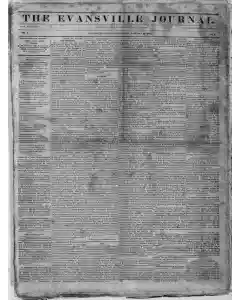
This newspaper page contains 17 articles. Subscribers can read the full text of each article.
Newspaper
Evansville Journal
Location
Evansville, Indiana, United States of America
Date
Jan 25, 1844
Page
1
Evansville Journal notice outlines weekly publication schedule and class ads terms. Advertising charges include 100 for three insertions of 12 lines and 25 cents for each continuance.
A partisan sheet favoring Harry Clay parodies rivals including Tyler Van Buren Calhoun and Cass with lines mocking their policies and loyalties. The poem frames a political race as a stage show urging support for Clay while lampooning other candidates and factions.
An 1830s style political speculation argues Henry Clay should be elected president, likening rival Locofocos to ancient Grecian captains and Themistocles. It recalls Plutarchs tale of nominations at Salamis, urging party pride to favor Clay for wisdom and leadership over rivals Jackson and others.
Washington correspondent for the Boston Post reports the fall member from Illinois drew the most attention on a Wednesday night. He stretched legs into the pit, causing disruption until police advised him to move or buy another ticket. An English lady and her black maid faced repeated insults from a Jamaican vendor and a slave-like remark prompted chagrin.
A New York Sun reader is urged to read Frances Harriet Whipple’s The Mechanic. The review celebrates the heroine’s respect for hardworking men, and the hero Victor who chooses architecture over bar life, arguing true dignity rests in labor and honest purpose. The passage highlights class, gender, and moral worth.
A plea for educated farming and motherly influence. The author argues farmers should train scientifically minded children, historians of agriculture, and uphold women’s reading to foster an intelligent community. He laments urban drift and urges rural steadiness for national health and progress.
A May issue essay praises the farmer's wife for mastering domestic duties and cooking yet argues for her broader role. It lauds neat, lively service and urges women to read and share knowledge to uplift family minds and future society members.
A rural reader defends borrowing newspapers as theft of rights from the printer and neighbors. The piece laments borrowing and urges immediate subscription to support press rights and information access. A second item recounts a New Year’s kissing incident involving Mick Mahony, Biddy Mahony, and Nancy Donahoe, before a Recorder who discharges them after humor-filled testimony.
A new publication named the Communitist starts in Mottville, Onondaga County, New York, as the organ of a new society of philosophers. The extract hints at a belief in equal human rights, shared earth’s resources, and rejection of buying selling and all established sects and governments as ignorance and superstition.
A nocturnal exchange at Hewlett's Hotel features Hannibal praised by a waggish guest for his greatness, with Hannibal replying he cannot outshine white folks but can outshine the speaker in footing and pride. The scene ends with Hannibal flashing his teeth as the guest jokes about steadiness.
A Western 7-A paper recounts a widower at his wife’s grave in tears saying he has lost hogs and cows but nothing cut him up like thisMoment captures rustic sorrow and stoic humor in a single grave scene
A fragment describes Barcelona as once grand with 170000 residents and busy trade with Africa England and the Levant. Revolution left the city ruined, warehouses deserted, the cathedral desecrated, 30000 families displaced, and many refugees seeking aid in France while others endure famine bombardment and looting.
A riverboat crew and a rafter converse aboard during a voyage seeking a Wheeling stop. The exchange touches on law, fire department actions, and keeping plans secret while moving a hidden store box along the gangway. The captain and rafter share terse, shifting intentions as the scene ends with a cryptic departure.
The Philadelphia U S Gazette lauds William Penn Chandler for retiring from the Wilmington Gazette. It calls him a competent Locofoco editor and questions the rewards of the editor’s life while wishing him success in future pursuits.
Young Parisian women now take on clerical duties in counting houses and banks. Grant notes that they are steadier and more attentive than men, with two daughters of a leading partner seen at work. The trend extends to public offices as the government adopts young women for tasks.
Col Ussey of De Soto Parish says he tested a cancer remedy sent by a local countrywoman. The method uses an egg yolk mixed with salt applied in a plaster for several hours. He reports success in two family trials.
A bill introduced in the Tennessee Legislature proposes forming a new state from East Tennessee. The measure names the new state and outlines proposed county cessions and potential additions from surrounding states to reach a viable territory.
We want people to find what they are looking for at NewspaperArchive. We are confident that we have the newspapers that will increase the value of your family history or other historical research. With our 7-day free trial, you can view the documents you find for free.
People find the most success using advanced search. Try plugging in keywords, names, dates, and locations, and get matched with results from the entire collection of newspapers at NewspaperArchive!
You can also successfully find newspapers by these browse options. Explore our archives on your own!
Browse by location and discover newspapers from all across the world.
Browse by date and find publications for a specific day or era.
Browse old newspaper publications to find specific newspapers.