Defense fallacies in Roosevelts grand plan for total defense
General discussion in Washington argues that the Presidents defense program lacks a solid plan and realistic timelines. It criticizes the rapid, uncoordinated defense spending, warns against overreliance on blank checks, and questions the feasibility of arming 2,000,000 men and 19,000 aircraft. The piece cautions against inviting foreign war while promising self reliance.
MENTIONED IN THIS ARTICLE
Washington, D. C
Roosevelt
Congress
Hemisphere
Equator
Cape Horn
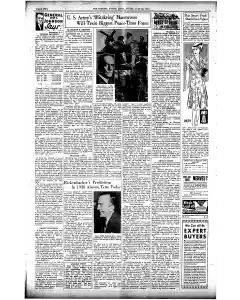
Mobilization for biggest peacetime war maneuvers
The article reports a vast 1940s mobilization with 310,000 troops from 12 states assembling for large scale exercises in four regions including Camp McCoy Wisconsin and Plattsburg New York. It notes mixed use of motorized, mechanized, air, and rail transport, plus a 560 mile mechanized march of the Seventh Cavalry brigade from Fort Knox to Camp McCoy and emphasizes reliance on both firepower and trained foot troops.
MENTIONED IN THIS ARTICLE
Regular Army
National Guard
Plattsburg
N. Y
St. Lawrence River Valley
Louisiana
Minnesota
Washington
Camp McCoy
Wisconsin
Stanley H. Ford
Seventh Cavalry Brigade
Fort Knox
Adna R. Chaffee
Wisconsin Maneuvers
Ford
Ife
Utah
Florida
Francis Townsend
Bee
Philadelphia
McNutt
Townsend
James Mead
New York
Adolph Sabath
House Rules Committee
John F. Carruthers
National Small Business Research Bureau
James G. Daly
National Small Businessmen’s Association
National Committee
John Raskob
al Smith
Bolter
Raskob
Farley
Evie Robert
Mack
National
Virgin Islands
Alice Longworth
Forrest Davis
Taft
Texas
Mississippi
Montana
Jim Farley
Ann
Chicago
Oa Seg
Rickenbackers Prediction In 1930 Almost True Today
The article recalls Eddie Rickenbacker’s 1930 forecast of coast to coast air travel in 1940 and a 13 hour 40 minute Stratoliner flight in 1947. It notes the inaugural flight averaged 11 hours 45 minutes with 248 mph, two stops, 15 passengers, and a Kansas City fuel stop.
MENTIONED IN THIS ARTICLE
Eddie Rickenbacker
U. S
Rickenbacker
Kansas City
Washington
D. C
Sunday Star
Transcontinental and Western Air Line
Four Trading Blocs Shape Postwar World Debate
Roosevelt aides warn that after World War II the globe may divide into four trading areas led by Japan China Germany Russia and the United States with trade controlled by governments. The piece contrasts options for the U S including subsidies, wage cuts, or establishing a government monopoly as seen in Nazi and Soviet models.
MENTIONED IN THIS ARTICLE
Shington
D. C
Roosevelt
Germany
Japan
China
Europe
Russia
United States
Canada
South America
Rio de Janeiro
Buenos Aires
U. S
New Deal
Smart Frock Slenderizes Figure for Bridge Parties
Ad describes Pattern No. 8679 a slenderizing dress with high cut front panel and waist flattening effect. It highlights gathers at the waist and yoke, bow at neck, plain slim skirt with moderate fullness, fabric options chiffon georgette voile lace ruffles. Sizes 36 to 52 and yardage for size 38 given. Send orders to the address.
Restrictions on child refugees from England face question of care
The piece argues for removing legal barriers to housing English child refugees in America and weighs the seasonal adoption pattern of homeless children. It notes institutions often reclaim children after holidays, questions future outcomes for refugees, and highlights public willingness to bear costs and responsibilities.
MENTIONED IN THIS ARTICLE
England
America
Iin
Spanked Wives Club Reported in Sioux City
Sioux City, South Dakota reports a new group called the Spanked Wives club led by Mrs. Lora Lane. The club consists of wives who describe spankings by husbands as part of a happier home life.
MENTIONED IN THIS ARTICLE
Spanked Wives
Sioux City
S. D
Spanked Wives Club
Lora Lane
Also Mentioned on This Page
General Hugh's
Johnson Jays
Dr. Cone
Tyaih
Biegee
Milton R. Kenton
Western Newspaper Union
Sewing Circle Pattern Dept
Wacker Dr
Lydia E. Pinkham
WNU
Iself

 This is just the beginning! Our collection holds over 300 years of history, including rare newspapers, obituaries, marriage records, birth records, and so much more—most of which you won’t find anywhere else!