Carter shifts focus to human rights and marijuana decriminalization
The Carter administration moves toward decriminalizing small possession of marijuana while expanding human rights rhetoric. Dr. Peter Bourne says penalties branding otherwise law abiding people for life are ineffective. A survey shows 30 million Americans have tried marijuana, a reality unlikely to vanish regardless of policy changes.
MENTIONED IN THIS ARTICLE
Carter
Mr. Carter
Peter Bourne
Office of Drug Abuse Policy
Los Angeles
Edward Davis
America
Positive Action In South Africa Promotes Equal Employment
Eleven major U.S. firms announce plans to end racial segregation in their South African operations. They pledge fair employment, equal pay for equal work, non white training, and integrated facilities to show American social and economic justice can be exported.
MENTIONED IN THIS ARTICLE
South Africa
U.S
South Afican
Nuclear waste fears debunked by Ralph de Toledano
In a response to reader John Sheldon, Ralph de Toledano argues that environmentalists exaggerate nuclear waste dangers. He claims U S disposal has been safe, notes ERDA cites three fixation methods, and asserts overall environmental impact would be favorable. He dismisses anti-nuclear campaigns as fear tactics despite scientific data.
MENTIONED IN THIS ARTICLE
Washington
John Sheldon
Savannah
Mr. Sheldon
United States
John Sheldons
Energy Research and Development Administration
Erda
Weouid
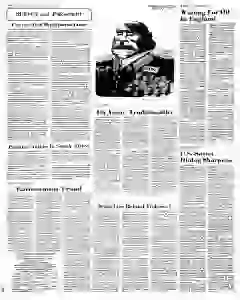
Idi Amin and Shaka Compared in Colonial Legacy Analysis
The piece argues Amin is a traditionalist figure aligned with 19th century African chieftains like Shaka. It asserts genocidal acts and ethnic expulsions as a continuation of “barbarian” Third World stereotypes, framing Western civilization as retreating while Amin sits in the mainstream of the era.
MENTIONED IN THIS ARTICLE
Idi Amin
Amin
Uganda
Stalin
Hitler
Mao
Tamerlané
Genghis Khan
Nigeria
Sudan
Angola
Mozambique
Bangal Desh
Indonesia
Amin 5
Arica
Napoleon
Shaka
Donald Morris
Usanda
Somme
West
Idi Austin
Violence warnings and the Hanafi crisis examined
Carl T. Rowan condemns a culture producing violence while recounting the Hanafi hostage siege in Washington. He credits police leadership and foreign diplomats for ending the 39 hour crisis. He links poverty, hunger, poor schooling, and a biased justice system to rising violence and calls for reform.
William Buckley Jr Sees Oil Change in England's Mood
William F Buckley Jr argues Britain faces gloom from inflation and high taxes that erode middle class gains. He warns socialism, Marxist outcomes, and heavy taxation threaten private property as North Sea oil nears, potentially altering the national character and economic fate.
MENTIONED IN THIS ARTICLE
London
Great Britain
Rhodesia
Robert Moss
Economist
Britain
Karl Marx
North Sea
Human rights issue sharpens U S Soviet dialogue
Charles Barnett assesses Carter's use of human rights in East West talks. Soviet writers mock Western life while defending their system, yet face internal repressions and Eurocommunist critiques. The piece notes U S emphasis on rights as a defining moral stance.
MENTIONED IN THIS ARTICLE
Washington
Carter
United States
Moscow
Gus Hall
Hall
West
Czechoslovakia
Gustav Husak
Poland
Madrid
Spain
France
Italy
Kremlin
Santiago Carillo
Soviet Union
Geoges Marchsis
Todor Zhivkov
Mitovan Dijilas
Lenin
Valentin Zorin
Hubert Humphrey
Also Mentioned on This Page
Ralph de Toledano
Danville
the Register Publishing Co., Inc
Union St
Jeffrey Hart
Africa
Cetshwayg
Carl T. Rowan
Stort
Egypt
Pakistan
Iran
Ohio
Cory Moore
Charles $. Treland
Howard University Hospital
Reader's Digest
Spiro Agnew
Richard Nixon
William F. Buckley Jr
England
Communist Party
Charles Barnlett

 This is just the beginning! Our collection holds over 300 years of history, including rare newspapers, obituaries, marriage records, birth records, and so much more—most of which you won’t find anywhere else!