Printing Office Adverts Warn of Low Rates
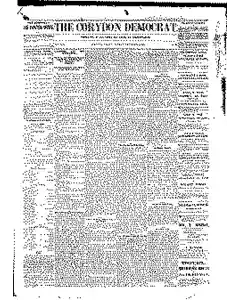
The Democrat Job Printing Office announces a large printing establishment offering all kinds of work at very low prices. Wills of all kinds will be neatly executed on short notice.

14 Sep 1880
Page 1
 This is just the beginning! Our collection holds over 300 years of history, including rare newspapers, obituaries, marriage records, birth records, and so much more—most of which you won’t find anywhere else!
This newspaper page contains 13 articles. Subscribers can read the full text of each article.
Newspaper
Corydon Democrat
Location
Corydon, Indiana, United States of America
Date
Sep 14, 1880
Page
1
The Democrat Job Printing Office announces a large printing establishment offering all kinds of work at very low prices. Wills of all kinds will be neatly executed on short notice.
The fragment notes subscription and ad rates with unclear words. It mentions payment deadlines and charges for notices and advertisements, indicating local notices and transient ads with inconsistent wording and potential editorial marks. The readable items include rates and timing references, but many details are garbled.
Directory lists district offices led by lon George AO Bicknell and others, with county roles for Sheriff Jewis Bowling and Coroner Brewster. It notes the Superior Court meeting pattern, post routes, and daily mail departures from Corydon to towns like Leavenworth and New Albany on specified days and times.
A commissioned interview with Jos H. Sheppard, superintendent at Franklin Landers' park house, reveals wages paid and raises linked to avoiding a strike. He states last winter’s pay was 1.95 and notes rivals paid 1.25, with a 10 cent raise for labor and 25 cents for knife men. the motive cited is political manipulation amid Indiana's 1880 campaign.
The piece rails against Republican leaders courting Black voters to undermine Indiana, praising a united Democratic front. It lists speakers, predicts decisive October victory, and denounces Republican lies as the Democratic cause intensifies across the state. It also reflects on public duties, progress, and civic responsibility.
A narrator recalls hearing two boys claim the world owes them a living. One, Ton Jones, has never worked and remains a burden to his parents, while the narrator reflects on idle, miserable people who benefit from others’ prior efforts and questions such a stance.
In Bloomington Illinois General Grant recalled his spring trip through the Southern States from Philadelphia to Florida and Havana returning via Texas. He noted hospitality and shared Union colors across recently rebellious states praising loyalty to the flag and rights for all. Critics in Chicago crucified Grant and used the "bloody shirt" to rally campaign sentiment.
The 1880 wheat crop is projected near 480 million bushels, up 30 million from 1879. After allowances for food and seed, exports should exceed 190 million bushels. The foreign crop is generally strong, though Russia may ship less than last year. A low U.S. price is expected but harms English farmers more than Americans. The London Telegraph notes American exports can undercut English costs at Liverpool.
The American Agriculturist says a surplus around 200 million bushels could be marketed abroad. This would push British farmers to abandon wheat growing and increase dependence on American supplies. A good wheat crop favors American growers overall.
Postal cards once mocked for being stingy and shabby now dominate a market shrinking writing paper by 12 to 15 million dollars annually. Holyoke Massachusetts employs about forty workers making three thousand card sheets that yield forty postals each. Three presses run continuously as sheets are slit and cut into cards, packed by girls, with a government officer guarding against pilfering. the factory prints about one million cards daily.
A young man sought an easy position from Rev Henry Ward Beecher. Beecher warned against easy roles and listed many trades to avoid. He then stated there is only one truly easy place in the world, the grave, underscoring the value of honest work over shortcuts.
The Newton Republican calls readers to abstain from voting or support Hancock, labeling James A. Garfield as corrupt. The paper describes itself as influential and a lifelong defender of the Republican party.
An advertisement touts Ayer’s Harm Vicar as safe for gray or faded hair restoring it to brown or black, cleansing the scalp, curing dandruff, and preventing hair loss. It claims new growth if follicles are intact, and notes the remedy provides lasting shine without oil or dye, with I A Russ as agent in Corydon Indiana.
We want people to find what they are looking for at NewspaperArchive. We are confident that we have the newspapers that will increase the value of your family history or other historical research. With our 7-day free trial, you can view the documents you find for free.
People find the most success using advanced search. Try plugging in keywords, names, dates, and locations, and get matched with results from the entire collection of newspapers at NewspaperArchive!
You can also successfully find newspapers by these browse options. Explore our archives on your own!
Browse by location and discover newspapers from all across the world.
Browse by date and find publications for a specific day or era.
Browse old newspaper publications to find specific newspapers.