Fragmented query prompts record crafting attempt
The input text appears garbled and lacks releasable facts. It cannot be reliably summarized into a coherent news item without readable entities, dates, or events to anchor a headline and summary.

 This is just the beginning! Our collection holds over 300 years of history, including rare newspapers, obituaries, marriage records, birth records, and so much more—most of which you won’t find anywhere else!
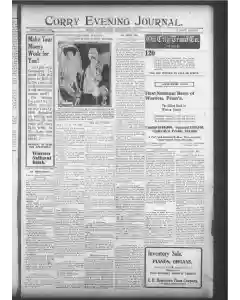
This newspaper page contains 12 articles. Subscribers can read the full text of each article.
Newspaper
Corry Evening Journal
Location
Corry, Pennsylvania, United States of America
Date
Feb 15, 1910
Page
1
The input text appears garbled and lacks releasable facts. It cannot be reliably summarized into a coherent news item without readable entities, dates, or events to anchor a headline and summary.
A fragmented horse racing scene unfolds with horses Doal the Burrerian and Dome Quist surging amid tension. A bystander recounts a tense exchange as the crowd comments on pedigree, style, and a claimed wager while a dialogue-heavy moment escalates toward a dramatic offer.
The text presents incomplete lines with distorted words. It appears to be a fragmented excerpt featuring odd dialogue and unclear speakers, lacking coherent narrative or identifiable entities. The readable content offers no definite event, person, or places to summarize.
A fragmentary and garbledOCR record recalls a battle scene near Koeniggrate with a king and riders. It mentions a commander Poone Binmarek Witt ob and a tense retreat then renewed attack as troops press forward amid confusion and suspense.
In a muddled overheard exchange Colonel Helerby and Byfore discuss a sham wedding arrangement. Jim is mentioned as being recently austere, and a cryptic dialogue follows about loyalty, bonds, and a supposed matter to be addressed before commitments. The garbled text hints at a local social dispute or staged union investigation.
A fragmentary English rendering of a Latin verse work circulates in European circles. The piece, praised for its depth by some readers while criticized for ornate language by others, showcases a tension between external imagery and inward sentiment in its prose and poetry.
An 1822 account recalls the first locomotive race on the Baltimore and Ohio line. Peter Cooper built the engine but horses carried the train for years, with riders noting the era’s perilous practices and improvised brakes. The century’s pioneers debated which method would pull the cars, while collisions and makeshift barriers highlighted dangerous trials of early rail travel.
An eccentric account recounts an Apache gathering to witness a terrifying fire wagon near the western plains. The crowd travels across mesas to watch, the engine wheezes and dark smoke spills as the engineer, startled, laughs and tries to control the throttle while braves hold the track.
Fragmented lines discuss sight, perception, and the effect of a blurred world on people and urban life. The piece notes inner experiences, distant imagery, and the challenge of recognizing faces amid a changing visual landscape. It hints at artistic and literary reflections on perception and identity.
A Pittsburgh Press account describes extreme winter findings from St Peter’s Dune and Perpetual Cold regions. It notes ice walls formed by river ice five feet thick and fifteen feet wide, with large ice buildings enduring weeks. It compares ice strength to gunpowder explosions and mentions distant palaces built of ice in Canada and the country.
The tale centers on Matz observing Balzac in dire poverty who, in a visit to Messini’s house, encounters a celebrity singer. Balzac, ignorant of her fame, asks to borrow a few francs, revealing his continued destitution despite social entanglements and his earlier bind.
A Science American correspondent outlines a vacuum tube railway system to cover 190 miles from Boston to New York in ten minutes and 185 miles to Philadelphia in six minutes forty four seconds. Magne tism and suspended car propulsion would reduce air drag and energy use while cushions prevent passengers from pitching forward.
We want people to find what they are looking for at NewspaperArchive. We are confident that we have the newspapers that will increase the value of your family history or other historical research. With our 7-day free trial, you can view the documents you find for free.
People find the most success using advanced search. Try plugging in keywords, names, dates, and locations, and get matched with results from the entire collection of newspapers at NewspaperArchive!
You can also successfully find newspapers by these browse options. Explore our archives on your own!
Browse by location and discover newspapers from all across the world.
Browse by date and find publications for a specific day or era.
Browse old newspaper publications to find specific newspapers.