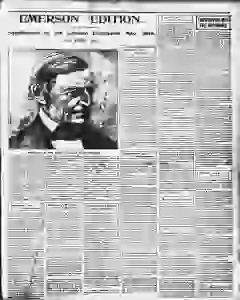
Centenary of Emerson Birth Celebrated in Concord
The one hundredth anniversary of Ralph Waldo Emerson’s birth will be observed in Concord on Monday May 25 with morning school programs and afternoon exercises at First Parish Meeting House. The Social Circle leads the event with a banquet in the evening for members guests and club officials.
MENTIONED IN THIS ARTICLE
Ralph Waldo Emerson
Concord
Emerson
Samuel Host
Loren B. Macdonald
William L. Eaton
Edward J. Bartlett
Thomas Hollis
Middlesex
Thomas Whitney Surette
Hoar
Charles Eliot Norton
Thomas Wentwuth Higginson
Frederick Holderlin
J. Troutbeck
Johnes Brahmas
Concord Choral Association
William James
George Frisbie Hoar
Johns. Reyes
John L. Gilmore
Richard F. Barrett
Chas. E. Brown
Woodward Hadson
Emerson on Napoleon a portrait of the French conqueror
The essay argues Napoleon Bonaparte embodies middle class traits and faults. It contrasts his unrelenting will with a lack of generous sentiment, noting his ruthlessness and willingness to use bloodshed without breadth of virtue.
MENTIONED IN THIS ARTICLE
Bonaparte
Ible
Napoleon
Gems of Wisdom From Emerson
Beware when the great God lets loose a thinker on this planet. Generalization brings a new influx of divinity into the mind and can revalue science literature and religion. Hearing truth lifts the soul while speaking confines it. Progress unfolds like a bud from instinct to opinion to knowledge. Trust the instinct to the end.
Emerson on Books and Reading
An essay on how books should be used to inspire and guide thinking rather than chain it. It argues for disciplined reading, valuing direct understanding over others' transcripts, and notes creative reading expands insight while recognizing the limits of any author.
MENTIONED IN THIS ARTICLE
Oracle
Plato
Shakespeare
Emerson on Manners and Social Grace in Civil Society
The essay outlines how fine manners serve as a subtle defense and aid to smooth social life. It argues manners blunt impediments in conversation and travel like a railway line clearing obstacles, while establishing propriety as a badge of class. It emphasizes good nature, generosity, and social adaptability as keys to success across events from marriages to funerals.
Emerson on Shakespeare Delineates Shakespeare as supreme in execution and insight
The piece argues Shakespeare surpasses all others in executive faculty and creation. It praises his precise, hairpoint detail and universal symbolism while noting he stops short of probing the deeper virtue within symbols. concludes he was master of the revels to mankind.
MENTIONED IN THIS ARTICLE
Shakespeare
Plato
Chaucer
Emersoniana and the Faithful Thinker in Creation
The passage argues that prayer plus detached reason fuels scientific insight and divine action in creation. It asserts deeds shape character. goodness ennobles, meanness degrades, purity is earned by renouncing impurity, and justice brings God’s presence into a just man.
Emerson on Pilato Emerson on Pilato
The passage extols Plato as more than a scholar or inventor, portraying him as the pinnacle of intellect and moral thought. It credits Plato with mapping intellectual geography, elevating fact to expansive ideas, and linking intellect with moral authority and poetic vitality.
MENTIONED IN THIS ARTICLE
Plato
Heaven
Earth
Phaxirus
Pythagoras
Emerson on Language and the Power of Words
Emerson argues that clear thought requires simple character and truthfulness. He warns that pursuit of wealth and fame corrupts language, hindering imaginative power. He notes that earnest speech naturally conjures images, and good writing becomes enduring allegory.
Proverbial Truths On Crime Benevolence And Trust
A reflective piece argues that crime leaves undeniable traces in nature and speech. It contrasts proverbs and sacred texts as intuitive truths, praises inexhaustible love, and notes frankness as the best tactic to foster trustworthy relations and fair dealing. It emphasizes benevolence beyond subscriptions and the social value of honesty.
Emerson on Man The Reformer
A meditation on man as a reformer and truth teller. It argues that true reform rests on enduring principles and the infinite worthiness of humanity, urging renunciation of false comforts and the cultivation of steady virtue. It contrasts practical tools with ideal moral reform and envisions a heavenly society led by transcendent principles.
MENTIONED IN THIS ARTICLE
Bae
Chewist
Smith
Emerson yin On Love
The text portrays love as omnipresent in nature and as the highest word and synonym of God. It traces love from private passion to universal flames, then argues love must become more impersonal while explaining how youth’s romance matures into enduring marriage as the real, foreseen union beyond initial attraction.
Emerson on Society and the Insufficiency of Our Natures
Emerson argues that many people cannot fulfill their own needs and rely on others to serve them. He depicts society as full of infirm individuals who boast ambitions but fail to cultivate true virtue, using gifts to refine luxury rather than abolish it.
MENTIONED IN THIS ARTICLE
Emerson
Also Mentioned on This Page
Emerson Edition
Concord Enterprise
Wisdom
Emersoniana
Pilato
Pansion
Language
Man
the Reformer
Emerson Yin
Love

 This is just the beginning! Our collection holds over 300 years of history, including rare newspapers, obituaries, marriage records, birth records, and so much more—most of which you won’t find anywhere else!