Military Men Look for Offensive by Hung Soon
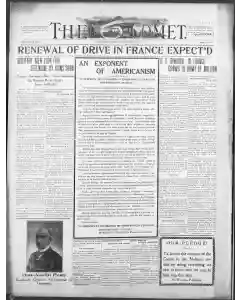
The article reports on Allied expectations of a possible west front offensive by German forces and the role of American and Chinese manpower in France. It notes French and British positions facing renewed artillery and gas shelling from Flanders to the Marne, along with British lines near Givenchy and Rolweg and American patrols at Belleau Wood. It also details Washington orders creating a Chinese labor battalion and a development battalion at Camp Sevier to train unfit men for combat or non combat service, highlighting Major LeRoy Meeves’s leadership and the battalions’ integration goals.
MENTIONED IN THIS ARTICLE
Belleau
Flanders
Marne
Armentians
River Lye
Givenchy
Rolweg
Inea
Ole
Aisne
Norh
Villiers Cotterets
Paris
Washington
United States
Exponent of Americanism at War’s Outbreak and Reckoning
Richard H. Edmonds denounces Germany as a predatory power responsible for the war’s horrors. He argues Allied suffering, famine, and civilian deaths stem from Germany’s prearranged plans to murder and loot, demanding accountability as America awakens to fight.
Development battalion to train disqualified soldiers
The army plans a development battalion that will grow as men are assigned to it to convert disqualified or defective soldiers into good ones. Training aims to cure physical defects and keep these men from hindering other units while undergoing development at Camp Suvier.
MENTIONED IN THIS ARTICLE
Camp Suvier
Former Russian Czar Killed by Red Guards
Copenhagen dispatch reports Russian Red Guards raided the residence of Nicholas Romanoff the former emperor at Ekramnbu g and murdered him. Stockholm note attributes the claim to Visla a Russian newspaper Lausanne confirms Bolshevik authorities at Yekaterinburg condemned Nicholas Romanoff to death after a brief trial and shot him details sparse.
MENTIONED IN THIS ARTICLE
Copenhagen
Nicholas Romanoff
Ekramnbu
G and i
Visla
Stockholm
National ‘Tidende
Geneva
Ukraine
Lausanne
Yekaterinburg
Nicholas’ Romanoff
Ithen
Senate approves national prohibition amendment in emergency bill
Washington June 27 the senate agriculture committee agreed on an amendment to the 111 million emergency agricultural appropriation bill to prohibit manufacture and sale of whiskey and wine after June 30 and to ban beer three months after final presidential approval, outlining a nationwide prohibition timeline.
MENTIONED IN THIS ARTICLE
Washington
Senate Agriculture Committee
Martial law expected in Austria Hungary amid food crisis
Garia June 27. Bwias dispatches report the seriousness of the food situation in Austria Hungary leading to expectation that martial law will be proclaimed throughout the empire momentarily.
MENTIONED IN THIS ARTICLE
Garia
Havas
Bwias
Austria-Hungary
Empire
U S DIMGION IN FRANCE GROWS TO ARMY OF MILLION
Washington June 25 The 1th division of the American army landed in France one year ago and has grown to an army of a million men to be sent forward by July. Behind this million are another million equipped in camps and tonments and a third million to fill gaps at home as divisions sail. The first division is a fighting force of 650 600 men with 250 000 more for supply and transport. Pershing now commands the substance of the first field army of eighteen infantry divisions with auxiliaries. American sectors lie from the Swiss border near German soil to Verdun on the right flank, holding the line as the British hold the left. More than 3 000 000 000 government checks have been issued by War Risk Insurance for families of service members, with total disbursements near 98 000 000 dollars. Monthly checks exceed 86 00, about 35 000 mailed daily, and June allotments begin July 1. Projections posts run behind French lines where the YMCA shows motion pictures to soldiers.
MENTIONED IN THIS ARTICLE
Washington
France
Pershing
Sampa
Cantonmenta
Perishing
United States
Marne
Picardy
Manders
Verdun
Paris
Bureau of War-Risk Insurance
Army
Navy
Bureau
Federal Food Administration AR Plan in war sugar limits
Nashville June 26 statement from Food Administrator Morgan outlines U.S. sugar shortages due to army needs, shipping disruption, war losses, and weak beet and Louisiana crops. Estimated half-year consumption about 60,000 tons, with household three pounds per month per person and Army needs about 1,500,000 tons. Plan restricts sales after July 1 to certificate holders. hard impacts on nonessential users.
MENTIONED IN THIS ARTICLE
Nashville
Morgan
France
West Indian
United States
Also Mentioned on This Page
Hung
Tialian
Launel
Ding
Prince and Flanders
David Lloyd George
House of Commons
Porte
China
Ese
Labor Army
Batalion
Siet
Camp Sevier
LeRoy, Meeves
Maj
Reeves
Tennessee National Guard
Johnson City
Third
Austin Peay
Tennessee
Hell
Germany
America
Canada
England
Italy
Dante
William
Hell On Earth
Jesus
Richard H. Edmonds
Manufactures Record
Senate
Austria
HUN
U.S
Food Administration
H. W. Lyle

 This is just the beginning! Our collection holds over 300 years of history, including rare newspapers, obituaries, marriage records, birth records, and so much more—most of which you won’t find anywhere else!