Bozeman Trail History and John Bozeman’s Death Defying Route
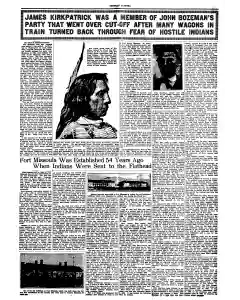
Grace Stone Coates recounts the Bozeman trail's doomed opening and the 1864 chartering of the Northern Pacific. It notes Red Cloud's absence from Fort Laramie talks, treaty outcomes in 1868, and details of John Bozeman and James Kirkpatrick as part of the famed western expedition.
MENTIONED IN THIS ARTICLE
Grace Stone Coates
Bozeman
Washington
Congress
Northern Pacific Railroad
Montana
Bozeman Road
Great Plains
Commission
Black Foot
Tagk
Horse Creek
Fort Philip Kearney
Dakota
John Bozeman
Georgia
Colorado
Bannack
John M. Jacobs
Jacobs
Fort Benton
Fort Hall
Butte
Three Forks
Gallatin
Clark
Pass
Bozeman Pass
Sacajawea
Yellowstone
Powder River
Fort Laramie
Missouri
James Kirkpatrick
Dillon
Oregon Trail
Idaho
North Platte
James Brady
Sam Ward
Lieutenant Coleman
Ed Waters
Charles Bliven
John Ensley
Wilson Brothers
Gus Streitz
John M. Mann
John Powers
William Grove
Wiliam Baker
Bouillon
Clear Creek
Rosebud
Crazywoman’s Fork
South Fork
Lodgepole Creek
Kirkpatrick
Mullen
Brady
Platte
William Coleman
Coleman
Fort
Bozeman Trail
Fort Missoula History Marks 54 Years Since 1877 Founding
Fort Missoula established in 1877 to relocate Bitter Root Indians to the Flathead reservation. The post, with 14 officers and 300 men, sits on 3417 acres, including a 1200 acre fort property, wood reserve. Congress will decide disposal. army will transfer personnel now.
MENTIONED IN THIS ARTICLE
Fort Missoula
War Department
Congress
Army
Hoovers
C. C. Gilbert
Seventh Infantry
United States
Bitter Root
Flathead Reservation
Maginnis
Nez Perces
Joseph
Worden
Third Infantry
Rawn
Williams
Missoula
Sherman
Brooke
Seventh
Twenty-fifth Infantry
Gibson
Andrews
the Big Hole
James A. Moss
St. Louis
Miles
Army Bicycle Corps
Perkins
Eighth Infantry
Twenty-fourth Infantry
Hoover
Fort Benton
American Fur Company
Missouri
Diamond City
Confederate Gulch
Smith River
Deep Creek
Camp Logan
Fort Keogh
Miles City
Nelson A. Miles
Fifth Infantry
Second Cavalry
Tongue River
Havre
Fort Assiniboine
John J. Pershing
Montana State College
Fone
Montana Experiment Station
Tana
Montana National Guard
Veterans’ Hospital
Fort Shaw
Sun River
Missouri River
13Th Infantry
William Clinton
Camp Reynolds
Robert @. Shaw
54Th Massachusetts Volunteers
Fort Wagner
Montana Forts and Trails Through Early Territorial Wars
The article traces Montana military posts from Fort Missoula and nearby forts through 19th and early 20th centuries, detailing garrison changes, proposed property transfers, and conversions. It covers Forts Missoula Harrison Connor Keogh Shaw and others, Bozeman trail events, Indian conflicts, and the impact on settlers, education, and veterans facilities.
MENTIONED IN THIS ARTICLE
Dangerfield Park
Third Infantry
Fort
Maginnis
Granville Stuart
Ford Creek
Judith Mountains
Porter
Glendive
Terry’s Landing
Fort Harrison
Helena
Montana
Also Mentioned on This Page
Shun
Red Cloud
Boston
Wisconsin
The
Mines
United States Commission
Flathead
Philippine Islands
Sixth Infantry
Fourteenth Infantry
18Th Infantry
State University
Harrison
Greater University of Montana
Forestry Service
58Th Infantry
P. H. Mullay
F. B. Robes
Fourth Infantry
William J. O'Loughlin
Eile Training Corps
C. P. Smith
Big Horn Valley
Wyoming
N. C. Kinney
Fort Phileeee
Fort Ellis
Andrew Jackson
A. 8
Grant
Daughters of the American Revolution
Fort Connor
Fort Reno
Montana-Wyoming Line
Montana Territory
Judith River
Camp Cook
Clinton
Rankin
Parker
Col
L. M. Black
Thomas Francis Meagher
McAdow
Yellowstone) Canyon
Meagh

 This is just the beginning! Our collection holds over 300 years of history, including rare newspapers, obituaries, marriage records, birth records, and so much more—most of which you won’t find anywhere else!