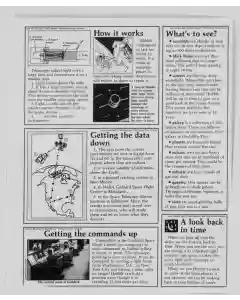
Getting the commands up for Hubble pointing
Controllers at the Goddard Space Flight Center use computers to send commands to Hubble telling it where to point. The telescope can hold a position while traveling 17,500 miles per hour, with pointing accuracy comparable to hitting a dime from Washington to New York.
MENTIONED IN THIS ARTICLE
Goddard Space Flight Center
Hubble
Washington, D.C
New York City
How the Hubble Space Telescope Works
Telescopes collect light over a large area and concentrate it on a smaller area. Light enters the tube and strikes a large primary mirror about eight feet across, focusing onto a smaller secondary mirror. The light then reflects through a hole in the primary mirror into scientific instruments. Hubble is designed to work for roughly 15 years and is built in modules to ease maintenance. Astronauts will return to space for repairs, and the telescope must point away from the sun when its mirror door is open to avoid damage.
MENTIONED IN THIS ARTICLE
Hubble
Data flow from instruments to space telescope data centers
Data from science instruments moves as digital signals to the spacecraft computers then via a relay satellite above Earth to a ground tracking station in New Mexico and NASA Goddard in Maryland before reaching the Space Telescope Science Institute in Baltimore where results are stored for astronomers to study and report back.
MENTIONED IN THIS ARTICLE
New Mexico
NASA Goddard Space Flight Center
Maryland
The
Space Telescope Science Institute
Baltimore
The Mini Page by Betty Debnam
Betty Debnam presents a concise children’s feature page with simple activities and notes. The item showcases a playful tone, kid friendly topics, and quick ideas suitable for a family newspaper section.
MENTIONED IN THIS ARTICLE
Betty Debnam
Universal Press ‘Syndicate
Universal Press Syndicate
Understanding celestial bodies for curious readers
The text explains asteroids comets black holes galaxies the Milky Way planets pulsars nebulae quasars and stars. It notes Hubble’s future view of the bright comet Austin and describes the scale of galaxies and quasar brightness in simple terms suitable for a general audience.
MENTIONED IN THIS ARTICLE
Milky Way
A Look Back in Time Through the Cosmos
The article reflects on how viewing the sky reveals the past. It notes that sunlight takes eight minutes to reach Earth and that the Hubble Space Telescope lets us glimpse objects billions of years old.
MENTIONED IN THIS ARTICLE
Earth
Hubble
Also Mentioned on This Page
Goddard
Instruments
Austin

 This is just the beginning! Our collection holds over 300 years of history, including rare newspapers, obituaries, marriage records, birth records, and so much more—most of which you won’t find anywhere else!