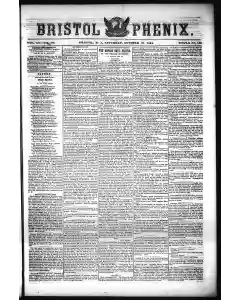
Briscon Dy EnE Public Notice Summary
Briscon Dy Eney publishes weekly notices every Saturday morning at 40 Bradford Street Bristol BR by W B Bayley. Rates show Te Dollars advance and annual subscription details for printed ads with lines and fees.
MENTIONED IN THIS ARTICLE
Briscon DY Ene
Bradford Street
Bristol
BR. T
W. B. & Bayley
Town
Vance
Dasacha
Seager
Matos
Speak Boldly in Freedom’s Holy Strife
Fragments of a 19th century exhortation urge bold faith and true deeds for freedom. It calls heroes prophets and poets to stand firm against oppression, with lines invoking God, truth, and courage in a martial civic struggle. The text blends religious imagery with revolutionary fervor.
MENTIONED IN THIS ARTICLE
Troth
Anakin
Manas
South Berwick fires plot leads to bond in burning case
Boston traveler report from South Berwick Maine states trader Benjamin Stillinga was bound over in 4000 dollars for hiring Wilkinson Pray and J C Pray to burn a Methodist church a barn dwelling and powder house and to blow up the Baptist Meeting House. The informer Wilkinson is key witness. Accused were allegedly inebriated. two incendiaries reportedly arrested in Dover.
MENTIONED IN THIS ARTICLE
Boston
South Berwick
Benj. Stillinga
Wilkinson
Dieu
Baptist Meeting
Wilkinon
Jiquora
Andrew Woy
Judge Hayes
Sillings
Dover
Parisian pleasures and youth in a social world
Horace Gresley observes Paris as a place of social pleasure where the Frenchman seeks theater music and public life nightly. He notes the islander’s constant recreation and contrasts youth’s prodigal vitality with older age’s lack of happiness and respect.
MENTIONED IN THIS ARTICLE
Ithan
Paria
Paris
Horace Gresley
Staffordshire described as Noahs ark in English report
The English paper remarks on the Boston ship Staffordshire noting uncanny proportions that liken her to Noahs ark with a beam about six times her depth and two thirds of the beam as depth. The passage comments on clipper ships and their surprises for Yankee observers.
Press and Public Opinion as Power for Reform
Gale Middleton argues that the press and mental power shape a new force in shaping moral worlds. He claims public opinion can overwhelm armies and despotic decrees, with concentrated thought acting as a sorcerer’s sword to advance liberty and rights.
MENTIONED IN THIS ARTICLE
Gale Middleton
Forgiven Strayers Urged to Return to Path
A devotional note urges those who wander to draw back and guard one another. It counsels that a kind word is more valuable than wine or gold and emphasizes helping an erring brother find the right path.
MENTIONED IN THIS ARTICLE
Tie
Mother's Grave and Moral Reminders Across Time
A reflective essay on a mother's grave as a sacred site of memory and virtue. It contrasts mournful solace with guidance from mothers and spiritual hope, then shifts to a public note on New Hampshire Quakers banning pork and broader health commentary from medical journals.
Last words of Mr Grimshaw on his death bed
On his death bed the good old man Mr Grimshaw uttered the phrase Here goes an unprofitable servant. The remark is recorded as his final testament and reflects a moral sentiment attributed to his character.
MENTIONED IN THIS ARTICLE
Mr. Grimshaw
Shameful for a man to live as a stranger in his country
Quote notes the disgrace of a man living as a foreigner in his own land and being ignorant of the affairs and interests of his nation.
MENTIONED IN THIS ARTICLE
Mani
Dryden Quip Inspires Caution in Clever Saying
A wry adage credits Dryden with a bite about misusing clever tools. The line suggests wise restraint and warns against turning a clever instrument into a weapon or harm.
A Year of Pleasure Passes Like a Floating Breeze
A damaged fragment notes how a year’s joy fades to memory while a sudden misfortune lingers, likening time to a breeze that shifts to long pain. The line hints at the swift passage from happiness to hardship without detailing the events.
Canine Hero Upsets Water Jar To Save Chick
A Boston Journal correspondent from Dorchester recounts a mastiff protecting poultry. When a newly hatched chick fell into a deep water jar, the dog raised a paw and toppled the jar, saving the chick and returning to sleep, an act he noted in his diary.
MENTIONED IN THIS ARTICLE
Tur Pullaytaroric Doo
Boston Journal
Dorchester
Massachusetts
A Servicvent Excuse for Skipping Lectures
A gentleman defends missing a course of lectures by saying his wife gives him a nightly lecture for nothing, a humorous quip illustrating domestic hearings as the real instructor.
Orphan Boy's Prayer Concludes in Henry Williams Blessing
In Bea uchampe's office Henry explains how he exposed the trial deception using clues from a marine deserter and a forged paper. Beauchampe grants Henry two thousand dollars for education, and Deacon Clifford reconciles with Henry after recognizing his noble conduct and unites Henry with Cora in a hopeful future.
MENTIONED IN THIS ARTICLE
Mr. Beauchampe
Henry
Finney
Delaware Ede
Jinney
Old Roger
Inney
Canada
Marine Corps
Jack Collins
Commandant of Marines
Aley
Wwe
Mr. Brown
Mme
John Dickenson & Co
London
Henry Williame
Beauchampe
Clifford
Woodbine
Cora Clifford
Cora
Deacon's Gate
Williame
Tohn
Ashley
Judge Beauchampe
Williams
Alate
Henry Williams
Fragmentary verse note from CHAPTER LY
A brief, literary fragment recalls seven years passing with flowers fading and fading again in a Deacon era setting, noting cycles of bloom and wither amid rustling foliage. The line hints at memory and renewal within a parable-like scene.
MENTIONED IN THIS ARTICLE
Deacon
Nocturnal Gastric Misguidance In Coastal Jests
A playful dialogue mocks medical jargon as a seaside quip about stomachs and nerves. The exchange features exaggerated terms like horsescopes and crustacean-piscatory calad, ending with a shouted Lah.
MENTIONED IN THIS ARTICLE
Skraitz
Friend’s boast of travel ends in odd incident
A friend bragged about a trip then claimed he tripped and fell into a young lady’s lap, recounting the awkward moment as a humorous mishap. The anecdote centers on the public embarrassment and the social reaction afterward.
MENTIONED IN THIS ARTICLE
Oure
Mayny
Laly
Newlywed Learns to Speak with Missing Teeth
A comic exchange ends with a groom fleeing after his palate drops out and his wife jokes about hair loss. A man resembling him is later seen asking directions to Texas, adding a note of chase and farce to the brief incident.
MENTIONED IN THIS ARTICLE
Aincé
Hong
Texas
Historical Garb of Leaders From Washington to Adams
Descriptive notes recount the attire of early American leaders and officials. It mentions Washington arriving in New York in 1798 in continental dress, then black on Sundays. Adams and vice presidents in formal dress with coats, wigs, stockings, and accessories. judges in scarlet and black velvets. robes and gowns with silk, damask, and satin details.
MENTIONED IN THIS ARTICLE
Hancock
Washington
New York
New England
John Adama
Philadelptia
The Miserly Man and His Generous Daughter
A cold winter scene shows a rich man’s daughter choosing mercy over wealth. She asks her father to share bread with starving birds, offering to save one in a hundred rather than none. Moved, the father directs her to crumble bread and feed the village poor.
Controversial Duel Over Poet Laureates Endures
A dying nobleman claims Aristotle outranks Deere as a poet, while a Confessor who admires Aristides urges acknowledgment of Aristo's superiority. The exchange reveals enduring debate between classic and contemporary poets.
MENTIONED IN THIS ARTICLE
Deere
Aristo
Dante
Ariete
Wipe Awaxe. Hudson Scotsman On Sleep Questioned
A ragged OCR fragment from Hudson recounts a Scottish visitor asked how he slept. He replies in broken phrasing that he slept fairly well but worse than a formidable person who warned him.
MENTIONED IN THIS ARTICLE
Hudson
Treth
Span
Fragmented archaic line hints at mood or scene
A garbled passage hints at a mood of awe under moonlight with a silver-plated night and distant allusions. Names and clear events are absent, leaving a fragmentary, poetic texture without concrete facts.
Quoted Scientist M Cuvier on Whale Pair Bonding
The text notes M Cuvier claiming that a whale pair can share domestic felicity, contrasting human numbers with a hypothetical 72,000,000 of voi r affapring. It discusses life spans and reproduction in a stylized, fragmentary manner.
MENTIONED IN THIS ARTICLE
Wrate Srone
M. Cuvier
Enduring Factional Rivalry Clouds Public Discourse
The passage argues that factionalism blinds judgment as people seek display and status. It urges calm rhetoric and firm, rational argument to persuade opponents without inflaming conflict.
Wealth Worship Reveals Weakness in Material Pursuit
A clipped exchange argues that valuing luxury for display signals moral decline. The speaker cites extravagant purchases like carpets as signs a man is ruled by money, not beauty, and warns such vanity invites danger and loss of character.
Dancing as Grace or Artificial Craft in Social Observations
The passage argues that fine dressing and dexterous dancing reveal whether grace is natural or taught by a dancing school. It warns that visible artifice in a girl’s movement deceives observers who expect true grace and beauty emerging from character.
Fragmentary Ethical Reflection on Duty and Respect
A poetic fragment urges memory of each life as necessary and worthy of respect, praising honor and fulfilled duties while honoring humanity without explicit context or a clear event. The lines emphasize reverence for every station in life and the value of duty.
Fragmentary dialogue on counterfeit money and paving
A garbled dialogue scene shows an exchange between a father and son about a neighbor's counterfeit currency and paving, as an elderly woman comments on a machine and a strange Middle Ages reference.
A Fragmentary Aphorism Reference in Frahtths Study
The text offers a partially legible quotation about diligence and standing before kings, attributed to Dr. Frahtths. It mentions five Midge and a dining honor, with garbled phrases suggesting an analysis of early life and moral maxim.
MENTIONED IN THIS ARTICLE
Frahtths
Also Mentioned on This Page
Bpeuazae
Tribsee
Wm,oland Bourne
Hero
Ourat
Baal
Mom
Bose
Oll
Li Cdn
Tomind
Aurora
New Hampshire
Mosce
Agea
Egypt
Syria
Buston Medical Journal
Dryden
Pictorial Drawing Room Companion
Sylvanus Cobb
Rupert Brown
Eaid
Atvia
Smith's
Tal

 This is just the beginning! Our collection holds over 300 years of history, including rare newspapers, obituaries, marriage records, birth records, and so much more—most of which you won’t find anywhere else!