BRB Hevs Store Promises Low Prices on Fancy Goods
At his store No. 132 Westminster Street the BRB Hevs offers the largest stock of fancy goods in the state with uniformly low prices.
MENTIONED IN THIS ARTICLE
Westminster Street

 This is just the beginning! Our collection holds over 300 years of history, including rare newspapers, obituaries, marriage records, birth records, and so much more—most of which you won’t find anywhere else!
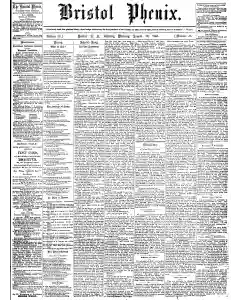
This newspaper page contains 21 articles. Subscribers can read the full text of each article.
Newspaper
Bristol Phenix
Location
Bristol, Rhode Island, United States of America
Date
Aug 20, 1864
Page
1
At his store No. 132 Westminster Street the BRB Hevs offers the largest stock of fancy goods in the state with uniformly low prices.
Classified notice item outlines ad rates for a one square weekly insert with three week option and higher charges for births and deaths. It specifies ten lines in minion type per square and states copy must be submitted by Thursday noon with special notices.
A reflective poem about life as a season of tears and joys. It contrasts memories of past loves with the ache of parting as time passes. The speaker, Nellie, notes how memories linger like a faded flower and a distant sea shell’s song, guiding and fading with the heart.
A reflective poem laments time passing from youth to death. It contrasts fleeting youth and dreams with the inevitability of decay, urging to live in the present. It envisions life as a race toward death and notes the equalizing inevitability of the grave.
A historical poem excerpt proclaims there will be no night in heaven. It imagines endless noon and constant light, banishing sorrow, pain, and darkness. The speaker envisions celestial landscapes where the Lamb provides perpetual light and eternal day amidst green pastures and radiant waters.
A fragmentary verse piece contemplates Welt Davis’s epitaph and Jeff’s legacy. It jabbers about loyal readers, lies above and below, strings on a bow, flattery, and a mix of prayer and devilish themes. It references West Point Benedict Cain and Casar Dorgis in a muffled historical frame.
An evocative verse passage describes a calm face with earnest eyes and a thoughtful brow. It contrasts boyhood feeling with manhood fire, suggesting a tender, aspirational look beyond the present moment.
Uncle Charles narrates the Grey family history from Lincolnshire to a distant settler, focusing on Old Richard Grey and his daughter Hannah. The tale follows the decline of a noble line, mortgage woes, and a young Grey who travels West to build a new life, earning respect for his blend of learning and practical grit.
In a colonial village Widow Langley grows wealthy from tenancies while her daughter Hannah longs for Richard Grey. He courts her through the woods and the pair marry after travel and social duty separate them briefly. They share fifty years, care for strangers, and lie together at last.
An Army of the Cumberland officer recalls a tale of endurance in rain and mud. A tired brigade paused in a marshy stretch until a gay private sang a comic line, sparking laughter and lifting spirits as they then burst into The Star Spangled Banner, resuming the march with renewed energy.
A reflection on how good humor uplifts daily interaction and keeps people cheerful amid hardship. The text contrasts a lonely, discontented man with one whose warmth invites friendship and mutual happiness through humor.
A reflection on how difficulties and mistakes shape progress. The author argues that challenges provide the best instruction and that wisdom grows from failure, teaching what to do by revealing what not to do.
The philosopher valued both inner order and external appearance. His cleanliness reflected decency and discipline, while his health care aimed to keep his mind free and tranquil.
The piece portrays Willie’s brave walk through the woods guided by a whispered prayer and his grandmamma’s counsel. It contrasts childlike trust with adult questions about God’s will, urging gratitude over fretful requests and highlighting a fatherly faith teaching seasoned readers.
A reflective poem describes a city at rest and a soul alone with God. The speaker finds sublimity in silence and solitude as stars, moon, and night communicate without words. The atmosphere emphasizes personal awe and spiritual communion during a hushed night.
The narrator recalls a life of excessive agreeableness, listing numerous favors and sacrifices. He notes being asked to be godfather forty eight times and giving away brides and dressing cases, accepting many umbrellas, cinema seating, and accommodation bills. After fourteen years he plans to depart for Australia from Basinghall Street.
The notice states U S postage on letters to or from British West Indies Cuba Aspinwall Panama and other foreign countries will be ten cents the single rate for half an ounce or under prepaid on letters sent and collected on letters received Newspapers and printed matter will be two cents each and other printed items at established rates. international postage between New Brunswick and the United States will be reduced to the single rate for half an ounce or under with prepaid option.
The document notes large migrations within the United States and across borders since the war began. Southern Unionists move north while some Southern regions shift toward the Confederacy. Northern cities see civic emigration to recaptured South towns, and many Americans head to Canada, with Canadians returning in larger numbers.
A humorous anecdote recalls a congressman famed for both skill and speed in billiards. He notes he was elected for being himself and not for his achievements, explaining his popularity came from entertaining games and bold boasting rather than legislative record.
Dr Lockhart details a Chinese technique to repair broken iron vessels. Cast iron is melted in a small crucible furnace, poured onto felt with ashes, pressed into the mold area, rolled, and finished by trimming. The resulting vessel is reported to be as good as new.
The passage argues against idleness and champions continuous action. It warns that voluntary leisure leads to morbid thoughts and ruin, while persistent work sustains health, purpose, and a long life, urging a life devoted to active effort.
We want people to find what they are looking for at NewspaperArchive. We are confident that we have the newspapers that will increase the value of your family history or other historical research. With our 7-day free trial, you can view the documents you find for free.
People find the most success using advanced search. Try plugging in keywords, names, dates, and locations, and get matched with results from the entire collection of newspapers at NewspaperArchive!
You can also successfully find newspapers by these browse options. Explore our archives on your own!
Browse by location and discover newspapers from all across the world.
Browse by date and find publications for a specific day or era.
Browse old newspaper publications to find specific newspapers.