Subscriber Campaign Urges Globe Circulation Help
The Campaign Offer aims to boost The Globe's neighborhood circulation by encouraging every subscriber to show sample copies and request free sample issues.

 This is just the beginning! Our collection holds over 300 years of history, including rare newspapers, obituaries, marriage records, birth records, and so much more—most of which you won’t find anywhere else!
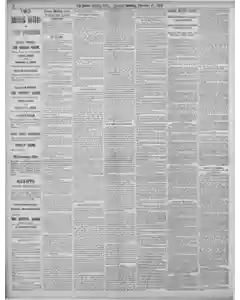
This newspaper page contains 22 articles. Subscribers can read the full text of each article.
Newspaper
Boston Weekly Globe
Location
Boston, Massachusetts, United States of America
Date
Nov 27, 1883
Page
4
The Campaign Offer aims to boost The Globe's neighborhood circulation by encouraging every subscriber to show sample copies and request free sample issues.
To those seeking representation the regular liberal cash commission will be paid. On request, a Poster, Agents Circular, and Sample Copies will be sent Free.
The Hoston Weekly Globe announces a new campaign offering sixteen original novels from now to March 4, 1885. Each tale will be published for $1, with a club program and readers invited to join. A new story is nearly ready and differs in plot from all prior Globe publications.
A lengthy broadcast urges readers to renew expiring subscriptions before year end to keep their names in type and avoid missing issues. It also notes varied topics from politics and crime to inventions and social curiosities, including bank expansion, railway electric lights, and a colorfully critical view of public figures and events.
A terse reflection notes that despite official bans and refusals the world continues to progress. It suggests resilience of life and power beyond political control, implying a stubborn forward pull of events regardless of authority.
Rumors from Egypt center on Er. Mehdi the False Prophet reemerging after a long quiet. Reports claim he could threaten the canal by seizing positions before reinforcements arrive, while En Menor's forces may be overestimated amid panicked city reports.
A reflective piece argues seven Supreme Court justices ruled women are persons but remain unsure how much personhood they possess. It notes contradictions on citizenship and voting rights, bar admission, and state board eligibility, calling the ruling a partial, unsettled step for women’s rights.
In merrie old England a clergyman fined for leaving a tricycle in a public way, while he entered a nearby shop. Mischief by boys escalates when red pepper is placed in an apple and the vehicle injures two youths and startles a nurse with an infant, until a passing gentleman restrains the scene.
A clergyman who owned a tricycle was fined for leaving an unattended vehicle in the streets as guardians of the peace confront a rowdy scene. The court indicated the owner should supervise his property, noting that while a coal cart and passing car may be tolerated, a tricycle cannot remain unattended on the streets. The testimony is not fully available, but the decision emphasizes owner responsibility amid boyish mischief and urban disruption.
The American consul at Crefeld examines American marriages to German nobles and reports that among thirty three such unions every case ended in divorce or abandonment. He argues American women should seek spouses at home, suggesting a more prudent approach to marriage and even joking about Bismarck prohibiting American pork and wives to spare these girls.
A Cooper Institute gathering led by Henry Ward Beecher featured David A. Wells and Henry Watterson. The audience overflowed, drawn by free trade talks. Wells argued limited markets from tariff laws cause overproduction while Watterson championed tariff debate but risked overextension. Public interest spanned East, West, and South amid broaderBanking and legislation discussions.
A man asserts that turning seventy grants fearless access to opera and theatre, remaining undeterred by critics who deem his ideas as liberal. He argues age should not curb enjoyment of the arts, emphasizing personal liberty in late life.
The passage surveys Standard Oil capital growth from 1 million to about 70 million, recalls a quip about A T Stewart and marriage, and includes assorted curiosities. It notes actors, political figures, a French stance on decadence, and varied cultural jests from a late 19th century newspaper.
In Washington on November 24 Joaquin Miller contemplates the Cox speakership fight. He portrays political zeal and lavish spending by factions, critiques the value of the speakership, and argues for a leader who has spent nothing. He compares American tastes for controversy to English parliamentary glory and urges caution against suspicion.
In a bustling Washington scene the writer recalls meeting Sunset at Willards with friends while noting the New York Herald and other major illustrated papers present. He jokes that barroom fumes may have dulled his mind and recalls predicting the New Opera House's failure, contrasting critics' dismissive views with public opinion.
The piece criticizes a costly New York project funded by newly rich patrons aiming for culture. It notes arrogance, railroading aims, and a pursuit of prestige rather than art. It claims the planners imported European musicians to perform, underscoring a clash between wealth and genuine culture.
A critic extols Irving as a unique performer whose voice and manner are fearfully original. He praises Irving’s Shylock for tenderness and justice toward the persecuted Jew, while noting generally that Irving’s vigor remains compelling though sometimes overbearing.
A reflection on Mr Cox as a champion of humanity and justice for all faiths. The piece recalls a wealthy New York Israelite who funded a Cox speech translated into Hebrew and sent to Russia during oppression. It notes the era’s building boom and its global reach.
The speaker praises Mr Cox as a writer while questioning rival candidates Mr Randall and others for Congress. He critiques New York's changing skyline, likening buildings near Madison Square and the Grand Opera House to mountains, and argues the city will remain a vast storekeeper’s town despite its grandeur.
Joaquin Miller voices calm judgment amid a heated national debate over the impending speakership. He mocks grandiose campaigns and festival excess, defending the country’s safety and predicting no significant impact from aspirants. He urges restrained public scrutiny while preserving the obelisk of stability.
An 18th or 19th century court tale recounts Elizabeth alias John Haywood known as Betty John who lived as a man, married a woman, and was found to be a real woman and wife after long legal drama. The piece cites Me Hutton and describes courtroom behavior, disguises, and the trial over several days.
A medieval style note explains how Roman republic laws restricted wine for men under thirty and for all women to detect wine tasting by kissing parents. It notes later relaxation allowing wine from boiled must. The piece ends with a drug ad for Raven on Covans and a cough remedy.
We want people to find what they are looking for at NewspaperArchive. We are confident that we have the newspapers that will increase the value of your family history or other historical research. With our 7-day free trial, you can view the documents you find for free.
People find the most success using advanced search. Try plugging in keywords, names, dates, and locations, and get matched with results from the entire collection of newspapers at NewspaperArchive!
You can also successfully find newspapers by these browse options. Explore our archives on your own!
Browse by location and discover newspapers from all across the world.
Browse by date and find publications for a specific day or era.
Browse old newspaper publications to find specific newspapers.