Campaign Offer to Boost Globe Circulation
The Campaign Offer urges Every Sub scriber to help raise THE GLOBE circulation in their neighborhood by showing sample copies and sending for free samples.

 This is just the beginning! Our collection holds over 300 years of history, including rare newspapers, obituaries, marriage records, birth records, and so much more—most of which you won’t find anywhere else!
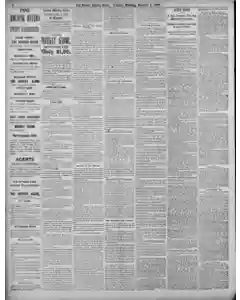
This newspaper page contains 24 articles. Subscribers can read the full text of each article.
Newspaper
Boston Weekly Globe
Location
Boston, Massachusetts, United States of America
Date
Dec 04, 1883
Page
4
The Campaign Offer urges Every Sub scriber to help raise THE GLOBE circulation in their neighborhood by showing sample copies and sending for free samples.
The notice offers regular liberal cash commissions to agents. On request, applicants receive a poster an agents circular and sample copies free.
Between now and January 1, 1884, many renewals will be due and most will be renewed. Subscribers are urged to check their dates and renew promptly to keep their names on the mailing list. Renew at once to avoid missing copies and form a club for the new campaign offer.
The Weekly Globe will not accept three-cent stamps under the new postage law. Subscriptions must be paid with two-cent stamps, while one and two-cent stamps continue to be accepted as before.
Subscription and address instructions for the Weekly Globe outline payment options United States Canada postage stamps and postal orders. Requests include full sender details changes of address and discontinuations with town county and state. Mail handling and free duplication of copies are noted along with contact details in Boston Massachusetts.
A plea to readers asks to mention seeing ads in THE BOSTON Wreeuivy cLonr when responding. The note prompts acknowledgment of source while placing value on advertised offers.
The Weekly Globe will be sent free until January 1885 to newspapers publishing for three successive weeks the provided prospectus. The note addresses requests from weekly newspapers to be placed on The Weekly Guions exchange list during the presidential campaign.
The Globe offers an eight page weekly edition with SG columns urging readers to subscribe. It invites sample copies and promotes a $1.00 price during the presidential campaign while offering special club rates for newspapers.
The notice invites distributing free sample copies to neighbors and offers free copies mailed to each address if names of likely subscribers are provided. It also suggests sending a list of names if the distributor cannot hand them out personally.
A new tale launches December 18 offering originality and power unmatched by prior Globe fiction. From now through March 4, 1885, sixteen original novels will be published at $1 each. readers are urged to form clubs and note the campaign.
The passage compares the society’s earlier brave struggle with its half century milestone and suggests remarkable possibilities for the next fifty years. It notes recent history makes future change not to be scoffed at and implies optimism for continued progress.
In a critical report the secretary argues for policy shifts toward Indians, praising some ideas while labeling others odd. He contends civilization harms the Indian yet backs removal of savagery, questions land titles and surplus value, and urges civil service reform on a broad scale.
The Democratic caucus displays courage and wisdom by nominating Mr. Carlisle for speaker. He aims to reform revenue and reduce excess taxation, opposes wild tariff schemes, and vows a fair tariff debate. With Carlisle guiding the House the country should see business stable and clear party course. The Herald endorses the nomination and predicts a path to the presidency if Carlisle’s revenue ideas are sustained.
A Dakota farmer feeds a cow hops malt and corn until she yields beer not milk. The piece imagines cows as distilleries and bars with milk punch gin fizz and bourbon options, suggesting endless drinkable dairy if extended, joking about tax and moonshine and linking to the song about milk from a cow.
Civil service examiners faced a punctuation quandary over a question on possessives in a sentence about the commissioner of customs report. Arguments among Eaton, Lyman, and others ended with Richard Grant White ruling that the apostrophe goes after the s in customs' report, a stance later challenged by a noted grammarian.
Governor Butler attacks Mr Blaine's scheme to tax Virginia and Connecticut to pay others debts and asks how Massachusetts would react to taxing its own cotton woollen and leather industries for others. He argues internal revenue tax unconstitutional as a direct tax on producers and favors abolishing whiskey and tobacco taxes with states collecting own taxes.
The community mourns Warren Handel Coopworth of East Boston, a devoted citizen and clergyman who served in peacetime and war. His funeral drew all classes as veterans and civilians paid homage to a life of continual service and Christian service. The article urges others to honor his memory and carry on his work.
The English court has sentenced O Donnell to death for murdering James Carey. The jury’s verdict, while unexpected to some, reflects strong British reckoning with Carey who is branded a diabolical figure. The editorial notes ending the chain of vengeance, with Carey removed and O Donnell sentenced.
A North Carolina youth falls for a farmer's daughter and agrees to a year of farm labor in exchange for marriage and a double barrel shotgun. After the year, the daughter refuses the match, plans to wed another, and the swindled suitor seeks $6000 and an injunction, lamenting poor courting choices.
The New York Sun notes Dr Vor predicts a mild December with scattered cold snaps and periodic rain through the month. He forecasts a late January snow event, floods in western New York, dense fogs, and rain on several early- and mid-December dates. The piece also mentions Evacuation Day observations near William A. Vand erbilt’s Fifth Avenue home, with soldiers mocking his lack of display.
The line carried the taunt “One, two, three. VANDERBILT, where is your flag?” causing Mr Vanderbilt’s face to show astonishment as he left the window, reflecting sentiments about the republic and its founders.
A collage of humorous notes from Philadelphia to St Louis includes rival tooth pullers, a marriage refusal in Anderson, a joke bout dough, Dr Mary Walker antics in England, odd weather quips, a pawn about a dog in Savannah, purse strings in Augusta, a New York restaurant menu, and assorted local curiosities. It also notes a Massachusetts court recognizing woman as a person and local political chatter around Governor Butler, with wit on crime, sport, and daily life.
In New York December 1 a bank president James D. Fish recounts early life from Mystic Connecticut to New York City in 1841. He describes how saving built vast wealth, notes New England’s growth through restrained spending, and recalls launching a grocery shipping business, owning Booths Theatre, and investing in Casino bonds. He reflects on banking evolution from 1861 to the 1880s and the shift to stock-based wealth.
In ca 1838 the government ordered a detailed survey of Mississippi and Missouri rivers. Fremont, tapped by Nicollet and urged by Senator Benton, fell in with Jessie Benton, then 15, and wed at 16 after fleeing Washington. Benton later forgave them. Jessie became Fremont’s wife and the pair sparked a storied frontier life.
We want people to find what they are looking for at NewspaperArchive. We are confident that we have the newspapers that will increase the value of your family history or other historical research. With our 7-day free trial, you can view the documents you find for free.
People find the most success using advanced search. Try plugging in keywords, names, dates, and locations, and get matched with results from the entire collection of newspapers at NewspaperArchive!
You can also successfully find newspapers by these browse options. Explore our archives on your own!
Browse by location and discover newspapers from all across the world.
Browse by date and find publications for a specific day or era.
Browse old newspaper publications to find specific newspapers.