Rate Change Notice for 1890 Agents
Agents are informed that the rate to January 1890 drops from 35 cents to 25 cents. The commission remains as previously announced in the private circular.

 This is just the beginning! Our collection holds over 300 years of history, including rare newspapers, obituaries, marriage records, birth records, and so much more—most of which you won’t find anywhere else!
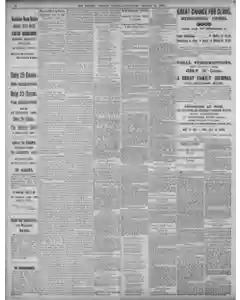
This newspaper page contains 23 articles. Subscribers can read the full text of each article.
Newspaper
Boston Weekly Globe
Location
Boston, Massachusetts, United States of America
Date
Aug 28, 1889
Page
4
Agents are informed that the rate to January 1890 drops from 35 cents to 25 cents. The commission remains as previously announced in the private circular.
The Weekly Globe promises subscribers more content for one dollar annually, including seventeen complete novels, numerous stories, poems, and news. It invites readers to form a club with a club offer advertised on the page.
The notice urges subscribers to renew promptly, stating expired subscriptions will be discontinued. It encourages readers to invite neighbors to subscribe, and to request free samples and agents' rates for new subscriptions.
In a Boston review style, the piece discusses army life as dramatic material, citing Captain Kina and Mrs. Custrr works and analyzing "The Deserter" as nearly a drama. It praises Army life imagery, frontier cavalry, social divisions, and the potential for a successful army play in American theatre.
William Suow, a Pennsylvania philanthropist who died recently, is praised for immense generosity. Executors reviewing Mr Shaw’s papers reveal many mortgages owed to him were small in amount and in arrears, yet he never exploited the destitute. His benevolence extended beyond mere fortune.
The speaker notes John Bull has proposed negotiations with the Washington government to settle the Behring sea dispute. He praises the move toward negotiation and arbitration as a vast improvement over forcing payments with threats. The piece warns against paying indemnities for prior seizures and urges a fair, future-focused settlement without drawing from the treasury.
The Dramatic Mirror praises Booties Baby for mirroring military life from West Point to frontier posts and battlefield skirmishes, urging dramatists to study army life. It envisions scenes of moonlit rivers, sutlers, privates, and comrades, with officer private tensions and frontier rescues as dramatic material. It also critiques society’s view of marriage and argues for broader social support to women, urging practical steps to improve wartime marriage opportunities and economic stability.
In verse, a New York World writer laments how modern children trade simple play for uniforms and costly tennis outfits. He notes his many sons require red shoes belts and blazer coats as rackets loom large and old toys lose favor. He reflects that progress pushes games toward fashion and away from his own childhood joys.
The article notes Tsar coronation era dining in a restored imperial hall built by Italian architects, with a buffet of imperial plate on grand days. It laments repeated rubbings by careless handlers, cites Burgundian captain Margaret’s 1641 remarks on vast gold and silver items, and records Willoughby’s account of a 200-person banquet served in gold vessels.
A portrait of John N. Edwards as editor of the Kansas City Times and Confederate veteran. The volume, compiled by his widow, gathers tributes and selections from Edwards writings, plus a final chapter recounting Shelby's expedition to Mexico. Proceeds benefit the widow. orders go to Wiley O. Cox, State Bank, Kansas City.
Edmund Yates notes a tale about the manuscript of Our Mutual Friend. George W. Childs owns the manuscript but it was not a Dickens gift. Trollope and Dickens debated the Times review prior to the manuscript’s £350 sale.
A man in a St. Louis restaurant ordered pork and beans hot with a bottle of yellow label. The waiter complied, the man ate contentedly, and his bill totaled 3 dollars and 90 cents, including 15 cents for the Boston luxury and 3 dollars 75 cents for champagne, which he paid quietly and left.
Bernhard Gillam, chief caricaturist of Judge, aged 82, once painted for a living but found little buyers. He smashed his works, became a wood engraver, and finally created caricatures that could make even a man with lockjaw laugh.
Johnny from Harvard led a Christmas lesson as part of an East side Sunday school program. The activity featured the Wise Men and highlighted teaching by the local instructor.
A 1890 national flower poll sparked by a Mayflower versus Golden-rod choice, organized with Louis Prang & Co. readers vote via a 26 cent card. Notables including clergy, writers, public figures and politicians weigh in, with votes split between mayflower and golden-rod. voters urged to decide by year end and await results sent after January 1, 1890.
A humorous portrait of a man chasing a fickle, stylish woman, praising her ever changing fashion as a desirable household piece. He endures judgment and expense, calls her extravagant, heartless, and fickle, yet persists to win her affection and place in his life.
A Starke colored farmer tired of hauling wood set vicious cars in his yard to force passersby to provide firewood. Dogs ran onto the road attacking pedestrians while the owner collected “earnings” at night. The cars are now poisoned and the man sits under a Jerusalem oak lamenting the situation.
The London Telegraph notes French cuisine claims 600 egg dressings, while English households still rely on plain boiled eggs for breakfast. Egg dishes like eggs and bacon, curried eggs, and eggs filled with anchovies gain fame, yet France favors cafe au lait and bread for breakfast, leaving English tables consuming more boiled eggs and eggs for desserts.
In a terse exchange Eli complains the steak is awful, Joe questions why it is eaten, and Eli admits the meat is kept to avoid hash, revealing a sly cost cutting motive in a terse kitchen moment.
Send for free sample copies for distribution agents wanted in every town address The Weekly Globe Boston Mass.
A veteran voice breaks down the true expense of keeping a horse, detailing bare living costs at $2.50 a week plus shoeing, plus optional higher bills for boarding and private stables. The piece compares $4 weekly basics to $10 weekly club care, and notes the full yearly burden can reach $700 or more. It emphasizes that careful budgeting reveals horsemanship remains a luxury rather than a necessity.
A foreign exchange cites extensive undrained coal regions worldwide including Netherlands Sweden Denmark Germany Bohemia Servia Hanover Russia Formosa and many others. It notes large coal beds across Asia Europe Africa and Oceania with potential totals in tens of thousands of square miles, implying U S dependence may be overstated.
A discovery in San Diego reveals a soap mine near the city with thousands of tons of fine natural soap. Local families tested the crude material with highly satisfactory results and samples shown in San Francisco indicate little extra treatment is needed for market readiness.
We want people to find what they are looking for at NewspaperArchive. We are confident that we have the newspapers that will increase the value of your family history or other historical research. With our 7-day free trial, you can view the documents you find for free.
People find the most success using advanced search. Try plugging in keywords, names, dates, and locations, and get matched with results from the entire collection of newspapers at NewspaperArchive!
You can also successfully find newspapers by these browse options. Explore our archives on your own!
Browse by location and discover newspapers from all across the world.
Browse by date and find publications for a specific day or era.
Browse old newspaper publications to find specific newspapers.