What is love said a bachelor bold in verse
A fragment from One Point of View presents a feisty exchange on love. The bachelor answers that love can buy a woman and sell a man, highlighting a cynical view of romance.

 This is just the beginning! Our collection holds over 300 years of history, including rare newspapers, obituaries, marriage records, birth records, and so much more—most of which you won’t find anywhere else!
This newspaper page contains 31 articles. Subscribers can read the full text of each article.
Newspaper
Big Piney Examiner
Location
Big Piney, Wyoming, United States of America
Date
Oct 26, 1916
Page
7
A fragment from One Point of View presents a feisty exchange on love. The bachelor answers that love can buy a woman and sell a man, highlighting a cynical view of romance.
Senator Treacle questions the reporter about silence while the servant reports the journalist believed the senator never missed a chance to talk. The dialogue contrasts discretion and expectation in a political exchange.
The first dear girl comments on the other’s heavy face paint while expressing surprise. The second girl replies with a snappy quip offering a borrowed mirror if her friend cannot afford one.
A humorous line laments a new sentimental ballad titled Drifting In a Canoe With the Girl of Your Dreams. The quip notes differing opinions on altering course and rocking the boat in this case.
The speaker recalls a demure woman with blue eyes and pure soul who inspires a confession about a sunset red. Her reply arrives as a blunt, confident line that challenges the speaker, delivering a striking twist in a cloudless moment.
A persuasive agent touts an essential article to a housewife, who counters she has sacrificed many things since marriage and would like to see something she cannot afford to do without. The dialogue captures frugal domestic bargaining and humor.
A sharp exchange erupts as observers describe the orator's long address filled with adjectives. Reporters note the crowd’s reaction and comments on sentence structure, with walls and ceiling humorously said to be splattered by split infinitives as the speech ends.
The dialogue centers on a bill claimed to run for about six years as speakers joke about perpetual motion. The exchange emphasizes duration and a playful suggestion of discovering perpetual motion.
Alleged humorist jokes about a manuscript while editor refuses to laugh. The exchange underscores a tense moment as the editor preserves seriousness, saying he feels more like crying when reconnecting with old childhood friends.
A fragment signals a dialogue about Bilggina and flattery. The speaker asserts Bilggina is immune to a flattering line aimed to influence his self perception. No broader context or events are provided in the readable text.
In a domestic skirmish Mr Scadson scolds Mrs Scadson for extravagant spending. She defends purchases by noting the fur coat cost eight hundred dollars while admitting she resisted buying a nine hundred fifty dollar alternative to save him money.
Herlock Shames jokes that the woman has a sour look from lemon juice folklore while Dock Watson and a pill peddler join in the banter. Shames counters that women generally have better complexions, then argues otherwise with a sharp remark.
A humorous quip notes a domestic relations judge asking relief from his duties due to rheumatism worsened by the constant tears in his court. The joke hinges on the idea that too much crying makes the atmosphere damp.
Informal plea asks if there is money in police work as a newspaper seller contemplates quitting the business to try something else. The dialogue reflects curiosity about earnings in law enforcement versus journalism.
Performers appear in every show as interpretive dancers mystify audiences with ambiguous themes. Critics search for meaning while audiences wonder what is being interpreted.
A dialogue questions a composer Boroffsky's health and age as excuses for his music. The exchange implies strong disagreement about the value of his work and the artistic merit of his composition.
A quirky report notes a track athlete lauded as a record breaker. An observer recalls offering breakfast to a tramp who boasted of counting a million crossties, adding a humorous local vignette.
A traveler warns a railway restaurant proprietor that a sandwich is oddly soft and easily bitten without breaking a tooth. The bemused boss questions the claim, as the traveler insists the sandwich isradically wrong and dangerously soft.
An agent offers a household necessity at a song in a brief exchange. A stout man at his lawn resists, saying he cannot sing a note, halting the proposed deal.
Enpeck notes Meeker’s good luck piling up as he and Mrs Enpeck discuss a $5000 court win from a man who alienated his wife’s affections. The brief exchange marks an odd display of envy over the rich outcome.
A girl in a sport skirt asks how to know if a man loves her. A maid with bar gain-counter hair answers she can tell by the way he looks at her when she is not looking.
A clipped phrase repeats praise for freedom from schedules. The Courter Journal snippet emphasizes leisure and escaping the clock and calendar.
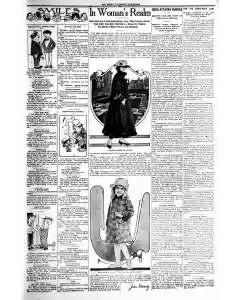
Luxurious furry fabrics dominate the season with thick textures in burgundy prunelle castor and dark brown tones. Fur trim is sought yet costly. Bolivia cloth coats and corduroy garments offer durable alternatives. The school coat features plaid velveteen, a bias cut shaped skirt, and velvet fur collar, suited for children from five upward.
United States Senator James A. Reed of Missouri rebutted Charles E. Hughes's attacks on the Adamson eight hour law and Democratic measures. He praised Wilson era reforms, warned of a return to old guard Republicanism, and argued Hughes would repeal progressive laws if elected.
Senator Henry M. Meyers of Montana cites a Chicago remark on a costly national strike and the mixed press reaction. He argues the nation should heed President Wilson’s approach amid wartime casualties and public worry.
Mrs Antoinette Funk Progressive leader now campaigning for Wilson challenged Raymond Robins who backs Hughes to meet and debate. Robins refused citing 17 challenges and bias accusations. Funk offered to unite women to back her, joking that her reply was from Robins office boy rather than Robins.
President F D Underwood of the Erle railroad in Milwaukee cites broad support among railroad chiefs for the eight hour workday. He warns it will cost Erle about 3 million dollars annually and says no new federal legislation is needed as the Interstate Commerce Commission can adjust wages and rates. He praises President Wilson and predicts continued prosperity with no bank or currency panics.
Senator Newlands of Nevada announces Chicago as the seat for a broad investigation into government ownership and control of railroads telegraph lines express companies river and ocean transportation and other public utilities beginning November 20. The inquiry will invite all interests to testify and may consider reorganization of the Interstate Commerce Commission and potential new regulation of wages and hours of carriers employees and related disputes. The scope includes national incorporation taxation and methods of acquiring government ownership.
National Democratic campaign trail lists major speakers. Vice President Marshall will visit Wisconsin Iowa Nebraska Missouri and Kentucky. Senators Lewis of Minnesota and Shafroth of Colorado headline a diverse slate including Towne Baker Walsh Hale Palmer Smith and Stone among others.
Harry A Garfield president of Williams College and son of James A Garfield is listed as vice president of the Woodrow Wilson Independent League of Massachusetts according to a New York press dispatch.
A Savannah Journal note observes a presidential candidate, Hughes, denouncing prosperity, describing the scene as a strange sight in a political portrayal. The remark highlights a campaign stance at odds with economic optimism.
We want people to find what they are looking for at NewspaperArchive. We are confident that we have the newspapers that will increase the value of your family history or other historical research. With our 7-day free trial, you can view the documents you find for free.
People find the most success using advanced search. Try plugging in keywords, names, dates, and locations, and get matched with results from the entire collection of newspapers at NewspaperArchive!
You can also successfully find newspapers by these browse options. Explore our archives on your own!
Browse by location and discover newspapers from all across the world.
Browse by date and find publications for a specific day or era.
Browse old newspaper publications to find specific newspapers.