J BE JUST AND FEAR NOT. THE DRA OF caxreraum
Poem fragment urges truth over pretense and courage over safety. The speaker counsels facing wind and danger rather than retreat, insisting the safe path is not our fate and action is required.

 This is just the beginning! Our collection holds over 300 years of history, including rare newspapers, obituaries, marriage records, birth records, and so much more—most of which you won’t find anywhere else!
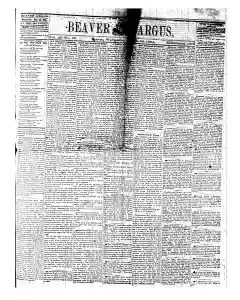
This newspaper page contains 25 articles. Subscribers can read the full text of each article.
Newspaper
Beaver Argus
Location
Beaver, Pennsylvania, United States of America
Date
Mar 23, 1864
Page
1
Poem fragment urges truth over pretense and courage over safety. The speaker counsels facing wind and danger rather than retreat, insisting the safe path is not our fate and action is required.
The article assesses General Sherman’s movement toward Vicksburg and the impact of his expedition on Mississippi railways. It highlights rail cuts, burned bridges and culverts, and the strategic effect on rebel supply lines, with credit to Grant and Sherman for shaping the next campaign.
Fragmentary OCR notes describe a rural incident involving a farmer and a deadly event affecting children. Details are unclear but suggest a tragic context with local residents reacting to the event.
An aged account describes a clashes in which a chief named Harrison dies after a cavalry action. A captured prisoner recalls the combat, noting the chief’s horse charging and a French bayonet securing the foe to the ground before the battle’s end.
The article details proposed federal rules for banks requiring notes in circulation, capital thresholds, and reserve holdings, plus possible bank closures by two thirds vote. It also reports a chaotic narrative involving a Shelby Kentucky figure, a prisoner question, and a Denver arrival by Fitz Porter regarding Colorado gold mining and a legislative resolution.
A partisan clash over a citizens committee to fund war efforts reveals distrust and claims of hypocrisy. The piece cites President Buchanan and Joby in a satirical, rail-thin tone, noting donors balk at taxes while others insist on supporting the cause amid public discontent.
A fragmented moral exhortation on duty and character urging officers to act by right over self interest. It warns against greed and gambling with public trust, promoting temperance, prudent money use, and avoiding wine or cigars to keep a clear mind. Emphasizes readiness to help, modest living, and restraint in expense.
A recent obituary recalls the death of Hon John E Bouligny of Louisiana and his independent stance during the Southern recession era. It notes his oath to sustain the U S Constitution and his pledge to resign if instructed by his constituents, vowing to stand by birth and the republic.
An 1860s Baltimore American fragment notes a Senate committee report on buying battlefield relics and several acres on South Mountain to honor fallen soldiers. It mentions funds for transport and a plan to restore the battlefield remains.
The document records President Lincoln ordering a draft of two hundred thousand soldiers for the army navy and marine corps with quotas by ward town and county to be set by the Provost Marshal General. It notes voluntary enlistment and drafts up to April 15 1864 and a bounty policy changing after April 5 1864 with $1000 total bounty and continuing previously paid incentives until then. Signed Abraham Lincoln and Ed Tuywneson official.
Reports describe a vigilance committee in Idaho Territory capturing and hanging five men near Virginia City and four at Bannock after confessions of gang involvement and robberies. Other officers including H Plummer and Geo Lane faced criticism amid broader attacks on Butler and anti abolition lectures tied to education reforms.
The passage argues that free American workers who migrate to the South will bring schools, churches, machinery, and educated labor, enabling the region to rival the North in wealth and loyalty. It posits Maryland and Virginia advancing like Massachusetts and New York, and Mississippi and Tennessee following the western states, to repeat the union’s developmental arc.
A garbled excerpt references the Delaware Legislature voting down a bill for the relief of volunteers and sympathy for wounded or slain soldiers. The text also mentions Copperhead themes and wartime measures, with unclear surrounding dialogue about money and Hides ob de.
Fragmentary OCR text references emancipation themes and abolitionist dissemination by the American Tract Society after a war period. Mentions Weidell Philippa Genttens and distributing publications to readers, reflecting 19th century reform messaging.
Gipthin Sampson Snyder reports that Bill Harper, long dreaded in Randolph and surrounding counties since the rebellion, was tracked to Leonard Harer’s house. A skirmish ensued as Harper’s men seized him. shots were fired, and Harper was subdued after twelve to fourteen bullets struck Snyder’s squad. Harper is blamed for numerous murders, cattle thefts, and widespread destruction.
An old lady accuses Sam’was Cavaut An. She marks his lips with chalk after Sam jokes about stealing jam. When she returns, she asks no questions as Sam’s lips show a chalked smear, a quarter of an inch thick.
Fragmented text notes a rebellion affecting local polls and congressional delegation selections in Missouri Kentucky and Tennessee. Kentucky members were chosen on a single ticket with the highest vote 998 and an unsuccessful rival also high. Humphrey Marshall is named among those elected and John Breckinridge among those defeated.
A fragment reports B Williams a longtime New York Times printer, humorously described after illness and a tale of a tax loss and odd remedies. The piece mentions Barnum and a curious popular resort, with odd details on bread, cloth, and tobacco usage.
The Examiner recounts raids and burning farm homes as Union forces strike toward Richmond. It notes rebels driven back by a cautious enemy and mentions Ulric Dahl, a youth wounded at Get York near Jefferson Davis’s captor, and a pale lad awaiting a new turn in the fighting.
A Massachusetts young man enlists, passes the surgeon, receives seven bouts of bounty, and goes into camp. He is discharged for defective vision and tries the same game again as a veteran, but is arrested and may lose an eye.
An English photographer Wynfeld claims his studio ranks above peers through careful posing and gentle light, noting that strict immobility is unnecessary. He urges sitters to move slightly to soften the form while preserving key features.
In a rough fragment, Rebel General Lee is described in a tent with unclear language. The text mentions drinking and popularity with the army, hinting at reliance on him, though many phrases are garbled.
A man named Oats was hauled to prison after beating children. During sentencing he claimed it was hard that a man is not allowed to thrash his own oats.
A government mint assesses issuing two new coins including a bronze piece and a two cent coin as a practical measure to extend the currency supply.
Fractured OCR item notes a person arriving in New York carrying money and a purchase related to a rebripe term, with illegible names and amounts.
We want people to find what they are looking for at NewspaperArchive. We are confident that we have the newspapers that will increase the value of your family history or other historical research. With our 7-day free trial, you can view the documents you find for free.
People find the most success using advanced search. Try plugging in keywords, names, dates, and locations, and get matched with results from the entire collection of newspapers at NewspaperArchive!
You can also successfully find newspapers by these browse options. Explore our archives on your own!
Browse by location and discover newspapers from all across the world.
Browse by date and find publications for a specific day or era.
Browse old newspaper publications to find specific newspapers.