Beaver Argus and Advertiser Notice
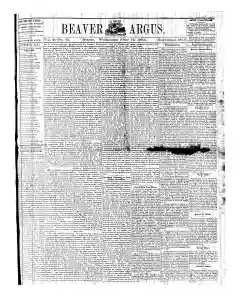
Fragmentary OCR shows a Beaver, Pennsylvania publication with address lines and prices. It references the Beaver Argus and Advertiser, a Wednesday issue, and a subscription rate. full details are unreadable.

 This is just the beginning! Our collection holds over 300 years of history, including rare newspapers, obituaries, marriage records, birth records, and so much more—most of which you won’t find anywhere else!
This newspaper page contains 14 articles. Subscribers can read the full text of each article.
Newspaper
Beaver Argus
Location
Beaver, Pennsylvania, United States of America
Date
Jun 14, 1865
Page
1
Fragmentary OCR shows a Beaver, Pennsylvania publication with address lines and prices. It references the Beaver Argus and Advertiser, a Wednesday issue, and a subscription rate. full details are unreadable.
A long witness narrative details Confederate agents in Canada plotting raids and assassinations against Lincoln and Johnson, naming James A. Seddon, Jefferson Davis, Booth, and others. It covers dispatches, commissions, and planned attacks including Ogdensburg, St Albans, and even destroying the Croton Dam. The testimony ties Surratt to conspiracies and describes interviews and implications for the Richmond government and Union reaction. It also recounts a Pennsylvania ceremonial clash returning battle flags to Governor Curtin amid Civil War reflections.
The fragmentary OCR appears to depict a World War I or II era commemorative passage with martial imagery. It references marches, bravery, sacrifice, flag symbolism, and honors owed to soldiers, though the exact event, author, or date remains unclear due to the garbled text.
The text argues for a balanced view of frugality and happiness, opposing stinginess. It asserts no duty to deny all amusement, seeking wealth only to secure independence and not to impress others. Wealth should not define a person. prudent economy is a virtue compatible with humane living.
The report from the Board of Church Extension details $252,868 in receipts over ten years and 203,316 in appropriations aiding 506 churches, plus property value gains and tens of thousands of worshipers served. It notes ongoing growth, with past efforts totaling 382 churches and $868,400 donated, and outlines related religious activities and prominent clergy.
The writer compares cow conformation and milk potential noting long calf length and body proportions affect milker quality. They prefer a first rate milker, despise poor form, and emphasize stable udder quality and breed reliability for future calving and sustained milk production.
Fragmentary text notes an establishment at Attietam Sharpsburg Maryland with a legislative appropriation of 7000 dollars. It mentions a battle field lot purchased near a town, and that ground once occupied by General Lea8 includes a signal station, reflecting wartime actions and commemorations.
The president urges new soldier clerks in the office, detailing a policy move to staff offices with private soldiers. The initiative aims to place enlisted personnel into clerical roles within the executive branch.
A fragmented OCR snippet references public notices including religious political and other notices. It mentions rates for business cards in a local paper and lists marriages deaths and public notices. The readable text remains incomplete and unclear which limits precise details.
In a Germantown Telegraph note, farmers discuss controlling pests on cantaloupe vines and radishes. After trials with dew-dewashing, strong alo es solutions, and soap suds, whale oil soap is recommended in about one pound per four gallons of water. Some suggest elder bushes as a pest repellent, but the article doubts its effectiveness.
The article describes a pest affecting European and American trees called the woolly aphis or wool praphia. A farmer named Afol treated infested trees with brush and boiling water, using a pruning knife to remove tumors. After repeated washing and boiling, the pest was destroyed and trees thrived with no recurrence.
The article discusses a rare equine ailment in horses treated with dry fodder soaked or moistened. It notes that in some cases disease early stages responded to mixing grease with food and recounts a peculiar instance where a horse improved after avoiding greasy water from dishwashing and later developed a liking for a drink.
Fragmentary remarks describe a quirky method or superstition about starting horses, noting repeated trials that allegedly never fail. The speaker claims it gives the performer another focus, with skeptical yet curious tone about the practice.
A fragment describes a folk remedy for a horse shoulder: boil a quart of water, dissolve salt, wet a blanket with the solution, apply to the shoulder, and repeat until relief or cure is noticed.
We want people to find what they are looking for at NewspaperArchive. We are confident that we have the newspapers that will increase the value of your family history or other historical research. With our 7-day free trial, you can view the documents you find for free.
People find the most success using advanced search. Try plugging in keywords, names, dates, and locations, and get matched with results from the entire collection of newspapers at NewspaperArchive!
You can also successfully find newspapers by these browse options. Explore our archives on your own!
Browse by location and discover newspapers from all across the world.
Browse by date and find publications for a specific day or era.
Browse old newspaper publications to find specific newspapers.