No Title
Poetic meditation on clinging to mortal things that fade with time. The speaker laments valuing passing objects yet finds meaning in their impermanence as a motive for living. The verse evokes timeless scrutiny of reality and attachment.

 This is just the beginning! Our collection holds over 300 years of history, including rare newspapers, obituaries, marriage records, birth records, and so much more—most of which you won’t find anywhere else!
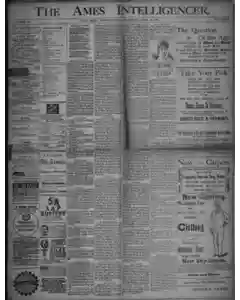
This newspaper page contains 14 articles. Subscribers can read the full text of each article.
Newspaper
Ames Intelligencer
Location
Ames, Iowa, United States of America
Date
Apr 16, 1891
Page
1
Poetic meditation on clinging to mortal things that fade with time. The speaker laments valuing passing objects yet finds meaning in their impermanence as a motive for living. The verse evokes timeless scrutiny of reality and attachment.
A report discusses how fear and other factors may influence outcomes from African arrow poison. It notes a dark resin-like toxin that can kill elephants, with rapid deaths after puncture and varying times to death in humans. Treatments tested include emetic, wound suction, injections, and ammonia solution.
An American traveler in London lends his umbrella with a monogrammed knob to a friend. The friend notices only A and B letters and misses the H, realizing the owner lent it to an Englishman who likely dropped the initial.
The item discusses Oxford slang bad form from Archbishop Laud’s 1888-89 letter about masters at St Marie’s sitting bare and out of form in streets. It also notes war-time government bonds drifting below par, with 1861 6s and 1864 5s fluctuating in 1862 and 1867, respectively.
The passage muses on common foot ailments and a surge of eccentric shoemakers as a sign of poor foot care. It quotes Paley on fish happiness and notes women's quick insight into male fickleness, while hinting at the elusive search for a woman.
A St. Louis dispatch reports Harvard President Eliot spoke at the Merchants Exchange rostrum arguing for a stable currency. He asserted business confidence anchors property values and warned against shifting westward opinion swamping ballots. He contrasted merchant stability with eastern regulatory waves.
A dense column discusses Farmers' Alliance activity amid pressure from Chicago exchanges over the American Live Stock Commission's dividends and possible bans. It cites figures like E. H. Robinson and P. B. Plumb, notes public criticisms, and recounts related political commentary and anecdotes from Kansas and New York papers.
The National Economist argues the sub-treasury is a shibboleth of reform and exposes farmers and leaders who support money power while disguising motives. It claims even honest opponents misunderstand the measure and that opposition always serves the best interests of agriculture.
John J. Ingalls argues the Alliance is not a casual impulse but a growing organization with potential presidential influence by 1892. He notes it will recruit from both parties, warns against radical elements, and praises its disciplined leadership and成果 in Kansas and Nebraska.
Notice served on Kansas congressmen that state patronage will be controlled by Senator Plumb and that only Republican postmasters and partisan gains await the Alliance. The move is framed as exposing administration hypocrisy in word versus deed.
Congressman Davis favors government lending of new legal tender notes to farmers at 1 percent. He outlines a method: imagine owing Love you $5,000 plus accumulated farm interest and handling the loan accordingly.
A brief meditation on misused phrases that hide true meanings. It notes we often echo others' expressions about clocks striking and actions being involuntary, highlighting how language can mislead without intent. The piece cites Harper's Young People as its source.
A quotation contrasts ancient Indian engravings in temples with modern neglect of durable inscriptions on copper. The note laments declining art energy as a nation ready to greet rulers yet fails to preserve lasting records. A light social aside follows about an eloping girl and her sweetheart noting a stern parent.
The piece profiles Lady St Vincent of England born Miss Duncomb in Philadelphia and her ascent from mint clerk to duchess sister to the Leinster, noting beauty and modesty. It also recounts a Scottish professor’s pride in building a university hall with his own hands and reflects on social change in New York society.
We want people to find what they are looking for at NewspaperArchive. We are confident that we have the newspapers that will increase the value of your family history or other historical research. With our 7-day free trial, you can view the documents you find for free.
People find the most success using advanced search. Try plugging in keywords, names, dates, and locations, and get matched with results from the entire collection of newspapers at NewspaperArchive!
You can also successfully find newspapers by these browse options. Explore our archives on your own!
Browse by location and discover newspapers from all across the world.
Browse by date and find publications for a specific day or era.
Browse old newspaper publications to find specific newspapers.