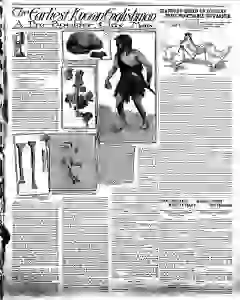
Ipswich Finds Modern Man Beneath Chalky Boulder Clay
A Ipswich discovery near a brick field alongside London clay reveals bones and flints from a preglacial era. Expert study at the Royal College of Surgeons notes a modern type of man beneath the chalky boulder clay, with a distinct tibia suggesting unique locomotion. The find ties to Galley Hill and Heidelberg remains, tracing evolution from pre boulder clay to Neanderthal forms and the Pithecanthropus erectus debate.
MENTIONED IN THIS ARTICLE
Ipewich
England
Europe
Germany
Belgium
France
Ipswich
London
Woolwich
Reading
Thanet
Reid Meir
Royal College of Surgeons
Arthur Keith
W. Whitaker
J. B. Marr
George Slater
F.G.S
M. i
Galley Hill
Thames
Upiminster
Hosex
Inswich
Keith
Gich
Valley
the Neckar
Heidelberg
W. J. Sollas
Eugene Dubois
Holland
Java
Dubois
Standard breed of poultry most profitable to farmer
By Oscar Erf the article explains pure-bred stock as uniform through generations, contrasting it with cross-bred and mongrel stock. It argues standard-bred poultry balances color, body shape, and production traits, noting pure-bred fanciers emphasize uniformity and practical meat and egg qualities over mere fancy.
MENTIONED IN THIS ARTICLE
Oscar Erf
Start with good stock not a flock of cull chickens
Many mistakes made at start. Advice to beginners: invest in good stock or eggs from reputable breeders rather than poor stock. Reflecting on wasted years and the cost of feed, the piece urges new poultry keepers to choose quality to avoid repeat errors and long delays in profitability.
MENTIONED IN THIS ARTICLE
Dex
Raising crops for the silo in corn farming plans
The article advises selecting land for the largest possible green corn yield to fill a silo efficiently. It recommends plowing alfalfa sod early, using well rotted manure, and applying fertilizer. Expect twelve to fifteen tons of green corn per acre at harvest, and build a large silo to accommodate expanding corn acreage and animal feeding.
Paralyzed Hens Dispatch Recommended for Such Birds
Paralyzed hens unable to stand but otherwise healthy are likely paralysed. Little can be done for these birds, and it is best to dispatch them quickly.