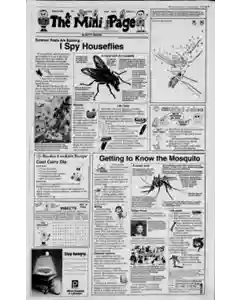
Summer Pests Are Buzzing Spy Houseflies
Summer pests are buzzing as houseflies and mosquitoes, relatives in the same insect group, fly up to 200 times per second. Flies spread germs by brushing them onto food after landing on waste, posing disease risks like cholera or typhoid in some regions, and diarrhea in the United States. they also play a part in nature by eating other insects and serving as food for birds.
MENTIONED IN THIS ARTICLE
United States
Life cycle of houseflies stages and reproduction
A concise overview of the housefly life cycle notes metamorphosis from egg to larva to pupa to adult. Eggs laid in manure or decaying matter hatch in eight to twelve hours into maggots. In about five days the larva hardens and becomes a pupa, and after roughly five more days an adult emerges. A female may lay up to two thousand eggs in a lifespan of about twenty six days in warm weather.
Getting to Know the Mosquito and Its Life Cycle
The article explains why floods boost mosquitoes by creating standing water for egg laying. It details the life cycle from eggs to larvae wrigglers and pupae tumblers, notes that bites inject saliva causing itching, and highlights diseases such as yellow fever and malaria. It credits experts from the Smithsonian for help.
Also Mentioned on This Page
Capita
Andrews
McMeel PO
Nansi Miimi
Poison
Gretchen Molina
Tara Marecek
Perrot Ainley
Mars
Feneledge
Ong
Quitoes
Columbus
The
New World
Philadelphia
U.S
George Washington
Walter Reed
Nathan Erwin
O. Orkin
Entomol
National Museum of Nature History
Smithsonian Institution
Washington, D.C
Mosquio

 This is just the beginning! Our collection holds over 300 years of history, including rare newspapers, obituaries, marriage records, birth records, and so much more—most of which you won’t find anywhere else!