He Who Knows a Book Poem Excerpt
A verse from Leslie's Monthly describes a traveler with a book in hand wandering from morning to night. The speaker finds rest and nourishment in reading, gaining comfort and ease on the road. The message praises books as companions that ease hardship and provide contentment day by day.
MENTIONED IN THIS ARTICLE
Leslie’s Monthly
Evocation of Madeline Ends in Tragic Vision
In a drawing room discourse on spiritualism, Pierre Franchel seeks proof of Madeline’s spirit through Scottish medium Claymore. The séance conjures a moonlit piano apparition that costs Pierre his life as he embraces his dead wife, leaving friends shaken by the peril of spectral belief.
MENTIONED IN THIS ARTICLE
Francois
M. Crooks
Pierre Franchel
Genain
Mme
Franchel
Mozart
Pierre
Madeline
Claymore
Paris
Gilbert Dore
Bahia Sees 200000 Residents in 17000 Homes
The Brazilian coast city Bahia counts about 200000 people living in 17000 houses. A cultural shift is noted as women claim responsibility for broader social leadership, challenging traditional male dominance.
MENTIONED IN THIS ARTICLE
Bahia
Ram's Horn Blasts and Sermons on Repentance
A collection of religious maxims warning against hypocrisy and urging inner purity. It contrasts faith with outward shows and notes on moral discipline, followed by long specifications of timber use for matches ties poles and paper, citing Gale Review.
MENTIONED IN THIS ARTICLE
United States
Gale Review
The Old Home and the Country Child
The piece reflects on Thomas Dunn English and his ballad Ben Bolt, praising songs about country life that stir nostalgia. It cites poems like The Old Oaken Bucket and Home Sweet Home, noting their humble charm and lasting memory for generations and young readers alike. It then shifts to weed destruction, urging farmers to curb spread, highlighting the Canada thistle as a manageable nuisance with cooperative farming practices.
MENTIONED IN THIS ARTICLE
Thomas Dunn English
Ben Bolt
Edgar Allan Poe
Annie Laurie
Swanee River
The Blue Jay as a Self-Assured Bold Bird
A Century article extols the blue jay as a confident, independent, and aggressive bird that outshines many men in perceived success. It notes his conspicuous voice in fall and winter, restraint in love songs, owl-baiting restraint, and secrecy about nest sites unlike robins, catsbirds, or thrashers.
Humorous Exchange Highlights Yiddish Wit
A brief New York Times quip features Hewitt and Jewett trading lines about life insurance and dying of joy. The banter frames ignorance as bliss and ends with a punchy retort regarding insurance and fate.
MENTIONED IN THIS ARTICLE
Hewitt
Jewett
New York Times
Killing a Noxious Weed Canada Thistle Battle Plan
A farmer facing Canada thistle should start in June with plowing and repeated tillage into fall to destroy young growth. Alternative methods include mowing when plants are shoulder high, or cultivating land for potatoes or cabbage followed by Hungarian grass seeding. Maintain control from July to frost and extend efforts to uncultivated roadsides with neighbor cooperation.
Detecting Counterfeits by Texture and Paper Quality
The article discusses how cashiers and tellers identify counterfeit money by instinct and texture. It explains the superiority of genuine notes due to engraving, printing quality, and dedicated government paper. It notes counterfeiters’ difficulty matching paper and printing processes and mentions controlled paper supply for national bank notes.
Lost Child in Strand Cheerfully Reunited by Police
A Metropolitan officer spots a crying boy in the Strand who proclaims he is lost. The kind constable vows to locate the parents and give a rebuke if found. A Bow Street sergeant asks if he knows the child, suggesting detention if no guardian is found. The outcome remains undisclosed.
MENTIONED IN THIS ARTICLE
Metropolitan Police Force
Strand
Boohoo
Bobby
Bow Street
His Marvelous Check and the 15 Cent Cigar
A penniless constituent of Abra ham Gruber asked for a dollar loan. Gruber gave a 2 bill and told him to buy a 15 cent cigar and return the change. The visitor returned with 85 cents and asked who the cigar was for, prompting Gruber to order him out.
MENTIONED IN THIS ARTICLE
Abraham Gruber
Colonel Gruber
Gruber
New York Times
If a Man Had 1600 Dollars What Would He Want
A humorous Arkansas man asked for a price of a universal saw mill and balked at 1600 dollars. A postal reply asked what he would do with that money. The excerpt closes with encouragement to drop a mistake and move on.
MENTIONED IN THIS ARTICLE
Arkansas
Also Mentioned on This Page
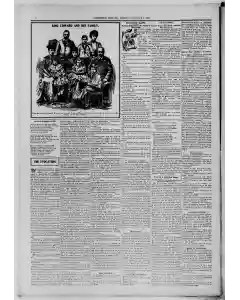
King Edward
King
Queen
Princess of Wales
Prince of Wales
Princess Victoria
Waleses
Madeline Meurice
Chateau
Changis
Mme. Franchel
Ram
Iaith
Robin
Theoburnum
Blue Jay
Canada Thistles

 This is just the beginning! Our collection holds over 300 years of history, including rare newspapers, obituaries, marriage records, birth records, and so much more—most of which you won’t find anywhere else!