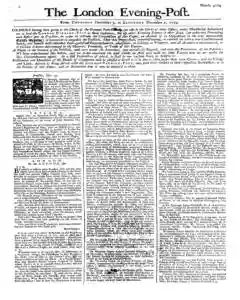
London Evening Post declares resistance to excise and press control
In December 1754 the paper announces clerks must stop sending customers the London Evening Post, urging circulation of other papers. It asserts its constitutional zeal against encroachments on liberty and property and invites noblemen, MPs, clergy, and laity to direct orders, via booksellers or the printer, for home delivery.
MENTIONED IN THIS ARTICLE
London Evening Post
Weil
House of Commons
London Evening-Post
India
China
East India Company
Gure
Mapoura
Brabant Assembly Eases Duties on Wine Tea and Trade
Brussels reports that in the latest Assembly of Brabant the duty of two Sols per pint of wine and fifteen Sols per pound of tea, plus other taxes, were lifted after representations to the Court. The Empress preferred loss over gains, arguing the duties harmed trade and violated treaties with neighboring states.
MENTIONED IN THIS ARTICLE
Brabant
Swift appointed Gentleman of the Ordnance in Dublin
In Dublin on November 30 Jonathan Swift was named by Lord Viscount Molesworth to replace John Marshal as a Gentleman of the Ordnance after Marshal’s resignation. A soldier in General Otway’s Regiment on Dublin duty died after ingesting gunpowder and brandy following a court martial punishment. A Kerry Amethyst cliffs operation is announced, producing stones like those in Europe used for a necklace and earrings once gifted by the Countess of Kerry to Queen Caroline.
MENTIONED IN THIS ARTICLE
Irelawn
Dublin
Jonathan Swift
Viscount Molesworth
Ordnance
John Marshal
Kerry
Europe
Countess of
Caroline
Mortlake
John Anftis
Anne
Corpus Christi College
Oxford
Order of the Bath
Bath
Devonshire
Cornwall
Thomas Stone
Serjeant Prime
Serjeant
Willes
Serjeant Poole
Huffey
Serjeant Wynn
Sex, Eyre
Robinson
Chester
Prince William
Prince Henry
Kew
Charlton- House
Jamaica
Knowles
Cooper
Moore
Eccles
St. Bartholomew the Lots
St. Bartholomew’s Hospital
Thomas Hay
Jenny Beckford
John Palmer
Mary Beckford, Nieves
Bailard Peckford
Laws for the Poor and Public Welfare Spark Debate
A London manuscript weighs fifty years of Poor Laws, arguing they fail to aid the incapable while ensnaring the industrious in rising costs and ineffective Bridewell reform. The piece criticizes patriotic rhetoric, calls for sharper policy, and touches on trade, currency, and colonial governance with numerous oblique references.
Also Mentioned on This Page
Brussels
London
Paris
Hannibal
Aras
Duke of ‘Bolu
Lort Ladttnsne
Rotorum
Hants
Fiasee
iejeutengat-Genera Asnes Pheumoncehus
Robert’ Hanks
Kington Fry
Dorchester
Learned Society of F Abitignatiés
Rolls
Daunterey Smith

 This is just the beginning! Our collection holds over 300 years of history, including rare newspapers, obituaries, marriage records, birth records, and so much more—most of which you won’t find anywhere else!