Class Driver Licence System Update Enters Effect
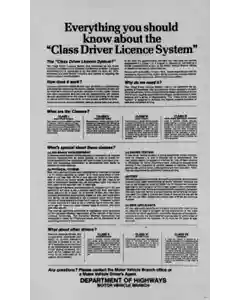
The Class Driver Licence System developed by the Driver Licence Committee of the Canadian Conference of Motor Transport Authorities will take effect on April 1 1975 Manitoba joins British Columbia and Alberta in adopting the Uniform Class Licence System. Drivers who completed the questionnaire will receive renewal applications for the class they qualify for and may have licences reclassified if their vehicle class changes. Birth dates in April 1975 renewing this month will get renewal applications for the class they qualified for. The system aims to raise knowledge skill and physical fitness for operating large vehicles and to recognize professional status and responsibility of drivers.
MENTIONED IN THIS ARTICLE
Canadian Conference of Motor Transport Authorities
Manitoba
British Columbia
Alberta
Motor Vehicle Branch
Classification of Commercial Vehicle Licences
Semi-trailer trucks are Class 1 vehicles requiring a Class 1 licence enabling operation of all other vehicle classes except motorcycles. Buses with over 24 seats are Class II vehicles requiring a Class II licence allowing operation of all classes except motorcycles and semi-trailer trucks.
New Licencing Rules Expand Air Brake and Vision Standards
Ontario driver licence changes introduce air brake endorsement and strict practical exams. Vision rules require 20/30 and 20/50 for Class I to IV with color distinction and 120 degree field. Medical reports are mandated for new and reclassified licences, with periodic renewals pegged to age. A new testing location opens in Winnipeg for Classes I to III, with enhanced examiner training. Fees rise: standard licence $3, road tests $10 for Class I and $7 for Class II and III, others stay at $7. Applicants must be 18+ and pass class-specific written tests.
MENTIONED IN THIS ARTICLE
Canadian Medical Association
The
Thomas St
Nairn Avenue
Winnipeg
Driver fitness rules persist for vehicle classes
Existing physical fitness and competence standards remain in force for drivers in Classes V VI and VII. Examinations will continue to be given at current driver testing locations and each class will stay restricted to its specific endorsement.
Definition of SS V Passenger Cars and Related Vehicles
Class V vehicles include passenger cars and buses while not carrying passengers, trucks with a gross vehicle weight not exceeding 24,000 lbs, increased from 20,000 lbs, and any other combination of vehicles such as trailers where the towed vehicle does not exceed 10,000 lbs.
Definition of Class II and Class III Vehicle Licences
The text defines Class II vehicles as those with gross vehicle weight over 24,000 lbs and Class III as any combination excluding semis and buses carrying over 24 passengers. It states a Class II licence is required to drive this class and permits driving lower classes except motorcycles.
Class IV Vehicles Defined in Licensing Rules
Class IV covers taxicabs buses with twenty four or fewer seats ambulances fire trucks and other rescue and emergency vehicles. A Class IV licence is required and authorizes Class V vehicles but not motorcycles.
Class VI Motorcycles Require Special License Endorsement
Motorcycles are designated as Class V vehicles and require a separate license or an endorsement on any preceding class to operate this type of vehicle.
Class VII Learners Licence Definition and Requirements
A Class VII learner’s licence authorizes operation of vehicles of the indicated class for learning. The holder must be accompanied by a licensed driver of the appropriate class and have at least one year’s experience operating that class of vehicle.
Also Mentioned on This Page
SS V
Motor Vehicle Driver’s
Department OF Highways Motor Vehicle Branch

 This is just the beginning! Our collection holds over 300 years of history, including rare newspapers, obituaries, marriage records, birth records, and so much more—most of which you won’t find anywhere else!