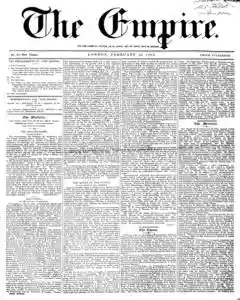
The Empire Departments Revealed in Historic Pageant
A fragmentary OCR list outlines departments and divisions within a historic empire themed pageant. It mentions Toe Platform, Parliament, Press, Nations, Colonies, Metro Polis, Prince, and various cultural and civic sectors alongside an advertiser section, all presented in a stylized, period voice.
Subscriptions for The Empire Offer Details
The Empire offers annual subscriptions at 21s and half year at 10s 6d and quarterly at 5s 3d, all payable in advance. All business communications should go to Mr. Thomas Dick at 145 Fleet Street, London.
MENTIONED IN THIS ARTICLE
Thomas Dick
Fleet-street
London
From Which They Speak Freely They Speak Alone
A terse note asserts that speakers on the platform may speak freely, yet each is personally responsible for the 18 utterances attributed to them. The wording emphasizes individual accountability for statements made in public discourse.
The British Babel and the Nation’s decay, SAXON
Aザ long denunciation laments a divided England amid church, state, and press quarrels. The author attacks clergy corruption and imperial decline, warns against revolution, and calls for constitutional reform and a new Parliament born of industrial life to restore national vitality.
MENTIONED IN THIS ARTICLE
England
Jerusalem
Denison
Russia
Rome
Cromwell
Salvation of England and France through reform and revolution
The speaker argues that England was saved by the Protestant Reformation and popular uprising, lifting the people to power and routing corrupt aristocracy. It claims public protest revived the nation, led to a new order of statesmen, and extended English strength for two centuries, while likening France’s Revolution to a salvation despite its violence.
MENTIONED IN THIS ARTICLE
Europe
Napoleon
Commonwealth
Rome
Israel
Egypt
Assyria
England
Commons
Colossus
Henry the Highth
Elizabeth
Milton
Cromwell
Blake
Eneland
France
Paris
The Queen of the World and the Power of Public Opinion
A provocative piece argues that public opinion should guide society, opposing Jesuit spiritual power and sacerdotal control. It condemns church fees, state coercion, and the abuse of religious authority, urging a library of secular works to emancipate opinion and avert national ruin.
MENTIONED IN THIS ARTICLE
Cain and Abel
Cardinal Wiseman
London
John
Earth
Imman
Paley
Christ
Zoroaster
England
Zwinglius
New Westminster Bridge
Cobbett
Gough
W. B. Carpenter
Crown Arrivals and Windsor Garter Ceremony Updates
The Queen and Prince Albert with royal party arrive at Windsor Castle from London. Morning services in the Private Chapel included Holy Communion. The Queen walked the grounds. Lord Alfred Paget becomes Equerry. Windsor hosts a Garter Chapter with Dean Gerald Wellesley sworn as Registrar and Earl of Carlisle knighted at St George's Chapel.
MENTIONED IN THIS ARTICLE
Wispsor
Fes
Prince Albert
Prince Arthur
London
Prince of Wales
Princess Royal
Alice
Prince Alfred
Duchess of Kent
Windsor
Wrypsor
de Lacy Evans
Alfred Paget
Charles Grey
Joe Garter
Order of the Garter
Gerald Wellesley
Royal Chapel of
St. George
George Earl of
Carlisle
Crisis reports portend new ministry formation
The Times outlines the Saturday to Wednesday crisis with Lord John Russell and Palmerston guiding audiences at Buckingham Palace. Palmerston to form a new ministry while most late ministers likely retain seats. War and Home posts to be filled, with changes including Panmure as War Secretary and Layard to Parliament Under-Secretary.
MENTIONED IN THIS ARTICLE
John Russell
Buckingham Palace
Lord Palmerston
Earl of Clarendon
Mr. Gladstone
Lord John
Sidney Herbert
Duke of Argyll
Gladstone
Earl of Aberdeen
George Grey
Privy Council
War and Home Departments
England
Globe
Lord Canning
Mr. Cardwell
John Young
Ionian Islands
Cmnisis
Windsor Castle
J. Graham
Duke of Bedford
Earl
Windsor
Lord Grey
Charles Wood
Robert Peel
Hayter
Lord Panmure
Cardwell
the Treasury
Earl Granville
Home Department
Layard
Ireland
Henry George Ward
Royal ceremony and new ministry at court
The Queen announced a Knight of the Garter and the Earl of Aberdeen retained the Thistle. A Privy Council met with Prince Albert and leading officials. Sidney Herbert sworn as Principal Secretary of State. Viscount Palmerston, Granville, Panmure, and others kissed hands as appointments were made. A proclamation was ordered to curb contact with the Queen’s enemies.
MENTIONED IN THIS ARTICLE
Francis Earl of Ellesmere
George Earl of Aberdeen
Order of the Garter
Earl of Aberdeen
Order of the Thistle
Prince Albert
Earl Granville
Viscount Palmerston
Marquis of Lansdowne
George Grey
Sidney Herbert
Lord Panmure
W. E. Gladstone
Charles Wood
Viscount Canning
Earl Spencer
Duke of Wellington
Marquis‘of
Abercorn
Henry Fitzroy
England and
Wales
Treasury
Privy Council
Also Mentioned on This Page
Toe
Toe Taronz
Tre Natrions
Co Onies
Metroo PoLis
Mepc.ury
PropLe
Tuee
Dramma
Muszeum
Tae Pogst
TuHe Booxworm
Farma
Bupcer
Wit—Tue Beycu
Mart—Tuhee
Toe Advertiser
THE
the Ministry

 This is just the beginning! Our collection holds over 300 years of history, including rare newspapers, obituaries, marriage records, birth records, and so much more—most of which you won’t find anywhere else!