Incomplete text fragment from year end notice
Fragmentary OCR text mentions entities likely tied to a year end report or accident, but lacks clear names, dates, places, or actions to form a complete summary card.

20 Sep 1940
Page 1
 This is just the beginning! Our collection holds over 300 years of history, including rare newspapers, obituaries, marriage records, birth records, and so much more—most of which you won’t find anywhere else!
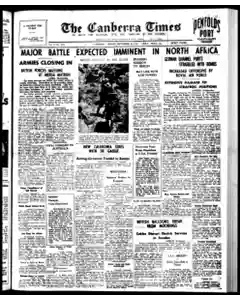
This newspaper page contains 15 articles. Subscribers can read the full text of each article.
Newspaper
Canberra Times
Location
Canberra, Australian Capital Territory, Australia
Date
Sep 20, 1940
Page
1
Fragmentary OCR text mentions entities likely tied to a year end report or accident, but lacks clear names, dates, places, or actions to form a complete summary card.
British and Italian armies tighten the noose toward a major desert battle near Cairo. Light British units delay Italian advances while tanks, supply wagons, and artillery push forward. RAF strikes targets in Benghazi, Malta, and surrounding areas as both sides prepare for large scale action.
Prime Minister Menzies warned in a remote address that Middle East developments risk altering Australia’s position in the AWLP. He said Italy’s advance toward Egypt plus thousands of Australians in the Middle East demand renewed reinforcements and a unified government to avoid Labour compromises on Britain or troop recall.
Dr Karl Kling of the State Bacteriological Research reports isolating the infantile paralysis virus in patient excretions and sewer water. He says infection spreads mainly by indirect methods like typhoid and cholera, and live virus has been found in butter made with contaminated water.
Rome report in The Giorni ditalla estimates the British Army in Egypt at 230000 with 90000 recent arrivals from Palestine. It notes high quality war material and a large number of armoured units including tanks and artillery of all calibres.
Militia forces attending instructional courses between 1 pm and 5 pm will receive travel allowances by rank. The rules, gazetted yesterday, apply retroactively to last July, with adjustments made to any prior allowances for this period.
Acting Governor of New Caledonia resigns amid demonstrations over Vichy allegiance. Sautot, Free France leader, succeeds him and expresses satisfaction at a bloodless change. Public mood favors De Gaulle, with about half the population backing rejection of Vichy. Trade talks with New Zealand seen as unlikely to yield immediate gains due to shipping limits.
Reports from Indo China indicate ongoing Japanese civilian evacuation with few Chinese leaving yet. US and British journalists in San Francisco say only a British victory or Western policy can avert Eastern turmoil, while China foresees national unity despite war. Chinese forces seize part of the Yunan railway as foreign warships move toward Indo China.
In London the Swiss representative Dr. Kel Jer arrived to discuss the food blockade and Swiss chartered ships held at contraband control ports. The talks involve arrangements with American interests and other sources of information amid ongoing global economic tensions.
A Times correspondent reports Dr Suner, Spain's Foreign Minister, stating Spain is momentarily non belligerent and General Franco will decide when to end aloofness. He notes Suner's Berlin visit aligns with Britain's settlement talks and mentions Rome conversations with Mussolini and Ciano. A British Spanish oil import agreement is praised as a product of long economic warfare negotiations.
The New York Times editorial endorsed Willkie, arguing he can sustain the defence program and boost economic activity, while a Roosevelt third term would threaten democratic tradition. The paper notes Roosevelt and Vince misjudge the danger and urges aiding Britain.
In a Wednesday broad cast Mr Herbert Hoover warned that the British Empire will not fall to heroic defence and that a prolonged war could cause famine across large areas. He urged preparation for the worst possible blows.
Royal Air Force bombers struck German port facilities across Calais Zeebrugge and Dunkirk with fires and widespread destruction. Reports describe multiple bomb runs along Bassin Carnot Bassin de Chouage and harbor areas plus attacks on ships barges docks and rail yards at Krefeld Hamm Osnabruck and Cologne region.
Dozens of British barrage balloons broke from moorings and drifted across southern and western Sweden, damaging electricity and communications as they crossed into the country. Stockholm saw the devices for the first time as planes and anti air craft fire attempted to bring them down, disrupting tram service and causing regional power outages. Reports from Berlin claim German planes shot down 20 balloons adrift over the continent.
Washington reports that the Aeronautical Chamber of Commerce estimates U S delivery of war planes to Great Britain at 600 monthly now. Projections show 1 000 a month by February and a stabilization at that rate through April as the United States plans to build its own air force. Britain is said to possess about 60 percent of the new planes.
We want people to find what they are looking for at NewspaperArchive. We are confident that we have the newspapers that will increase the value of your family history or other historical research. With our 7-day free trial, you can view the documents you find for free.
People find the most success using advanced search. Try plugging in keywords, names, dates, and locations, and get matched with results from the entire collection of newspapers at NewspaperArchive!
You can also successfully find newspapers by these browse options. Explore our archives on your own!
Browse by location and discover newspapers from all across the world.
Browse by date and find publications for a specific day or era.
Browse old newspaper publications to find specific newspapers.