Fragmentary OCR Item Sparks Routine Reading
A damaged text fragment provides partial readable words and poses challenges for reconstruction. No clear events or proper names are identifiable from the legible portions.

 This is just the beginning! Our collection holds over 300 years of history, including rare newspapers, obituaries, marriage records, birth records, and so much more—most of which you won’t find anywhere else!
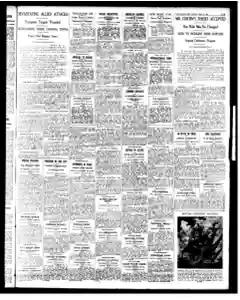
This newspaper page contains 32 articles. Subscribers can read the full text of each article.
Newspaper
Cairns Post
Location
Cairns, Queensland, Australia
Date
May 12, 1944
Page
5
A damaged text fragment provides partial readable words and poses challenges for reconstruction. No clear events or proper names are identifiable from the legible portions.
The readable fragments describe a disjointed text about a case involving several unnamed parties and unclear events. Names, dates, places, and concrete actions are missing, preventing precise identification or a clear single outcome.
Allied air forces launched widespread attacks on Berlin and targets across France and rail lines near Paris. Mosquito bombers and heavy bombers pressed a multi-site campaign, striking railway yards, fuel depots, and urban districts as the RAF and USAAF reported heavy bombing and fires, with thousands of bombs estimated and intense fires visible in the target cities.
A fragmented OCR passage discusses religious services and special prayers within the assembly, mentioning figures and activities related to planning and public faith observances. It references groups, officials, and a focus on spiritual support amid political discussions.
The Prime Minister speaks in London about wartime plans and Australias role in the war effort. He praises the conference of Prime Ministers and assures continued unity and resolve. He references Australia and New Zealand support, and the need for coordinated actions to help defeat the enemy.
Reported from Sevastopol describes a massive bombardment by Soviet artillery on the coast front. The barrage allegedly killed thousands of Russian and German troops amid heavy shelling and granite blocks, with Romanian forces mentioned in the fighting.
The Admiralty announced that last month United Nations ships delivered about 1 256 000 tons of war equipment to Russia via Arctic routes. British and Allied warships aided the effort under the direction of Admiral Sir Bertram Ramsey. About 80 percent of supply ships reached Russia, with some cargoes damaged by enemy action.
London reporting May 16 states Britain's efforts in aiding Russia are modest next to American and Soviet sacrifices. Churchill answered questions on gifts from Britain, timber shipments, and what Britain has handed over, noting Russia’s own efforts and ship returns in the war effort.
A wartime communique reports renewed offensive actions along the flattan front. Allied forces, including light infantry and heavy bomber units, attack railways and viaducts south of Rome and near Fiumicino, causing damage and civilian disruption.
Fragmentary OCR notes indicate a treason related charge mentioned in Squam with references to a trial or hearing. The text names individuals and terms suggesting a legal proceeding and possible dates or locations, but details are garbled.
London dispatch notes alleged Allied and German moves on the Russian front with claims of ships and barges, German transports, and attention to the Black Sea. It mentions potential intervention by Britain and the United States over Spanish actions and asserts German activity persists.
Fragmentary text mentions a commission in Albania and a meeting or event with unclear names and roles. No clear dates, organizations, or outcomes are readable.
Churchill announced steady deliveries to the Soviet Union totaling machinery, industrial plant, and materials. The report cites multiple shipments from Canada, the United States, Britain, and Australia, including ships carrying more than 10 million worth of goods and military equipment.
The inquiry begins May 21 in Brisbane to examine the sugar subsidy. The joint task force will continue hearings into the subsidy program with further details to follow.
A fragmented foreign economic note cites an Australian representative and a U S official discussing a Sweden trip. The text mentions settling a ball bearing issue and references government charges and a proceeding timeline.
The Australian and United States governments clashed over how to pursue full employment while supporting public works. They proposed differing approaches and pressed for a conference if employment risk rose, highlighting tensions at the international labour forum and prompting Beasley to condemn the failure to reach a joint commitment.
The report presents Chinese criticism of the United States and Allies over wartime aid and employment commitments. It notes Chinese fears of insufficient armaments, transport limits affecting the Burma road, and appeals for greater Allied arms to sustain resistance against Japan. It cites Chinese leaders urging timely economic collaboration and signaling readiness to adjust policy if Allies withhold support.
Allied fighter bombers strike targets across northern France and Belgium. Thunderbolts attack Valenaves and Blesigny areas while others hit Tourcoing Cambrai Beugen and Charleroi Saint Martin Messerys and associated airfields. Marauder bombers join night sorties.
Southeast Asia communique reports Chinese east of the Mogaung Valley advancing against opposition. Allied air activity and ground operations in Burma include strikes near Kohima and Imphal, with Japanese positions described as contested and ongoing.
Australian and London press report Queen Elizabeth II's engagements facing uncertain attendance. May 9 events were affected by illness and weather concerns with official notes stressing the Queen's presence did not reflect lack of interest or duty.
The article reports Averill Hartmann meeting with Provident Roosevelt and sidestepping a question on a possible message from M. Stain. The State Department notes Hartmann returned for standard exchange information and discusses American ideas for liberated countries amid the evolving Cold War dialogue.
Coloured cotton from the Soviet Union demonstrates new dyeing methods and color ranges. Reports note early experiments with green brown and other shades, highlighting progress in textile science and state production.
Fragmented text reports a government panel urging action to widen coal supply. It notes warnings to the Commonwealth Government and discusses rates, restrictions, and fuel coordination amid wartime demands. The piece implies a push to sustain fuel by increasing coal production and limiting services.
Chancellor Jahe Amderees voices a long term plan for an international fund linking central banks. Sir John Anderson backs a future economic framework for the United Kingdom and Commonwealth built on a shared currency mix and gold reserves.
A fragmentary report from London outlines discussions on Anglo American currency coordination and postwar railway expansion. It notes proposed international monetary arrangements, a potential debt settlement, and Britain’s need to boost exports by about 50 percent while considering monetary unison with the United States and Commonwealth nations.
Fragmentary report notes discussions or aims regarding German prisoners in Australia and potential conditions or treatment. The text mentions humane treatment and proposed improvements. Details are unclear due to damaged OCR.
A distorted report notes proposals for a broad prisoner exchange program between Australia and Japan. The piece cites statements to the Minister for Information and mentions Allied police and inquiries into returned soldiers. It references potential changes affecting wartime prisoners and public sentiment.
Sydney May 1 report on censorship cases notes the date of nearing remains unfixed as officials discuss timelines for hearings and related actions. Authorities and observers weigh potential implications for ongoing communications policy in the Commonwealth.
Australian Prime Minister Curtin’s proposal to boost food supplies and adjust Australia’s war role gains support from Churchill and Empire leaders. The plan foresees Australia prioritizing food production for liberated Europe while maintaining commitment to the Pacific fight, with debates over postwar peace and alliance strategy among Allies.
Fragmentary report from London describes Ms Curtin and others meeting at a house to discuss plans for taking up residence in Canberra. It mentions Mr Curtin and references to related individuals and events, with unclear details and damaged phrasing.
A Dublin mother, amid a troubled election, defeats government backers on a controversial provincial reform bill. The vote redirects plans for a regional railway easement and related projects, altering timelines and political alliances.
The readable text fragments describe a political policy discussion and international reports, mentioning Londres and Rivaise nalavence. Names and places are inconsistent, making a coherent summary impractical.
We want people to find what they are looking for at NewspaperArchive. We are confident that we have the newspapers that will increase the value of your family history or other historical research. With our 7-day free trial, you can view the documents you find for free.
People find the most success using advanced search. Try plugging in keywords, names, dates, and locations, and get matched with results from the entire collection of newspapers at NewspaperArchive!
You can also successfully find newspapers by these browse options. Explore our archives on your own!
Browse by location and discover newspapers from all across the world.
Browse by date and find publications for a specific day or era.
Browse old newspaper publications to find specific newspapers.